

The World Bank is projecting to empower at least 24,000 scholars through its additional $65 million funding to the Sustainable Procurement, Environmental and Social Standards Enhancement (SPESSE) Project.

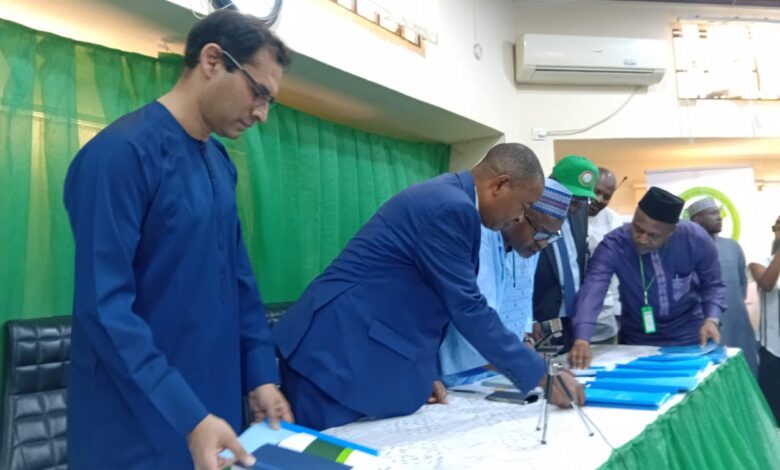
This was announced at the signing of a performance contract by the National Universities Commission (NUC), SPESSE benefiting Universities and the World Bank, held in Abuja on Wednesday.
Executive Secretary of the NUC, Prof. Abdullahi Ribadu explained that the SPESSE Project was conceived to address a critical gap in the Nigerian University System (NUS): the insufficient supply of skilled professionals in procurement, environmental, and social safeguards, as well as the limited availability of specialised academic programmes in these fields.
Ribadu informed that with the support of the World Bank and under the coordination of the NUC, six Centres of Excellence were established across the six geo-political zones of the nation to provide sustainable capacity-building in these critical sectors, laying a foundation that ensured that no region was excluded.
He stated, “with an additional financing package of $65 million from the World Bank, the SPESSE Project’s total funding portfolio has now risen to $145 million. The new financing extends implementation to June 2029 and is expected to consolidate earlier gains while scaling training, institutional infrastructure, and professional certification systems across the country”.
Speaking on the gains of the project so far, the ES stated: “Collectively, the SPESSCEs have established over 68 international partnerships to deepen collaboration in teaching, research, and professional development”.
He also laid out expectations for the new phase of the project.
“Across the Project, we expect to see the production of at least 60 PhDs, the enrolment of no fewer than 60 foreign students, the facilitation of at least 18 staff internships, and the provision of no less than 60 student exchange programmes with foreign institutions”, he said.
Similarly, the National Project Coordinator, Dr. Joshua Atah disclosed that under the Additional Financing phase, attention will increasingly focus on scaling up training across all programme tracks, strengthening professional certification systems, and deepening institutional sustainability.
“A new performance-based condition on digital procurement reform through the Electronic Government Procurement (E-GP) system has also been introduced. Performance under the new phase, will increasingly target high-spending Ministries, Departments, and Agencies at both federal and state levels, while disbursements will continue to depend on independently verified performance benchmarks under the project’s results-based financing model, with oversight provided by the Independent Third-Party Verifiers”, he said.
On his part, Task Team Leader, SPESSE Project, Mr Ishtiak Siddique stated that the project was dear to the World Bank because it cuts across critical areas like procurement, environment and social sectors.
“So without these three critical areas, it’s not possible to provide any service to the citizens. That means we are actually touching these three critical areas, which ensure that the government resource is used for the intended purposes, efficiently and effectively, and maintaining the environment and social safeguard of the country, which is extremely important”, he said.
Siddique further disclosed that, “this additional financing of $65 million has been active. But it’s built on the success of the original project, that was the $80 million original project of SPESSE. We have wonderful success achieved by all of you present here, the Centers of Excellence, Ministry of Women Affairs, Ministry of Environment, BPP, NUC. Everyone worked together to achieve the result”.
According to him, more than 40,000 people have been trained already, and the additional financing would ensure 24,000 more benefit:
“So, a few important things that we’ll be focusing on under the additional financing. We’ll continue with the good training by the Center of Excellence. We are aiming even higher. An additional 24,000 people at least will be trained under the additional financing, one change that we are making, we are targeting the critical public agencies”, he said.