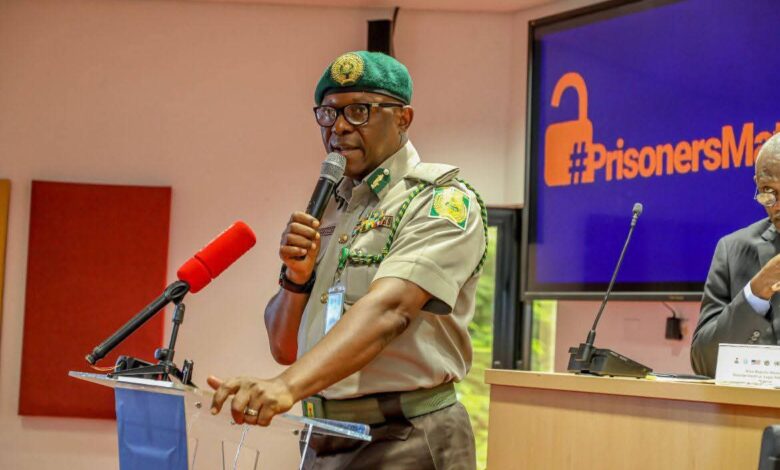


The Controller General of the Nigerian Correctional Service (NCoS), Sylvester Nwakuche, has reaffirmed the commitment of the Service to the full implementation of the Nelson Mandela Rules.
The NCoS stated on Friday that Nwakuche made the reaffirmation while participating with other Justice Sector stakeholders at the United Nations Office on Drugs and Crime (UNODC) Project Exhibition at the UN House in Abuja to commemorate the 10th anniversary of the adoption of the United Nations Standard Minimum Rules for the Treatment of Prisoners, now known as the Nelson Mandela Rules.
The 10th anniversary celebration of the Mandela Rules serves as a call to action for governments and correctional institutions worldwide to consolidate gains, close remaining gaps, and invest in correctional systems that are just, humane, and transformative.
In his remarks, CG Nwakuche commended the long standing support of the UNODC in the ongoing NCoS reforms and noted that the Service has continued to embrace programs centered on inmate welfare, rights-based rehabilitation, and staff professionalism.
The Director Joint Services, Nasiru Usman, who was represented by Barr. Babatunde Ogundare, the Special Adviser to the Honourable Minister of Interior on Correctional Service Reforms, commended the efforts of UNODC in enhancing the mandate of NCoS in line with the vision of the Minister of Interior to restore hopes behind bars.
Also speaking, the Chairman, House Committee on Reformatory Institutions, Honourable Chinedu Ogah, emphasized the National Assembly’s commitment to legislative backing for correctional reforms.
“We are keen on ensuring that correctional facilities in Nigeria meet international standards, not only through oversight but through laws that promote accountability, funding, and the rights of inmates and officers alike, and the UNODC have been greatly impactful in this regard”, he said.
The UNODC Country Representative, Cheikh Ousmane Toure, in his reflections, gave an overview of the project conducted in the key focal areas which include Adamawa, Maiduguri and Gombe, and called for prioritization of non-custodial alternatives, electronic monitoring and expedited trials in line with the Tokyo Rules as overcrowding is a human rights crisis.
He also called for enhanced staff welfare, training and upskilling to drive the reforms.
The event, organised by UNODC, brought together high-level government officials, diplomats, human rights advocates, and correctional experts to reflect on a decade of progress in promoting humane and dignified treatment of persons deprived of liberty.
A major highlight of the gathering was the presentation and discussion of a comprehensive prison audit report on six custodial centres across the North-East geopolitical zone, conducted by the UNODC.
The audit focused on critical areas such as living conditions, healthcare services, overcrowding, access to legal support, staff capacity, and compliance with international standards.
The Controller General also toured the UNODC exhibition stands showcasing project achievements, capacity development interventions, and support tools provided to the Nigerian Correctional Service in the areas of prison reform, data management, and human rights compliance.