

The Nigerian Midstream and Downstream Petroleum Regulatory Authority (NMDPRA) is implementing polices that promote infrastructure expansion, open access to facilities, and investment in gas processing, storage, and transportation systems.
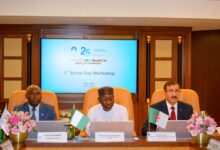
This was disclosed by the Authority Chief of the NMDPRA, Engr. Farouk Ahmed, while speaking on Monday at the ongoing 18th Annual International Conference of the Nigerian Association for Energy Economics (NAEE), with the theme: “Emerging Geopolitics of Energy: Navigating GlobalShifts and Impacts on Developing Economies,” holding at the PTDF Building in Abuja.
Represented by Prof. Zainab Gobir, Executive Director, Economic Regulations and Strategic Planning Directorate, NMDPRA, Engr. Farouk said the Authority is also advancing the Gas Infrastructure Blueprint to connect production centers to markets and industrial hubs.
“We are also supporting the Gas Flare Commercialization Programme, transforming what was once waste into value,” he added.
He said the NMDPRA is encouraging public-private partnerships to accelerate investment in key infrastructure —pipelines, LPG facilities, CNG networks, and storage depots — all designed to strengthen energy security and affordability for Nigerians.
According to him, the Authority has been working diligently to create the enabling environment for the sector’s transformation inline with its mandate as enshrined in the Petroleum Industry Act (PIA) 2021.
He said the theme of this year’s conference —“Emerging Geopolitics of the Energy Landscape: Navigating Global Shifts andTheir Impacts on Developing Economies” — could not have been timelier. Saying that across the world, the dynamics of energy are being reshaped by geopolitical tensions, technological disruptions, environmental imperatives,and shifting alliances.
Farouk noted the ongoing conflict in EasternEurope, instability in parts of the Middle East, supply chain realignments, andthe accelerating global energy transition — all underscore how deeply interconnected and volatile the energy landscape has become.
He said for developing economies like Nigeria,these global shifts bring both challenges and opportunities.
“On one hand, we face exposure to market volatility, constrained access to investment capital, and pressures from the global transition agenda. “On the other hand, we are presented with aunique opportunity to redefine our energy pathways — to leverage our naturalgas, our human capital, and our strategic geography to create sustainable growth and inclusive development,” he said.
Also speaking, the Chair of the African Petroleum Producers Organization (APPO), Omar Farouk, said for the first time since the International Energy Agency (IEA) began to strongly advocate the end of fossil fuel use, the agency has now admitted that fossil fuels cannot be easily eliminated and that the much-touted promises of renewable energy are far frombeing realized within the time frame the world has been led to believe.
“What the IEA has now acknowledged issomething APPO has consistently maintained since the formal global shift awayfrom fossil fuels symbolized by the 2015 Paris Climate Agreement. As leaders in Africa’s energy industry, I hope this significant admission by the IEA encourages us to be more critical in accepting dogmas presented as scientific facts,” he said.
On his part, the founder and Group Chief Executive Officer/Managing Partner of Teno Energy Resources Limited, Dr. Tim Okon, said whatever the direction of the global energy transition, Nigeria must understandits economic implications for the country.
“The term “transition” implies moving from onesystem to another. But before we can move, we must first master what wecurrently have. Right now, we are energy insecure. Our power systems remainfragile, and our mastery of even the existing technologies—alternating anddirect current systems—is still limited.
“So, as we navigate global energy politics,import substitution must remain our first priority. Anything we rely on foreign sources to import will always be vulnerable to geopolitical manipulation.
“Whatever the preferred energy source of thefuture, the choice will ultimately be economic. Fossil fuels will survive aslong as they remain economically viable. Africa contributes barely 3 percent toglobal carbon emissions; we are not the ones warming the planet. Those responsible for environmental degradation must not impose restrictions that stifle our growth,” he said.
Earlier, the President of the InternationalAssociation for Energy Economics (IAEE), Professor Edmund Lewis, while speakingon the choice of the theme said, “around the world, we are witnessing unprecedented transitions in energy geopolitics: from the decarbonization driveto the reshaping of trade alliances, from energy security debates to new paradigms of affordability and equity.
“These shifts underscore why the IAEE exists —to analyze change through evidence, not emotion, and through policy dialogue,not political posturing. We must understand how global transformationsintersect with regional priorities, especially for developing economiesstriving to balance energy access, climate responsibility, and economic growth.The dialogue taking place here in Abuja is therefore not peripheral — it iscentral to the IAEE’s mission.”
Represented by Prof. Edmar Almeida,theIAEE President said as the world confronts new uncertainties — from energy marketvolatility to technological disruptions and environmental imperatives — theIAEE reaffirms its commitment to collaborative knowledge creation and informedpolicy dialogue.
He said under successive administrations, NAEE has built intellectual bridges between academia, industry, and government — thetriple helix plus model — ensuring that energy economics remains a tool fornational progress rather than a mere theoretical pursuit.
He extended his deepest appreciation to NAEEfor its consistency, excellence, and service, while he looks forward tocontinued partnership in organizing continental workshops, nurturingearly-career energy economists, and promoting a balanced global energydiscourse — one that is inclusive, evidence-based, and development-focused.