NERC @20: FG Celebrates Commission’s Embodied Professionalism, Resilience, Vision
By Sunday Etuka


The Federal Government has commended the Nigerian Electricity Regulatory Commission (NERC) for its professionalism, resilience and vision that has shaped the nation’s power sector on the path of growth trajectory in the last 20 years.
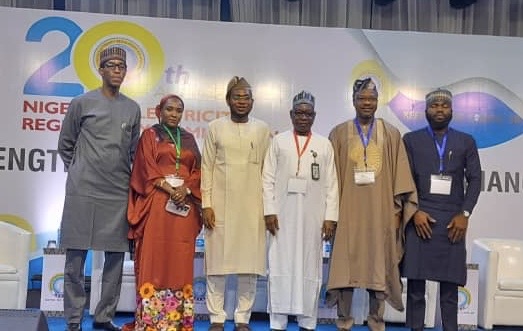
Minister of Power, Chief Adebayo Adelabu, gave the commendation on Thursday at the Technical Session organied in Commemoration ofthe 20th Anniversary of the Commission with the Theme: “Strengthening Power Sector Governance for a Sustainable Future,” held at the Transcorp Hilton, Abuja.
He said: “As NERC marks two decades of service, we celebratean institution that has embodied professionalism, resilience, and vision. Let this anniversary inspire a renewed commitment to collaboration between the Federal and State Governments, between regulators and operators, between public institutions and private investors.”
TheFact Daily reports that the Anniversary reflects the Commission’s remarkable journey from the early challenges of its establishment, through the regulation of the unbundled power sector, the privatisation of key assets in the value chain, and the oversight of the Nigerian Electricity Market from the post-privatisation and Interim Market stages to the Transition Electricity Market, among other milestones.
Speaking further at the event, the Minister said the federal government is implementing reforms to strengthen the entire value chain, especially the financial and operational capacity of the Distribution Companies (DisCos).
Chief Adelabu said that the success of these reforms would be measured by their impact on the Nigerian people.
“This means transparent tariff-setting, enhanced metering through initiatives like the Presidential Metering Initiative, and holding all operators accountable for service delivery.
“States are now empowered to challenge DisCos and the Transmission Company of Nigeria (TCN) to better serve their people,” he explained.
According to him, the government is developing a National Electricity Policy Coordination Framework to align Federal and State actions; supporting States establishing new regulators; and strengthening investor confidence through policy consistency and regulatory clarity.
“The Federal Government has provided the legal and policy framework. The states now have the autonomy to act. The private sector has the capital and innovation to invest. Let us not fall into the trap of constant, hasty amendments before the current Act has been fully tested. Let us have the resilience and patience to allow this new model to mature,” he said.
The Minister who was represented at the event by the Director, Distribution, Ministry of Power, Mustapha Baba Shehuri, said the administration is also advancing the Presidential Power Initiative (the Siemens Project) and have sustained generation capacity at an average of 5,300MW in 2024, up from 4,200MW in 2023.
While affirming that a decentralized system cannot thrive in an insolvent national market, Adelabu said that strategic efforts are being made by the government to address the liquidity crisis in the sector.
“The government is acutely aware of the debilitating liquidity crisis, with debts to Generation Companies (GenCos) posing a severe threat to sector stability.
“I am pleased to inform you that Mr President has recently approved a N4 trillion bond to clear verified GenCos and gas supply debts. Alongside this, is the commercialization effort at developing a targeted subsidy framework to protect vulnerable households and ensure a sustainable path towards full commercialisation,” he noted.
Also speaking, the former President of African Development Bank (AfDB), Dr. Akinwumi Adesina, said the people that would solve the Nigerian electricity problem are Nigerians. Therefore, those in leadership positions should protect and defend the local investors. Stating that Charity must begin at home.
“The people that built America are Americans. The people that built Korea are Koreans. If we treat our own with levity and dignify the foreigners, we are only destroying ourselves and our future,” he added.
Adesina, who was represented by the Group Managing Director/CEO of Sahara Power Group, Mr Kola Adesina, noted that if the DisCos are interested in collecting electricity tariff for Band A, they must be ready to give Band A service.
On tariff, he disclosed that majority of the people who engage in energy theft and meter bypass are those who are metered, especially the rich, stating that such an act is retarding the progress being made in the sector.
“We have seen it in our own system, that people that are metered, and most especially the rich, they are the ones bypassing meters. They are the ones stealing electricity.
“The reality of the case, which needs to be interrogated intelligently, is that the incentive for bypass is not so significant for insignificant consumers, it is significant for those who know that they are paying a lot of money, and they can bribe our staff to bypass.
“So, if those that are metered are bypassing the meters, what incentive is there to do universal metering, and then you will not have universal theft? If we cannot account for the energy we are receiving from the generation company, and not account for a true payment commensurate with the electricity that is generated, we are in a mess,” he said.
Earlier in his Opening Remarks, Vice Chairman, NERC, Dr Musiliu Oseni, said twenty years ago, the Electric Power Sector Reform Act established the Commission with a clear mandate to provide regulatory oversight of the Nigerian Power Sector.
He noted that despite the regulatory challenges faced, the Commission has recorded significant achievements in its two decades of existence.
“The Commission oversaw the privatisation and unbundling of the hitherto state owned vertically integrated monopoly.
“We have developed standard regulatory instruments to strengthen the electricity market, improve reliability of supplyand enhance consumer protection.
“Relative to 20years ago, not less than 30% of the electricity consumers have experienced significant improvement in their electricity services.
“Through effective regulation, the Commission has saved the Federal Government several trillion of naira in subsidies thereby contributing to improved fiscal position of the FGN,” he said.
Dr Oseni said the Electricity Act of 2023 provides for regulatory oversight at the subnational level, and today, 15 states have got their transfer Order from the Commission.
“Eleven of them have crossed the six months transitional period but only eight out of the eleven are currently operational. There is a vacuum in Edo, Ogun and Oyo states. I congratulate all the states that have operationalised their regulatory commission,” he said.
The VC advised the State Electricity Regulatory Commission to note that regulation is not populism, activism orpolitics, rather, it requires being objective, analytical, attention to details, having an independent mind and being able to see beyond the surface.
“You must constantly remember that there must be a utility before you can be called a regulator! While it is impossible to isolate yourself from the government (policymakers or legislature), always remind yourself of your roles as an unbiased umpire.
“I also urge you to avoid being in acompromising position with your licensees no matter the situation. This is necessary to avoid regulatory capture,” he noted.
Oseni thanked the Commission’s staff, both past and present, for their invaluable contributions to the Commission and the growth of the nation’s power sector.