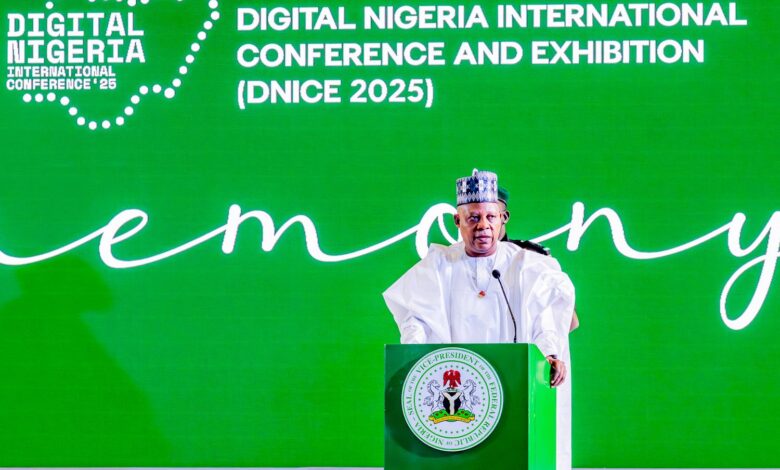


The Vice President, Senator Kashim Shettima, has stated that the administration of President Bola Tinubu has ended the regimes of volatility and unpredictability that hitherto branded the nation’s economy.
Senator Shettima spoke on Tuesday in Abuja while declaring open the Digital Nigeria International Conference and Exhibition 2025, with the theme, “Innovation for a Sustainable Digital Future: Accelerating Growth, Inclusion, and Global Competitiveness.”
He said: “What this Administration has achieved is to end the regimes of volatility and unpredictability that once defined our economy. The phase before us now is to ensure that these macroeconomic gains trickle down to the people, from the kiosks of our neighbourhood traders to the boardrooms of our multinational corporations.
“We did what we have done because we can no longer apply 20th-century solutions to 21st-century problems,” he declared, even as he expressed delight with the conference and exhibition, saying it is an “affirmation of innovation for a sustainable digital future that accelerates growth, inclusion, and global competitiveness.”
Shettima noted that the ongoing reforms undertaken by the Tinubu administration are already stabilising the economy, just as they have inspired investor confidence and attracted commendation from independent observers.
According to a statement by the Senior Special Assistant to The President on Media & Communications, Office of The Vice President, Stanley Nkwocha, the VP stated that “the world is taking note of the steady course the nation is maintaining.”
The statement said Shettima observed that the vision of the conference and exhibition with the theme, “Innovation for a Sustainable Digital Future: Accelerating Growth, Inclusion, and Global Competitiveness,” aligns perfectly with President Tinubu’s economic reform agenda because the future the administration is building “is one where the young Nigerian takes the front seat, sits at the decision-making table, and has a voice in shaping our destiny.”
He stated that the watchword for Nigeria’s long-term stability is digital, noting however that the nation must set its priorities right if it “must move beyond the “quick wins” of simple apps to building deep-tech solutions that address foundational challenges in agriculture, health, logistics, and governance.
“We need a digital ecosystem that works as seamlessly in Lagos as it does in Abuja, in Port Harcourt, in Kano, in Gusau, and across every corner of our nation. The digital success we seek is one where the farmer in Bida can access real-time market data to sell his harvest at a fair price, where a young woman in Oguta can work remotely for a global company because she has connectivity and the skills to compete. That is the inclusive growth President Tinubu envisions,” he added.

The Vice President pointed out that Nigeria cannot keep lamenting its “absence at the table in the previous Industrial Revolutions” when the current digital wave has offered the nation “a redemptive opportunity to define its own “terms in the next chapter of global progress.
“And at the forefront of this ambition stands a man of a thousand visions, the progressive leader we are fortunate to have as President of this beloved nation at a time that demands reformers and patriots, His Excellency, President Bola Ahmed Tinubu, GCFR,” he maintained.
Senator Shettima outlined three pillars on which the strategy adopted by the Tinubu administration rests to include “People, Infrastructure, and Policy.”
On People, he said, “We are building a holistic pipeline of digital talent, integrating digital literacy into school curricula, promoting inclusion through the Digital Literacy for All (DL4ALL) initiative to digitise the informal sector, and developing world-class expertise through the 3 Million Technical Talent (3MTT) programme.”
He continued: “On Infrastructure, we are constructing the broadband “superhighway” that powers a digital economy. Through projects like Bridge and 774, we are ensuring high-speed connectivity so that a startup in Gusau enjoys the same access as one in Lagos.
“On Policy, we are creating an enabling environment that encourages innovation. The success of our cashless reforms has positioned Nigeria as one of the most dynamic fintech ecosystems in the world.”
The VP disclosed that the administration was already in the advanced stages of passing the National Digital Economy and e-Governance Bill into law, saying “just as the cashless policy unlocked the fintech revolution, this new Bill will unlock the GovTech revolution, an era of smarter governance, greater transparency, and inclusive service delivery.”
He solicited the support of the private sector, including economic experts, stating that the government cannot achieve its goal without them, just as he described them as the pillar of the nation’s digital economy, as well as “the innovators, the disruptors, the dreamers who turn possibilities into progress.”