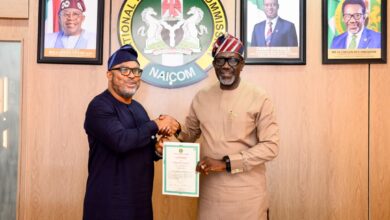
We’re Committed To Collaborating With Stakeholders On NIIRA 2025 Implementation -Omosehin
By Sunday Etuka


The Commissioner for Insurance, National Insurance Commission (NAICOM), Mr Ayo Omosehin, has reiterated the Commission’s commitment to collaborating with relevant stakeholders on the implementation of the Nigerian Insurance Industry Reform Act (NIIRA) 2025.

Mr Omosehin restated this when the representatives of the Organized Private Sector (OPSN) paid a visit to the NAICOM, accompanied by delegates from relevant federal ministries to discuss coordinated implementation of provisions of the NIIRA 2025 and the deployment of sector specific insurance products for the maritime and petroleum sectors.
He emphasized that the Commission is responsible for issuing frameworks, guidelines, and premium determinations for compulsory insurance products under NIIRA 2025, and that technical proposals must align with the regulator’s remit.
In a statement made available by NAICOM on Monday, the Commissioner stressed that consumer protection was paramount, and proposals must be justified and assessed for fairness.
Earlier, while speaking, the leader of the delegation and Chairman of the OPS Insurance-Tech Committee, Dr. Alban Igwe, stated that the engagement follows months of stakeholder consultations across the maritime and petroleum sectors, including freight forwarders, transport associations, retailers, and underwriters.
He said they were at NAICOM for regulatory discussions on implementation of provisions of the Law and operationalization of insurance products to address longstanding gaps in compensation and risk transfer in these sectors.
Dr. Igwe said the initiative was a multi-stakeholder, private sector led effort mandated by two federal ministries (Ministries of Petroleum and Blue Economy) to coordinate stakeholders and propose implementation of insurance provision under the NIIRA 2025.
OPSN identified umbrella organizations participating in the effort, including the Nigerian Chamber of Commerce, Manufacturers Association of Nigeria, National Association of Small-Scale Industries and trade associations in the transport and petroleum distribution sectors.
OPSN described two priority tracks: Maritime sector product(s) to mitigate container and cargo-related losses and to provide faster compensation for affected parties, and Petroleum sector product(s) to provide public liability/commission liability cover for retail distribution and transit risks (noting tight retail margins and the need to consider pricing templates.
The meeting concluded that a technical working group should be established to review the proposal and develop implementation modalities.