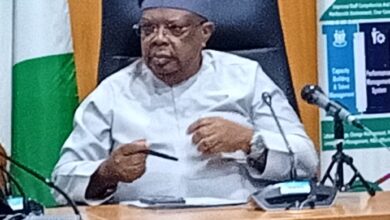
On Monday, August 21, 2023, the former Minister of Power, Chief Adebayo Adelabu, assumed office with great enthusiasm to unravel the mysteries behind the nation’s power woes.
Chief Adelabu was full of confidence that he has the capacity to solve Nigeria’s power puzzle. Without blinking his eyes, he promised to give Nigerians stable, accessible, and improved power supply through the implementation of the Electricity Act.
The Electricity Act, signed in June 2023, provides a comprehensive, privatised, and contract-based legal and institutional framework aimed at attracting investment and enhancing efficiency in the power sector.
It mandates cost-reflective tariffs, promotes renewable energy integration, empowers states to regulate intrastate markets, and repeals the 2005 Act to address operational inefficiencies.
To impress his employer, President Bola Tinubu, who also pledged to give Nigerians a stable power supply, Adelabu wasted no time before announcing his plan to prioritise sector reforms, grid stability, and renewable energy to boost industrial and residential supply.
He was quick to pass a verdict on the sector by announcing to the world that despite having competent Engineers in Nigeria, the country generated 2,000 megawatts of electricity in 40 years.
In fact, to be more precise, Adelabu said: “In 1984, the country generated 2,000MW of electricity and this was not increased to 4,000MW until about 40 years later around 2022.” This also shows that the power generation in the country was hovering around 4,000MW before his appointment as the Minister of Power, in August 2023.
It is true that before his appointment as Minister of Power, issues of liquidity, lack of investment in infrastructure, and shortfalls in market remittances were prominent. However, as a former deputy governor, operations, of the Central Bank of Nigeria (CBN) one thought that these issues would be speedily addressed. Unfortunately, the issues persisted even after his exit.
ADELABU’S FAILED PROMISES
INCREASED POWER GENERATION: conscious of the fact that the power supply in the country was grossly inadequate, Adelabu promised to increase power generation to 6,000MW by December 2024, to stimulate businesses and enhance the livelihoods of Nigerians.
He made the promise amid persistent liquidity shortfalls, unpaid debts, inadequate gas supply, lack of investment, market inefficiencies and other numerous challenges confronting the sector.
Sadly, at the set timeline in December, 2024, Adelabu failed to fulfil his promise to Nigerians. In 2025, he still couldn’t achieve the target. Even though the sector achieved peak generation of 6,003MW in March, 2025, this could only be sustained for a few hours.
Nigerians continue to suffer chronic energy poverty even after almost three years of being at the helm of affairs. Currently, power generation in the country hovers around 4,000MW, after his exit, despite installed capacity of 15,500MW.
The current generation capacity was lower than what was required to meet the estimated load demand of 30,000MW, with the demand expected to grow to 45,662MW by 2030.
For a country of over 200 million people, the 4,000MW of power generation is grossly inadequate. According to industry experts, about 88,000-100,000MW of electricity is needed to meet industrial, economic and population demands in Nigeria.
GRID STABILITY: Adelabu promised to fix the issue of persistent national grid collapse, which he described as a national embarrassment to the country. However, right under his watch as the Minister of Power, the national grid collapsed about 21 times.
For instance, the national grid collapsed about three (3) times in 2023. It collapsed on September 14, September 19 and December 11, respectively in 2023.
The national grid also collapsed about twelve (12) times in 2024. It collapsed on February 4, March 28, April 15, July 6, August 5, October 14, October 15, October 19, October 22, November 5, November 7, and December 11, 2024.
The sector under his watch recorded a national grid collapse about four (4) times in 2025. It collapsed on February 12, March 7, September 10, and December 29, 2025.
In 2026, the story is not any better as the grid has collapsed about two (2) times since the beginning of the year. It collapsed on January 23 and January 27, respectively.
This is despite constituting a six-member Committee to advise the Federal Government on necessary solutions to make the national grid robust and reliable.
VANDALISM OF POWER INSTALLATIONS/THEFT: Adelabu promised to tackle the menace of vandalism of power installations and theft across the country, to boost power supply to Nigerians.
He attributed his inability to meet the 6,000MW power generation target by December 2024 to the rampant vandalism of power infrastructure across the nation. To address this, he earmarked about N8billion in the Ministry’s 2025 budget for advocacy against vandalism.
According to him, the money would be used to sensitise Nigerians across all the 774 local government areas, including education, enlightenment, and the deployment of technology to protect infrastructure.
He announced that the ministry was working with the relevant security agencies, including the office of the National Security Adviser (NSA), local security, hunters, and community stakeholders to safeguard power assets across the country.
Despite these, about 128 transmission towers were destroyed or damaged between January 2024 and early 2025.
In January 2026, the Transmission Company of Nigeria (TCN) announced that the underground electricity cables supplying power to various parts of the Federal Capital Territory (FCT), Abuja, were attacked and damaged by vandals.
The incident occurred at the 132kv transmission line and underground cable transmitting bulk power to the 132kv Central Area transmission substation, Katampe, in the Central Area of Abuja.
On March 15, 2026, the TCN announced the collapse of Tower T99 along the Ughelli/Benin 330kV Transmission Line, attributing it to vandalism.
The incident prevented the evacuation of bulk power supply from Transcorp Power Plc to the national grid through the Benin 330kV transmission line.
INTRODUCTION OF COST REFLECTIVE TARIFF (CRT): barely a year after assumption of office, Adelabu approved a significant electricity tariff increase for Band A customers, as part of efforts to increase the liquidity in the sector. He approved the jerk up of the Band A tariff to ₦225/kWh, but was later reduced to ₦206.80/kWh, after public outcry.
As designed under the Service-Based Tariff (SBT) Scheme by the Nigerian Electricity Regulatory Commission (NERC), Band A are supposed to get a minimum of 20 hours electricity supply, Band B, 16 hours, Band C, 12 hours, Band D, 8 hours and Band E, 4 hours.
Recent checks revealed that the Distribution Companies (DisCos), are not meeting up with the expected hours of supply, leading to massive meter bypass. While the policy is good, there are issues with the implementations.
WEAK DISTRIBUTION NETWORK: Adelabu, while in office, lamented that despite the tariff adjustments that boosted market liquidity by 70%, raising sector revenue from N1trillion in 2023 to N1.7trillion in 2024, the distribution segment of the power value chain remains the weakest link.
According to him, the chronic underinvestment in distribution infrastructure, has continued to cripple service delivery nationwide in spite of the landmark reforms in the electricity sector.
To address the anomaly, Adelabu said he would restructure the DisCos, and tighten enforcement of performance benchmarks. This was not achieved before his exit from the sector.
CAPACITY BUILDING: Adelabu announced that the issue of training has been relegated to the background in the sector. Noting that the last crop of engineers that were trained were those from the old National Electric Power Authority (NEPA), promising to go back to that era of rigorous training of engineers.
According to him, the sector’s vibrant training institute, the National Power Training Institute (NAPTIN) would collaborate with the Nigerian Society of Engineers to achieve the set target.
He explained that to replace the ageing workforce in the power sector, the government would train about 1,200 electrical engineers within the next ten (10) years. However, he left without training any set of engineers
On April 23, 2026, Adelabu announced his intentions to exit as the Minister of Power. On April 30, 2026, he exited to pursue his governorship ambition in Oyo State, leaving Nigerians in total darkness.