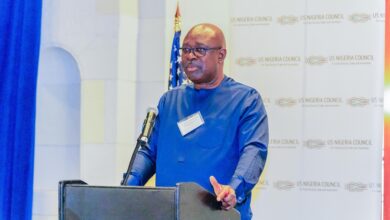

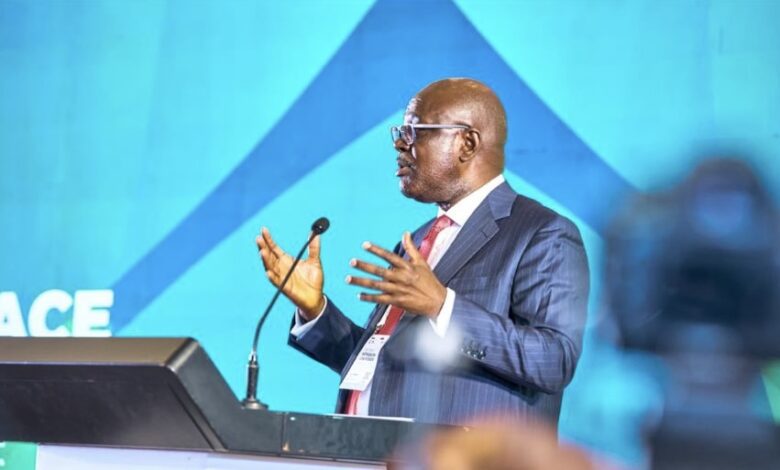

The Minister of State for Petroleum Resources (Oil), Senator Heineken Lokpobiri, has disclosed that the continent of Africa currently spends over $120 billion annually on hydrocarbons alone.
This level of expenditure, according to him, primarily on the importation of refined petroleum products and other hydrocarbon-related services, represents not just a financial cost, but a lost opportunity for economic transformation.
Senator Lokpobiri spoke on Tuesday at the 9th Nigeria International Energy Summit (NIES 2026), held at the State House, Abuja.
He said if Africa could retain a proportion of that spending within the continent through localized value addition, infrastructure development, and industrial participation the economic impact would be transformative.
He called for support for the African Energy Bank (AEB) with its headquarters in Nigeria, stressing that if Africa does not mobilize the appropriate resources to solve its energy problems the misery would increase, noting that as the population increases the responsibility also increases.
The Minister said as host country, Nigeria has fulfilled its obligations, saying that the ball is in the court of the promoters to set the ball rolling.
He explained that the shift was not merely about energy self-sufficiency, but about economic sovereignty, industrialisation, and inclusive growth.
Lokpobriri, said although Nigeria posses enormous hydrocarbons endowment, and a geography that combines deepwater, shallow, and onshore acreages, resource richness alone is not enough. Affirming that
What makes Nigeria different is the legal, regulatory, financial, and structural transformation it’s delivering.
“Because “investment-ready” means more than just having reserves; it means having clarity, predictability, efficiency, incentives, and alignment,” he added.
He narrated that then this government started, the sector was struggling, production and capital flight, investment had stalled. Saying that for more than a decade there was no major final investment decisions on new projects, as investors were cautious, and confidence was lacking.
However, it said the government implemented the Petroleum Industry Act (PIA), which gives investors a stable fiscal framework, clearer licensing, stronger regulation, protection for host communities, local content provisions, and ensures that contracts and terms are predictable.
The Minister disclosed that determined to reduce costs in upstream operations, the government issued the Upstream Petroleum Operations (Cost Efficiency Incentives) Order 2025, which granted tax credits to companies, lower unit operating costs and other far reaching fiscal regimes.
He also mentioned that the government launched “Project One Million Barrels” in October 2024, and in less than a year, production rose to between 1.7-1.83 million barrels per day, up by roughly 300,000 barrels in July 2025 alone.
“The number of active rigs jumped from a paltry 14 in 2023 to over 60 as at today. These are signs that the reforms are working, that idle assets are being activated, and existing assets are being optimized,” he added.
According to him, international confidence has also returned, stating that the Shell’s $5 billion Bonga North project, and TotalEnergies’ $550 million Ubeta project marks Nigeria’s first major FIDs in over a decade.
“This was followed by Shell’s 2 billion Dollars HI project and the $1.8m cumulative spent by Chevron in their Panther project.
“Only recently, the global CEO of Shell announced their commitment to taking a $20billion FID, with several other FID lined up to be announced in this year and in the coming year,” he said.
Lokpobriri revealed that in 2025 alone, 28 new field development plans worth $18.2 billion were signed, with potentials of 1.4 billion barrels of oil daily.
He added that between 2024 and 2025, of the seven major FIDs announced across Africa, four were in Nigeria.
This, according to him, did not happen by accident, noting that it was the result of steady work, policy clarity, and better governance.
“These are not rhetorics but proof that Nigeria is once again a magnet for serious business,” he added.
He announced that the investment climate in Nigeria allows for free movement of capital. Adding that in line with Global best practice companies could invest and divest at will.
“We recently enabled International Oil Companies (IOCs) to transfer onshore and shallow water assets to capable Nigerian companies.
“From Shell to Renaissance, ExxonMobil to Seplat, Eni to Oando. These are not just transfers of assets, they are transfers of confidence, capability, and ownership which has resulted in additional 200,000 barrels per day.
“It will interest you to know that these divestments were stalled for several years, but with the leadership of President Bola Ahmed Tinubu, we were able to advance them and concluded them in record time leading to the gains made by their new operators for the benefits of all.
“These are concrete, measurable results that send a strong signal to investors. Nigeria is offering certainty, policy transparency, incentives, and large-scale opportunities.
“We are also strengthening refining and downstream capacity,” he said,
Earlier, the Minister of State for Petroleum Resources (Gas), Rt. Hon. Ekperikpe Ekpo, said over the years, NIES has truly evolved to be more than a conference. Saying that it has become a trusted platform for dialogue, cooperation, innovation, and increasingly, for peacebuilding through energy collaboration.
He commended the organizers for sustaining the summit as a forum where policy meets investment, and where shared challenges are transformed into collective solutions.
He noted that while tthe world accelerates toward lower-carbon systems, our continent continues to grapple with energy poverty, industrial underdevelopment, and limited access to reliable power.
“These realities compel us to pursue a transition that is not only green, but also just, inclusive, and pragmatic,” he said.
Ekpo emphasized that Nigeria advancing an energy pathway that balances climate responsibility with development needs, leveraging its abundant natural gas resources to power industries, expand access, and create jobs.
The Minister said the natural gas remains central to Nigeria’s energy future.
“It is our most abundant hydrocarbon resource and our most practical instrument for economic transformation. Gas enables reliable power generation, underpins industrial growth, supports cleaner cooking solutions.
“Through gas, we are creating jobs, strengthening value chains, reducing energy poverty, and positioning Nigeria as a regional energy hub,” he said.
He said over the past year, Nigeria’s gas sector has recorded measurable and encouraging progress.
“In 2025, our gas production sustained a clear upward trajectory, with average daily output reaching approximately 7.5 to 7.6 billion standard cubic feet per day.
“Notably, domestic gas supply exceeded 2 billion standard cubic feet per day for the first time, a historic milestone that underscores our commitment to energy access, industrial growth, and economic transformation.
“This increased domestic availability has translated into more reliable gas supply for power generation, industries, and households.
“We have also made meaningful gains in efficiency. Gas flaring levels declined to some of the lowest recorded in recent years, reflecting steady progress toward our zero routine gas flaring by 2030 commitment and reinforcing Nigeria’s environmental responsibility.
“Investor confidence has strengthened, evidenced by Final Investment Decisions in key upstream gas projects, unlocking new volumes and mobilizing capital. These developments have been supported by improved regulatory clarity under the Petroleum Industry Act, which continues to enhance transparency and governance,” he added.
Looking ahead, he said country remains firmly committed to scaling production toward 10 BSCFD by 2030, positioning gas as a cornerstone of Nigeria’s energy security and prosperity.