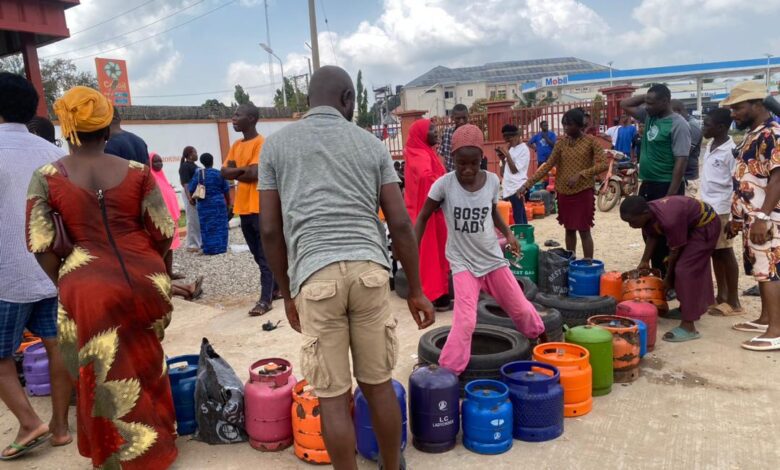

Many Liquefied Petroleum Gas (cooking gas) users in the Federal Capital Territory (FCT), Abuja, disgruntled with the scarcity of the product have condemned the negative impact the situation is having on livelihoods and businesses, and have blamed the government for the woes.
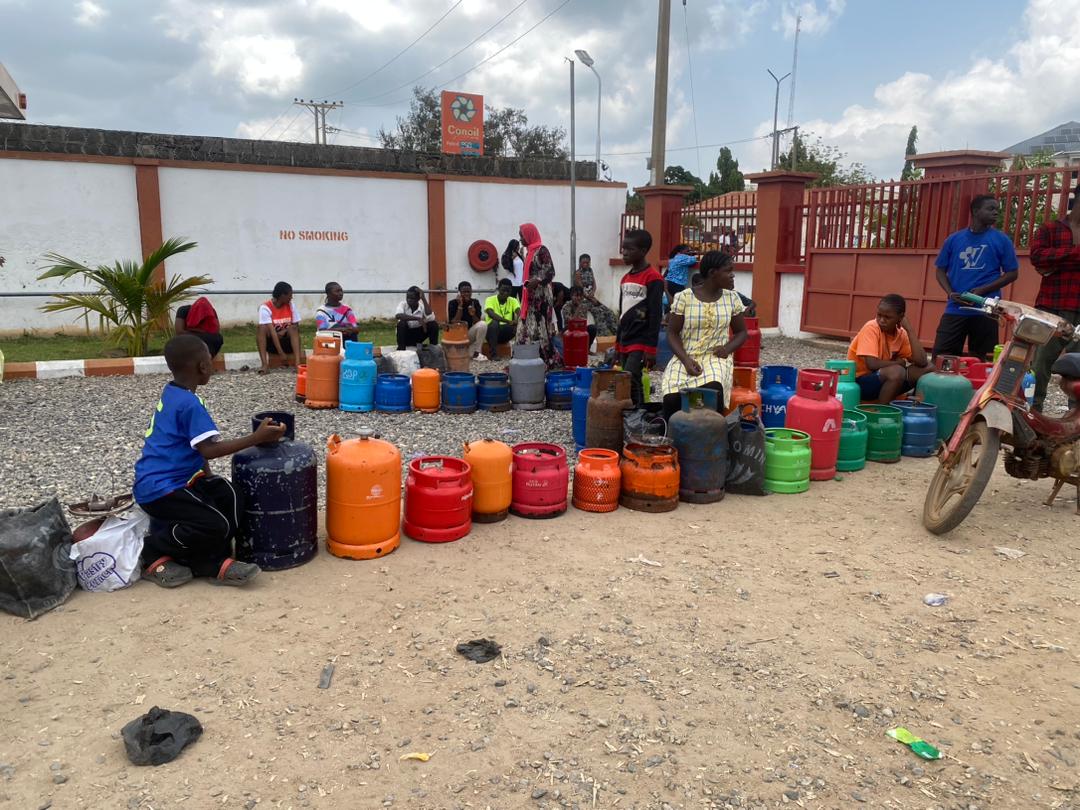
A cross-section of the consumers who spoke to TheFact Daily on Saturday at the NIPCO gas station along Nyanya-Jikwoyi road were unhappy as they waited for hours just to fill a 6kg Cylinder of gas at the station.
Majority of the consumers who came from as far as Kurudu and Kpegi to Jikwoyi gas station, expressed dissatisfaction with the government over the scarcity and exorbitant price of the product, which has persisted for weeks now.
A consumer who spoke on a condition of anonymity told this paper that the price is high in Kurudu, as the black marketers are selling between N1,500 and N1,800 per kg.
“The price is very high in Kurudu where I am coming from. The roadside guys sell between N1,500 and N1,800, so that is why I am here at NIPCO gas station to buy. If you calculate it very well, NIPCO is selling at the rate of N1,200 per kg, which is far cheaper than the price the roadside guys are selling, even with the transport.
“We pray that the situation normalises very soon so that the suffering will end. Imagine, I have been here on the queue since 7am and this is 1pm, it’s too much. I have wasted all the time,” he lamented.
Another, who simply gave his name as Mr Mike, said he came all the way from Kpegi, a suburb in the Abuja Municipal Area Council, to fill his 12 kg Cylinder of gas at the NIPCO gas station in Jikwoyi.
Mr Mike said he spent over three hours on the queue before announcement was made by the NIPCO gas attendant that preferential treatment be given to those with 12 kg Cylinder and above.
Meanwhile, the product scarcity and price hikes across the country, were attributed to temporary disruption caused by the industrial action declared in September by the Petroleum and Natural Gas Senior Staff Association of Nigeria (PENGASSAN).
Even though the strike has been suspended, the product supply and distribution has not been fully restored nationwide, leaving the consumers at the mercy of the retailers who are exploiting them by inflating the prices.
Although the Nigerian National Petroleum Company Limited (NNPC Ltd.) has assured that the prices would normalize when the supply and distribution issues are resolved.
Just recently, the Minister of State Petroleum Resources (Gas), Rt. Hon.Ekperikpe Ekpo, directed the Nigerian Midstream and Downstream Petroleum Regulatory Authority (NMDPRA) to intensify monitoring of the cooking gas depots across the country to prevent product hoarding and other sharp practices capable of worsening the current situation.
The directive follows the exorbitant price of the product, ranging between₦1,000–₦1,100 per kilogram to as high as ₦1,500–₦1,700 per kilogram in some parts of the country.
The Minister, who expressed concern over the development, appealed for calm and understanding from Nigerians, assuring that the situation is temporary and would normalise in no distant time.
He explained that the recent price surge was primarily caused by two factors: The industrial action by the PENGASSAN at the Dangote Refinery, which temporarily halted LPG loading, and Ongoing maintenance activities at the Nigeria LNG Train4 facility, which reduced the volume of LPG available in the domestic market.
These disruptions, according to him, led to a shortfall in supply and a consequent increase in prices due to demand–supply imbalance.
He noted that operations at the Dangote Refinery have now resumed, with loading of LPG to the domestic market already underway.
Similarly, he said the Bonny River Terminal operated by Seplat Energy has commenced loading, while the Nigeria LNG is gradually restoring normal operations as maintenance nears completion.
“With these developments, supply to the domestic market is expected to stabilise by next week, leading to a gradual reduction in prices,” he assured.
Rt.Hon. Ekperikpe Ekpo, also reiterated that the LPG market is deregulated and appeals to marketers, distributors, and all stakeholders along the LPG value chain to be patriotic in their dealings, desist from hoarding, and refrain from exploiting consumers for profit.
He reassured Nigerians of the Federal Government’s commitment to ensuring sufficient and affordable gas supply to all households across the country.