
As the nation prepares for the full implementation of the new tax reforms laws in January, 2026, a coalition of Civil Society Organisations (CSOs), FCT Tax Justice, has underscored the need for fair and equitable tax justice system for the informal sector in the country, especially in the Federal Capital Territory (FCT).
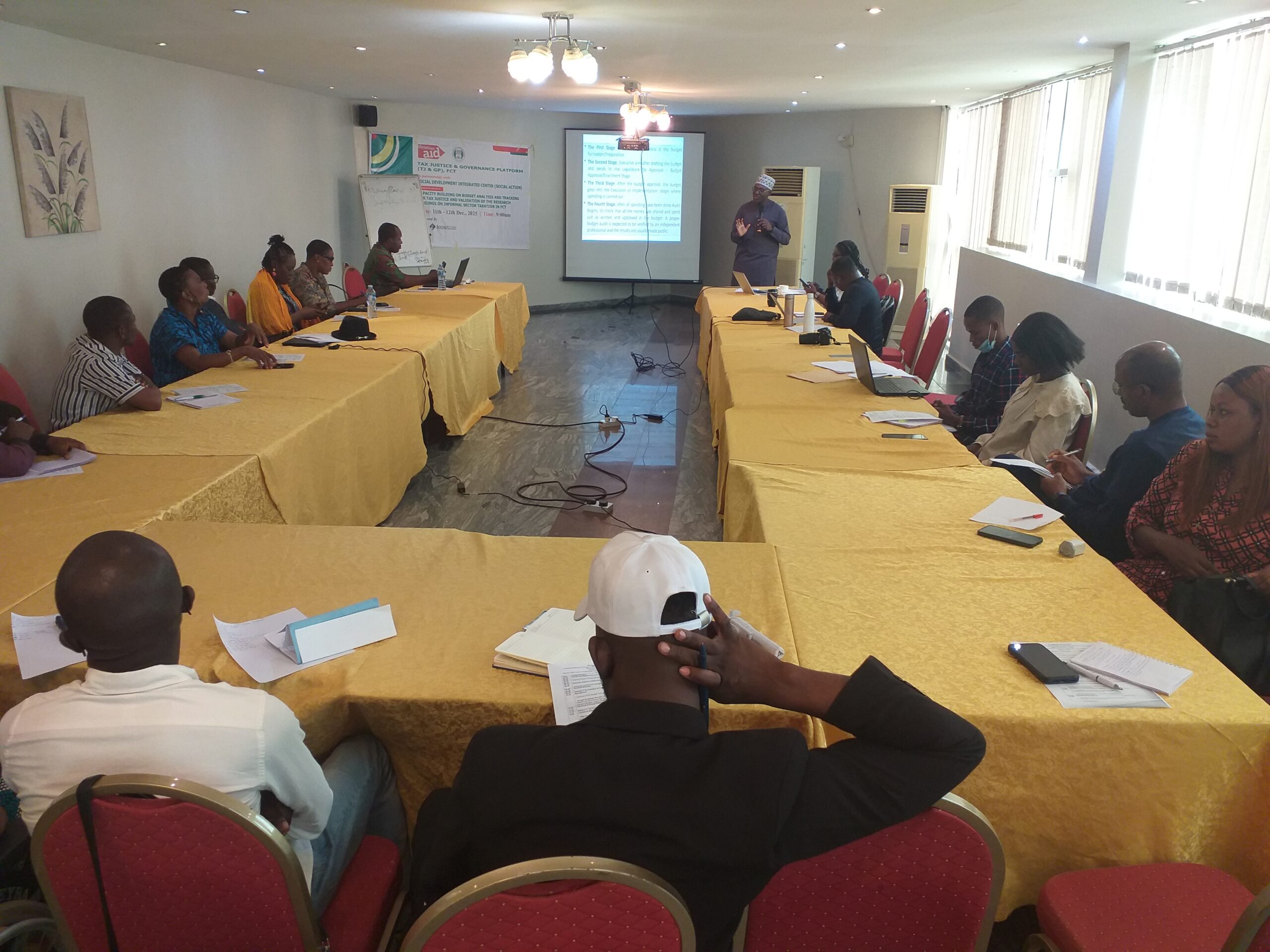
During a Tax Reforms Training organised for its members and media Stakeholders at AES Hotel & Apartments on Friday in Abuja, the CSOs also called for the unification of ideas to evolve a framework for improved informal sector taxation in FCT.
Speaking during the meeting, the team lead, Social Action/Tax Justice and Governance Platform, Botti Isaac, said the gathering was aimed at harnessing inputs from stakeholders to improve informal sector taxation in Nigeria, particularly in the FCT.
According to him, the plan was to build an evidence-based advocacy around a fair, equitable justice system in the FCT informal sector. Adding that the platform engages by working with stakeholders, other segments of Civil Societies to promote knowledge, skills that could help promote advocacy and critical engagements that could bring about a fair tax justice system.
He also mentioned that the coalition has commissioned a study on informal sector taxation in FCT to fully understand their plight, especially with regards to multiple taxation and other pressing challenges confronting them.
“It’s in this context that we conceived that idea to say in FCT, we will not be talking about a fair tax justice system if we do not have the basis to do so. We do not have the background knowledge of the situation and context of the FCT taxation system, particularly within the informal sector.
“We know that the informal sector comprises the major sector where we have about 60% of the country’s revenue and 60% of the workforce, and we have at the moment, a new tax law that will be coming into full effect by January, next year.
“How is the implementation going to affect the informal sector? What is the current situation with the informal sector? We took FCT as a pilot phase because we are based in FCT. How can the informal sector taxation be improved such that it’s not left out in the scheme of things, and particularly in the implementation of the new tax law? What ideas and thoughts that can be presented and pushed forward that can help improve informal sector taxation?
“Over the years, we hear things like multiple taxation and others in the informal sector. We have also seen the disarray and the taxation structure in the informal sector, with the role of non-state actors, and how this is affecting the players in the informal sector. So, we conceived this idea so that we can be able to have a better and clearer understanding of the informal sector taxation. And then see how our collective ideas and inputs can help to bring about recommendations that can reshape the dynamics in the informal sector. And within the context of the new tax law we can make the informal sector taxation fairer, equitable and able to meet the aspirations of the people in that sector,” he said.
Earlier, in a presentation, one of the Researchers, Chris Kaka, said the study found out that most of the laws used to back up revenue collection in FCT were non-existent.
He also disclosed the existence of multiple taxation in the informal sector under different names and titles that are untraceable to any account or institution of government.
The study, according to him, disclosed poor tax education in the FCT, especially in the informal sector, as most of the players do not have Tax Identification Number (TIN).
The study, however noted improved tax administration in FCT, pointing to simplification of assessment, digitisation of collection and voluntary compliance.
Also speaking, the Chairman, Abuja & District Society, Chartered Institute of Taxation of Nigeria, Dr Enamudu Benjamin said that the popular maxim that Nigerians don’t pay taxes is not true.
He said that Nigerians pay taxes at one point or the other, but the challenge has been with the payment of income taxes, noting that the tax administration on income taxes in Nigeria is quite lopsided.
He said while some states like Lagos, FCT and Rivers are trying, others are lackadaisical about tax enforcement and collection.
“I think it is a structural problem. The nature of federalism we operate in Nigeria has not yet gotten to the level where we can say indeed there is a true fiscal federalism.
“When we have fiscal federalism, the state generates the money they use in running their states rather than running to the centre to go and collect allocation every month.
“By the time we are able to shore up the system and create enough efficiency and effectiveness around it, most states will be generating way more than they are generating now.”
Speaking on the aspect of tax justice, Dr Enamudu said “I want to believe that we have not yet gotten there, out tax system is being shore up to see that people don’t evade payment of taxes and meeting their civic obligations. But for now, quite a number of persons are not in the tax nest and are not paying their taxes. Even those paying are not paying what they are supposed to pay. We hope that as the society evolves, we are able get more people into the tax nest and make it more equitable for everybody.
“Then also on the aspect of tax justice we must not fail to talk about government’s accountability, yes, because it’s one of the key factors that drive and encourage people to pay their taxes. When they see what government is doing with the revenue with the taxes that we are paying, we would be encouraged to pay more. Government must sit up and minimize wastages in the system to see that the little we are contributing is put into judicious use.”
He clarified that there is no rivalry between the FIRS and the FCT-IRS because their jurisdictions are different. “Yes, they may not be working together as they ought to, but the new law has given them a lot of power to synergise and conduct joint tax audit, so we will see a more collaborative engagements staring first January 2026. It’s not just for the FCT-IRS, but for the various states Internal Revenue Service across the country. There is no rivalry, they are all working together to advance taxation in Nigeria. And helps the government meet its revenue obligations.”
On his part, the Clerk, House of Representatives, Yusuf Sadiq, thanked the FCT Tax Justice for commissioning the study and pledged the House’s unalloyed support in strengthening tax laws in Nigeria, especially in the FCT.