

The National President of the Association for Public Policy Analysis (APPA) Nigeria, Chief Princewill Okorie, has blamed the liquidity crisis in the power sector on the negligence of the Distribution Companies (DisCos).
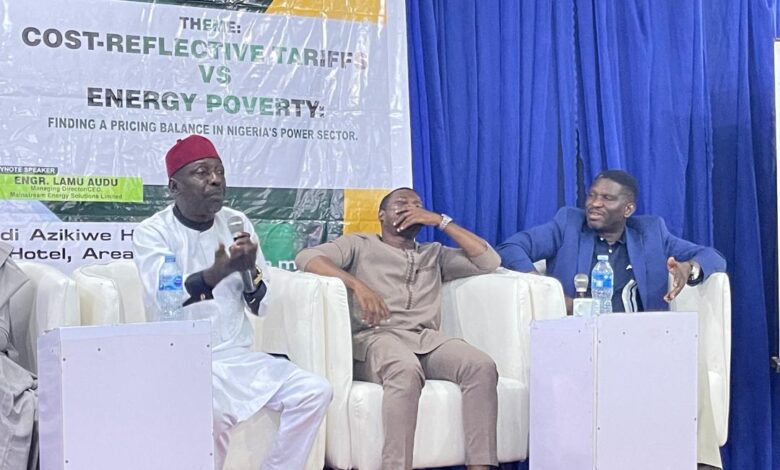
Chief Okorie Spoke during the Panel Session at the 5th Edition of the Power Correspondents Association of Nigeria (PCAN) Conference on Thursday in Abuja.
With the theme, “Cost-Reflective Tariff vs Energy Poverty: Finding a Pricing Balance in Nigeria’s Power Sector,” the conference brought together journalists, policymakers, regulators, operators, investors, and civil society organisations to discuss the issues affecting Nigeria’s power sector.
He argued that the cost-reflective tariffs should be based on investment in infrastructure, especially, at the distribution value chain of the power sector. Adding that the negligence on the part of DisCo is contributing to their claim of lack of liquidity in the sector.
“You see GenCos complaining of N6 trillion debt, and the DisCos do not spare any consumer for owing them one naira, yet the GenCos are not paid. So, the question here is what is the ideological perspective for this cost-reflective tariff?
“The cost of transformers, poles, cables, feeder pillars, meters etc. which enhances distribution of electricity to end users (Consumers) should be considered as a major component of cost incurred to supply electricity.
“Are these costs taken care of by the GenCos, DisCos, consumers or government? It is expected that the DisCos who are investors should bear the cost of electricity infrastructure and maintenance. Hence, it should be part of the cost to be considered in fixing cost reflective tariff.
“If they fail to bear the cost, refund to those who bore the cost should be considered in fixing cost-reflective tariff,” he submitted.
Chief Okorie, who is also the Executive Director of Electricity Consumer Protection Advocacy Centre, contended that NERC approves Operational Expenditure (OPEX) and Capital Expenditure (CAPEX) to enable the DisCos provide infrastructure and maintain them.
Unfortunately, he said the CAPEX and OPEX approved and given to DisCos are not made public for consumers to know when and the amount of money given to DisCos for that purpose.
“DisCos take advantage of this situation to abdicate the responsibility of providing and maintaining infrastructure, thereby raising a question as to what the DisCos do with the CAPEX and OPEX approved for them?
“The sad story here is that it is the consumers who pay tariff that still provide and maintain infrastructure, which the DisCos take over as national critical assets and infrastructure, to make money without refunding the consumers who many a times borrow to provide them and pay back with interest to the banks without being refunded by the DisCos who use them to generate revenue.
“It will amount to exploitation, Inhuman treatment and gross injustice against the consumer if this is not considered in addressing cost reflective tariff. Survey should be carried out to identify the investments made by DisCos and consumers in electricity infrastructure and maintenance before a just, fair and balanced cost-reflective tariff can be arrived at,” he added.
Chief Okorie stated that the NERC has third party investment policy which entails that people who are not DisCos could invest in the sector to enhance network expansion and get refunded by the DisCos, with a condition that an agreement is signed between the DisCo and those who intend to invest before commencement.
He lamented that neither the Ministry of Power, NERC nor DisCos carry out enlightenment on this policy to enable consumers who intend to invest as third parties to understand the procedure. Hence, the DisCos fail to refund them after investing on the excuse that agreement was not signed at the beginning.
The consumers’ Advocate also submitted that since the commencement of privatization of the Power Sector in 2013, the Federal Government has intervened to support the DisCos in several ways, irrespective of the fact that they are private sector operators.
Among such interventions, according to him, was the National Mass Metering Programme introduced by NERC and CBN in 2020 for which N200 billion naira was ear-marked and N59 billion released to the eleven DisCos at the zero phase of implementation.
He said an evaluation of the implementation of that programme (NMMP) by the House of Representative, which showed that the process has not been efficient and has been manipulated.
“In some cases, the meters which were said to be free were sold to consumers and the revenue the meters have generated from vending has been diverted. Yet DisCos are complaining of lack of liquidity.
“Worst is that different narratives come from NERC, CBN, Discos and the Fund managers on the project while consumers who are short changed are still made to pay for the meters without proper account on how it was managed.
“Similarly, World Bank, GIZ, European Union etc. have contributed substantial funds to support the DisCos. Can a transparent and accountable review of the funds be carried out to establish the claims and justification for cost reflective tariff?”, he asked.
On estimated billing, Okorie alleged that the DisCos bill consumers on estimation without obeying NERC approved estimated billing cap thereby making more money.
“Similarly, corrupt practices as we have witnessed in the field shows that most DisCos staff collect money through their private accounts thereby making DisCos lose revenue. This practice needs to be checked,” he added.