

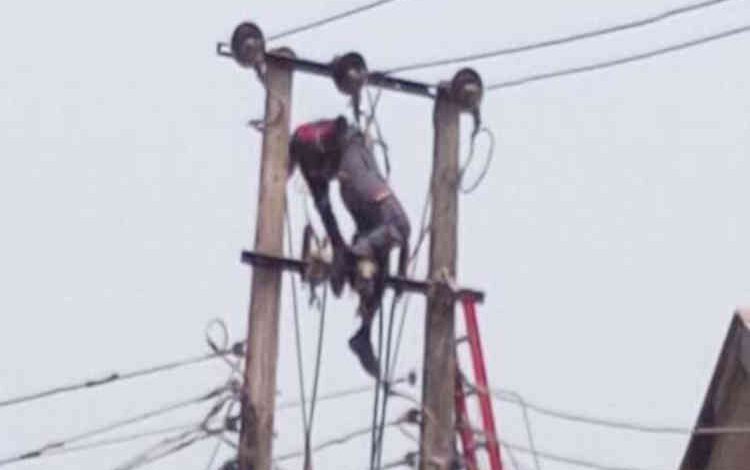

The Nigerian Electricity Regulatory Commission (NERC) has disclosed that about thirty-eight (38) deaths were recorded in the nation’s electricity sector in the second quarter of this year.

NERC disclosed this in the Q2, 2025 Report for the Power Sector released recently.
According to the report, the total number of accidents in 2025/Q2 was sixty (60), which resulted in nineteen (19) injuries and thirty-eight (38) fatalities.
The Commission, however, disclosed that it has launched investigations into all the accidents and would continue to work with all sector stakeholders to improve the overall health and safety of the Nigerian Electricity Supply Industry (NESI).
On the state of the industry, the NERC report said in 2025/Q2, there were twenty-eight (28) grid-connected power plants consisting of five (5) hydro, two (2) steam, nineteen (19) Open Cycle Gas Turbines (OCGT) and two (2) Combined Cycle Gas Turbine (CCGT) plants.
It said during the quarter, the average available generation capacity of the grid-connected power plants increased by 28.84MW (+0.54%) from the 5,366.88MW recorded in 2025/Q1 to 5,395.72MW.
The report noted that across the quarters, twelve (12) out of the twenty-eight (28) grid connected power plants recorded increases in available capacity, while the remaining fifteen (15) recorded decreases. Adding that the Alaoji power plant was unavailable throughout the quarter.
It said the most significant increase in average available generation capacity in 2025/Q2 compared to 2025/Q1 was recorded in Geregu_1 (+109.13%). Revealing that notable increases in available capacity across the quarters were also recorded in Zungeru_1 (+31.09%), Ihovbor_1 (+30.86%), Olorunsogo_2 (+25.43%), Trans Amadi_1 (+24.77%), Ibom power_1 (+23.05%), and Egbin_1 (+16.69%) power plants.
Conversely, it said there were significant decreases in the average available capacities of Rivers_1 (-49.72%), Omoku_1 (-44.72%), Odukpani_1 (-35.65%), and Sapele Steam_1 (-21.09%) power plants in 2025/Q2 compared to 2025/Q1. Figure 1 shows the plants with the highest average available capacities across the two quarters.
On distribution, the report said in 2025/Q2, the average energy offtake by the Distribution Companies (DisCos) at their trading points was 3,582.62MWh/h, which represents a decrease of 199.33MWh/h (-5.27%) when compared to the average offtake in 2025/Q1 (3,781.94MWh/h).
This reduction in energy off-take, according to the report, was despite an overall increase in available energy across the quarters (Available PCC: 2025/Q2 – 3,903.44MWh/h vs. 2025/Q1 – 3,861.53MWh/h).
The report disclosed that all the DisCos except Benin recorded a decline in their offtake performance between 2025/Q1 and 2025/Q2.
On an aggregate level, it said the available PCC increased marginally by 1.09% while the gross energy offtake decreased by 5.27% between 2025/Q1 and 2025/Q2.
“The cumulative energy offtake performance of DisCos during the quarter was 91.78%; this translates to a 6.16pp decline in the energy offtake performance of the DisCos relative to 2025/Q1 (97.94%).
“The resultant differential between the regulatory set wholesale generation cost and the actual cost incurred by the DisCos arising from poor energy offtake is borne entirely by the DisCo; deemed capacity expenses are not passed onto customers,” the report said.
The Commission noted that the Orders on Performance Monitoring Framework for DisCos (NERC/2024/086 – 096) issued on 05 July 2024 mandate DisCos to off-take at least 95% of their available PCC or face sanctions by the Commission.
It said in 2025/Q2, only Benin (100%), Enugu (97.84%), Ikeja (96.02%), Port Harcourt (95.85%) and Yola (95.20%) DisCos met the threshold set in the Orders. Noting that the remaining six (6) DisCos (Abuja, Eko, Ibadan, Jos, Kaduna and Kano) took less than 95% of available PCC, with Kaduna recorded the lowest uptake performance of 75.37%.
“The Commission has commenced the implementation of appropriate sanctions against defaulting DisCos,” the report noted.