
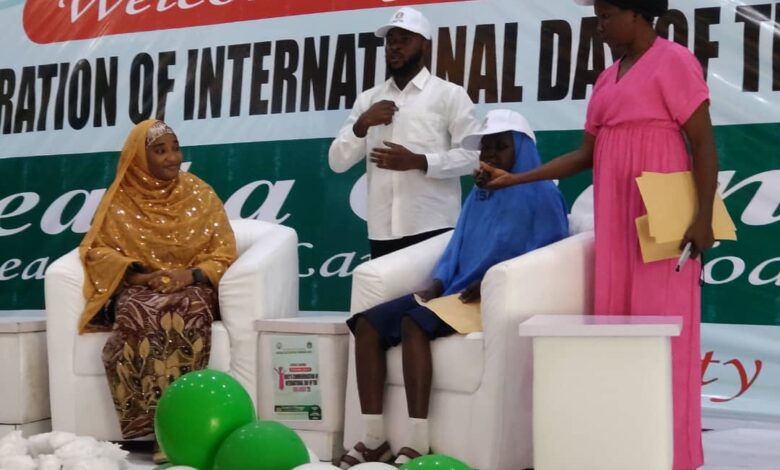

As part of efforts to drive an inclusive education, the Federal Government has put a policy in place to institutionalize the teaching and learning of sign language in all basic education schools across Nigeria.
Executive Secretary of the Universal Basic Education Commission (UBEC), Dr. Aisha Garba disclosed this at the agency’s 2025 International Day of the Girl Child celebration, held in Abuja on Thursday.
Speaking on the theme: “Lead a Change: Learn Sign Language Today”, the Executive Secretary said the Renewed Hope Agenda of the Federal Government has continued to invest so much in the Education and Empowerment of the Girl Child.
“The recent Migration of the LUMINAH project to the Commission is a testament of our corroborative effort to Educate and empower the Nigerian Girl and this speaks true for the girl with disabilities.
“At the Universal Basic Education Commission (UBEC), we recognize that education is the great equalizer, and inclusion is its backbone. That is why we are working closely with the relevant stakeholders to ensure no child is left behind.
“The theme we choose is a clarion call, a bold and necessary reminder that inclusive communication is not just a courtesy, it is a right. And we must ensure that every girl, including the hearing-impaired, is seen, heard, and empowered to lead change.
“We celebrate not only the potential of the girl child, but we also reaffirm our collective responsibility to amplify her voice, protect her dignity, and equip her for leadership regardless of her abilities or challenges”, she said.
The Executive Secretary continued: “Today, we take that commitment a step further by championing the learning of sign language in our basic education schools. This does not in any way downplay challenges faced by persons living with other disabilities but demonstrate that collectively we can make the world a better place for each other if we try.
“I would like to remind you that a policy is already in place to institutionalize the teaching and learning of sign language in all basic education schools across Nigeria”.
On her part, the Minister of State for Education, Prof. Suwaiba Ahmad noted that the occasion reaffirms the nation’s commitment to inclusive education, to the rights of persons with disabilities, and to the expansive potential of every girl learner.
“Today, we are joined by pupils from special needs schools and regular schools, by colleagues from other ministries and heads of relevant agencies, by dedicated teachers, and by the entire UBEC family. Together, we will reaffirm our shared conviction: talent does not wait for perfect conditions; it grows where opportunity, support, and belief come together.
“To our girls, who navigate the world with unique challenges, I want you to know that doors of education are widening for you. We have heard your voices and your dreams are legitimate, your contributions invaluable, and your futures bright with possibility. You are the driving force of change”, she said.
Prof. Ahmad stated that the Universal Basic Education Commission had a crucial mandate: to ensure that every child had access to free, compulsory, and quality basic education.
“We will continue to expand inclusive education programs—ensuring adaptive learning environments, sign language interpretation where needed, and teaching methodologies that meet diverse learning needs.
“Sign language is a bridge, not a barrier. It connects minds, shapes friendships, and unlocks futures. Our theme : Learn Sign Language Today calls us to action train more sign language interpreters in schools, introduce sign language across teacher training curricula, equip classrooms with the tools that enable visual-gestural communication, and mainstream sign language as a recognized part of our national education framework. When a student can express themselves and be understood, classrooms become laboratories of confidence, collaboration, and creativity.
“We must align our policies, coordinate our funding, and synchronize our programs so that a girl who begins her journey in primary school will have pathways that lead to secondary education, vocational training, and beyond. We must ensure that disability inclusion is not an afterthought but a core principle across all sectors”, the Minister said.