
The Federal Government has directed the Federal Road Safety Corps (FRSC) and other relevant stakeholders to implement the Nigeria Road Safety Strategy.
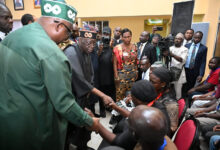
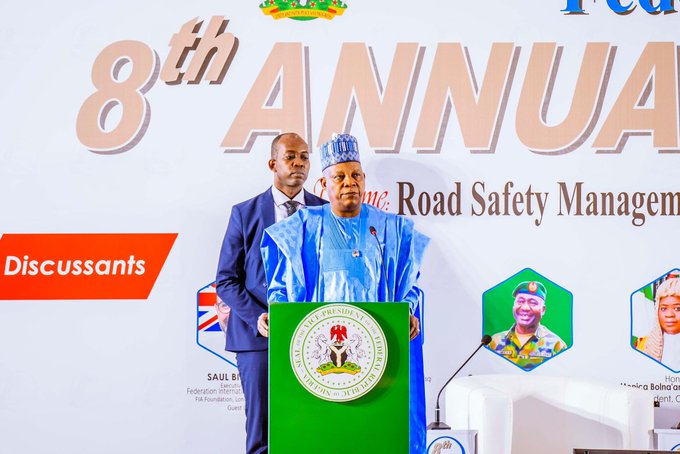
Vice President Kashim Shettima, who gave directive on Wednesday, during the Federal Road Safety Corps (FRSC) 8th Annual Lecture Series, stated that much work is still required to keep the roads safe across the country.
TheFact Daily reports that the NESS is a plan developed by the Nigerian government to achieved zero fatalities on its highways by applying the UN’s Safe System Approach.
The strategy is divided into two periods, with NRSS I (2014-2018) and the ongoing NRSS II (2021-2030), which aims for a 50% reduction in road traffic fatalities by 2030 compared to the 2019 baseline.
Senator Shettima, in a statement by the Senior Special Assistant to The President on Media & Communications, Office of The Vice President, Stanley Nkwocha, said latest statistics indicating a startling record of deaths on the roads are quite disturbing, as they suggest that the nation still faces considerable road safety challenges.
He implored stakeholders in government and the private sector to pursue indigenous solutions, while collaborating with global partners in the bid to ensure safer roads across the country.
“I commend the leadership of the FRSC for the vigour and innovation with which you have pursued this cause. But let me add a note of caution: we do not yet have the luxury to celebrate. The road ahead remains long and demanding.
“Much work still lies before us, and we must draw from both our indigenous solutions and effective collaborations with global partners to achieve our objectives,” the Vice President said.
Noting that “Nigeria still faces significant road safety challenges, with recent statistics revealing a troubling record of deaths on our roads,” VP Shettima pointed out that the duty of keeping the roads safe is a collective task that cannot be done in isolation, even as he called for a recommitment to implementing the Nigeria Road Safety Strategy.
“We must recommit ourselves to implementing the Nigeria Road Safety Strategy. We must ensure that all tiers of government, the private sector, and other stakeholders, including Non-Governmental Organisations, are fully engaged in road safety activities. Only through such shared responsibility can we guarantee sustainable outcomes,” he maintained.
Speaking in his capacity as Chairman of the National Road Safety Advisory Council (NaRSAC), the VP reaffirmed his commitment to ensuring that President Bola Ahmed Tinubu’s pledge “to make the vision of the National Road Safety Strategy a reality is never relegated.”
He noted that the Annual Lecture Series is a platform of accountability and reflection that offers the opportunity to make amends by comparing indigenous solutions and results with the best practices from around the world, emphasising that “strategic engagements and activities such as this serve as our vehicle towards that goal.”
The Vice President applauded efforts of the FRSC, saying the Corps has produced refined minds whose insights enrich the nation’s “quest for safer roads,” even as he observed that “the theme of this year’s edition speaks not only to the FRSC’s resolve to keep reinventing itself but also to its alignment with global standards in road safety management.”
Acknowledging results achieved so far, he stated: ‘Distinguished ladies and gentlemen, this administration has made it a priority to enable critical Ministries, Departments, and Agencies to function to public expectation.
“In its thirty-seven years of existence, the FRSC has demonstrated the promise, the potential, and the practice of prioritising safety and securing the lives and property of road users.
“The Federal Government has also shown its commitment to this mission through massive infrastructure development, consistent road maintenance, and the expansion of our highway networks.”
Also speaking, the Secretary to the Government of the Federation, Senator George Akume, stated that the FRSC annual lecture series tradition has metamorphosed into a platform for dialogue on effective road safety and transportation management.
He said while Nigeria faces urbanization, there is a need to embrace new partnerships while strengthening local systems “to protect the lives of our people.”
The SGF pointed out that “Road Safety is not merely a transport issue but a national development priority,” adding that it promotes social well-being.
He said even though the FRSC is appreciated and recognized for its tireless work, “much remains to be done,” even as he assured that the “Federal Government is committed to doing more” for the institution’s efficiency and effectiveness.
Among other government interventions, he said the Tinubu administration will support the FRSC with capacity building and interagency coordination, adding, however, that the responsibility for safer roads in Nigeria rests on all Nigerians and residents.
Earlier, the FRSC Corps Marshal, Shehu Mohammed, said the purpose of the lecture series was to share perspectives on road safety management in Nigeria in view of emerging global challenges.
Mohammed expressed optimism that the event would provide critical insight towards achieving road safety management objectives across Nigeria.
He appreciated the physical presence of Vice President Shettima at the event, noting that it further affirmed the commitment of the Tinubu administration in road safety management as an imperative for national development and a critical component of the Renewed Hope Agenda.