
The Federal Government has explained why a whooping sum of N5.41 trillion was allocated to defence and security in the 2026 budget.
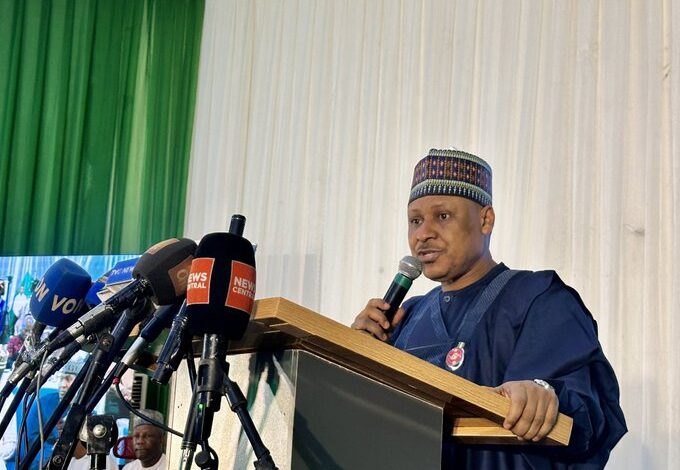
Minister of Information and National Orientation, Mr Mohammed Idris, made the clarification at the end of the year Press Conference on Monday in Abuja.
Recall that President Bola Tinubu last week presented the 2026 Appropriation Bill of 58.18 trillion to the National Assembly, christened as “Budget of Consolidation, Renewed Resilience and Shared Prosperity.”
The Minister explained that the single biggest allocation of N5.41 trillion was given to defence and security for the protection of lives, property and prosperity.
This, according to him, would be achieved through modern equipment for the armed forces, a new national intelligence architecture, and a secure digital border surveillance system.
He also mentioned that the largest ever capital expenditure allocation of ₦26.08 trillion was earmarked for tangible infrastructure, roads, rail, power, and ports.
Idris stated that the budget was funded by prudent assumptions of oil at $64.85/barrel, production at 1.84 million barrels/day, and an exchange rate of N1,400/$. Adding that the government would fund the deficit through an aggressive, digitized revenue mobilization drive, ensuring that every liable entity pays its fair share, without imposing unfair burdens on anyone.
He said President Tinubu has also vowed that 2026 would see a full unification of existing budget cycles, saying that henceforth the country would operate on a single unified budget that is backed by a single revenue cycle.
The Minister said that the budget sets the stage for a year in which the landmark new Tax Reform Laws would go into operation, ushering in an era of fiscal growth and a deepening of the social contract between the government and the people.
He therefore called for the understanding of Nigerians in this regard, as it promises a new era of accountability in revenue generation and government expenditure.
Speaking on the economic reforms introduced by the administration, Idris said the reforms are yielding results with the nation’s Gross Domestic Product (GDP) growing by 3.98% in the third quarter of 2025, demonstrating resilient and sustained expansion in the non-oil sector.
He stated that the nation’s headline inflation has significantly declined for eight consecutive months, to stand at 14.45% in November 2025, adding that food inflation is also on a steady downward trend.
“Our external reserves have strengthened to approximately $44.56 billion, providing a robust buffer that stabilises our currency and assures international investors.
“Nigeria recorded a trade surplus of N6.69 trillion in the third quarter of 2025, a 27.29 percent growth year-on-year.
“The most recent Purchasing Managers Index (PMI) data – an important measure of business sentiment – indicates that Nigeria has now seen 12 consecutive months of expansion in economic activities,” Idris submitted