

The Federal Government of Nigeria says it is laying a solid foundation to achieve the $1trillion economy target by 2030, even though the nation’s GDP currently sits at approximately $375 billion.
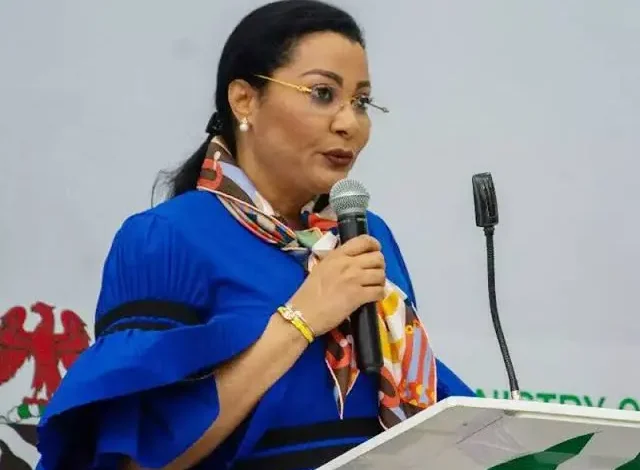
Minister of State for Finance, Dr. Doris Uzoka-Anite, made this known on Wednesday while speaking at the 2026 Annual General Meeting (AGM) of the Finance Correspondents Association of Nigeria (FICAN) in Abuja, with the Theme: “Actualizing President Bola Ahmed Tinubu’s $1 Trillion Economy Agenda.”
According to her, to reach $1 trillion economy requires sustained GDP growth of between 10 and 12percent annually over the coming decade. Adding that though ambitious, the target is achievable.
The Minister, who was represented at the event by an Assistant Director of Information in the Ministry, Uloma Amadi, said that the foundation the federal government is laying is sound enough to carry that $1 trillion ambition.
She stated that the decision made by the current administration in 2023: the removal of the fuel subsidy and the unification of the exchange rate are currently being vindicated by the data.
“In January 2026, S&P Global Ratings revised Nigeria’s outlook to positive, affirming our B-/B credit ratings and citing measurable improvements across our external, fiscal, monetary, and economic trajectory. That kind of third-party validation is not given lightly,” she said.
Dr. Uzoka-Anite, also noted that the government has restructured how the budget works.
“For the first time, we are treating investment expenditure as a distinct pillar of public finance, separate from recurrent spending.
“This matters because it disciplines government to ask a different question: not justhow much are we spending, but what are we building with what we spend,” she said.
The Minister said while the first wave of reforms restored market integrity. The second wave, which is now underway, was designed to unlock productive capacity.
Explaining that in collaboration with the Central Bank of Nigeria, the Ministry of Finance has co-authored the Disinflation and Growth Acceleration Strategy, which we call DGAS.
“Thisis not a policy document that sits on a shelf. It is a nine-pillar implementation framework designed to deliver non-inflationary growth above 7 percent by 2027,” she said.
On the international front, she noted that Nigeria was removed from the FATF greylist last year, a recognition, she said, has strengthened the nation’s anti-money laundering and counter-terrorism financing frameworks to global standards.
“This matters because it directly reduces the compliance costs foreign investors face when engaging with Nigerian institutions. Capital flows more freely to countries that international regulators trust,” she added.
The Minister mentioned that the government has also submitted Nigeria’s ECOWAS Tariff Offer to the AfCFTA Secretariat, establishing zero duties on 90 percent of goods traded within the continent.
“Abinding commitment to a market of 1.4 billion people with a combined GDP ofover $3 trillion is not a gesture. It is a strategic repositioning. When global trade routes become contested, as they are today, regional corridors become the most reliable alternatives. Nigeria is deliberately placing itself at the center of that alternative,” she submitted.
While stating that the reforms being implemented are technically sound, but are not self-explanatory, the Minister called on the association to help build the public understanding of the reforms.
“When you report accurately on inflation trends, on exchange rate dynamics, on what consumer credit access actually means for a family in Ado-Ekiti, Kano or Owerri, you are doing something that no government press release can replicate. You are building the public understanding on which policy sustainability depends.
“I therefore want to extend an open invitation to the leadership of FICAN and to your members: come to the Ministry. Ask the hard questions. Hold us accountable to the numbers we have put in the public domain. Rigorous financial journalismis not a threat to good governance; it is one of the conditions for it,” she said.
Uzoka-Anitesaid that President Tinubu’s $1 trillion economy agenda would not be built through government action alone.
“It will be built through the confidence of investors who trust our institutions,the productivity of entrepreneurs who can access capital and markets, the skills of young Nigerians who find opportunity rather than frustration, and the informed engagement of citizens who understand what their country is trying to do and why,” she concluded.