

The Federal Government of Nigeria says it’s advancing oil and gas exploration with the resumption of drilling of three oil wells in the Kolmani region of Bauchi and Gombe states.
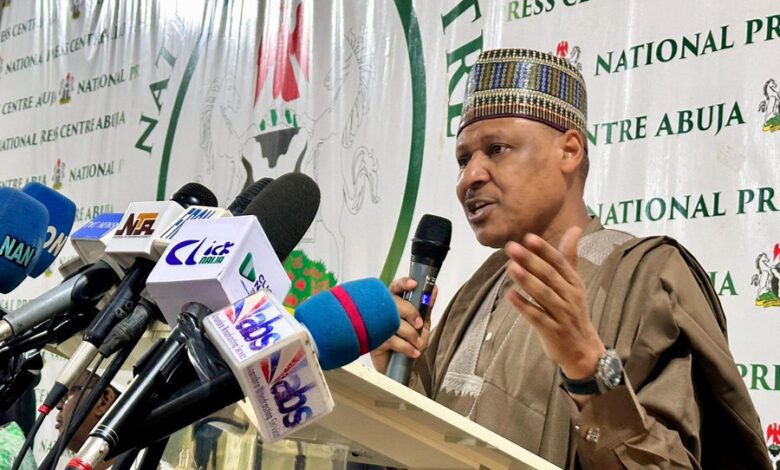
Minister of Information and National Orientation, Mohammed Idris, announced this on Monday, at a Press Conference to commemorate Nigeria’s 65th Independence Anniversary in Abuja.
“We are advancing the AKK Gas Project and other critical gas pipelines, while frontier basin oil and gas exploration has resumed with the drilling of three oil wells in the Kolmani region of Bauchi and Gombe States,” he said.
Recall that the Group Chief Executive Officer of the Nigerian National Petroleum Company Limited (NNPC Ltd.), Engr. Bayo Ojulari, disclosed in May this year that the company would resume oil drilling in Kolmani, after a two-year hiatus since its initial launch in November 2022.
The project aims to boost Nigeria’s oil production, stimulate regional economic development, and secure skilled manpower through new infrastructure like the oil and gas Academy in Bauchi.
The Minister acknowledged that the progress in the oil and gas sector has been unprecedented, especially with the steady increase in oil production to meet the nation’s OPEC quota, and an equally steady reduction in oil losses to a 16-year low.
He noted that gas flaring is also at an all-time low, while new investments are flooding in to scale up gas exploration, processing and distribution. Disclosing those new investments in deepwater oil and gas exploration have exceeded five billion dollars.
Idris also noted that the administration has revived the 255MW Kaduna Power Plant and is determined to bring it to completion.
“The Presidential Power Initiative (aka Siemens power project) is on course, as is the Presidential Metering Initiative, a vital collaboration between the Federal and subnational governments, which will deliver 7 million smart meters to close the country’s metering gap by 2027,” he added.
According to the Minister, “currently, Nigeria is home to the implementation of one of the world’s largest distributed renewable energy projects—the Distributed Access through Renewable Energy Scale-up (DARES) project, a $750 million World Bank supported program that will deliver clean and off-grid electricity to more than 17.5 million Nigerians.”
In solid minerals and mining, he said the country welcomed investments such as the $50 Million ASBA Lithium Plant in FCT, and the $600million Avatar Lithium processing Plant in Nasarawa State. Between 2023 and 2024, royalties earned by the government on solid minerals more than doubled, reflecting the success of our diversification efforts.
In healthcare, over 1,000 primary health care centres have been rehabilitated across the country, underscoring the administration’s commitment to human capital and social infrastructure.
“Recently, the Federal Government, through the Ministry of Health and the Nigeria Sovereign Investment Authority, has commissioned three advanced and world class oncology centres as part of a broader push to expand health infrastructure in the country.
“The commissioned cancer centres are located at the University of Benin Teaching Hospital (UBTH), Federal Teaching Hospital Katsina, (FTHK), and the University of Nigeria Teaching Hospital (UNTH). Another three new centres are nearing completion at the Jos University Teaching Hospital (JUTH), Lagos University Teaching Hospital. (LUTH), and the Ahmadu Bello University Teaching Hospital, (ABUTH).
“Contrary to the perception being pushed in some quarters, this administration has demonstrated uncommon commitment to balanced and inclusive development since assuming office,” he noted.
Beyond these, he added that the Federal Government is actively going further to support various subnational infrastructure projects, like the light rail projects in Kano and Kaduna States, for which funding to the tune of ₦150 billion and ₦100 billion respectively has been secured.
“President Tinubu has also established the Federal Ministry of Livestock Development to harness our underutilised potential and transform Nigeria’s livestock sector into a sustainable and globally competitive industry.
“In addition, to spur agricultural production, the Bank of Agriculture has been recapitalised to the tune of N1.5 billion, and is regarded as the most significant boost to agricultural financing in Nigeria.
“This is the more reason why the ‘All Hands-on Deck’ message is apt and timely—henceforth no tier of government has any excuse not to fully pull its weight in this collective task of comprehensive economic growth and development,” he said.
Speaking on road infrastructure, the Minister said “we are in the middle of a road and transport infrastructure revolution, of which the flagship initiative is the one comprising the Presidential legacy highways, designed to connect Nigeria’s geopolitical zones, enhance national integration and unlock new economic corridors.
“These landmark road projects are the 1,068-kilometre Sokoto-Badagry Superhighway; the 750-kilometre Lagos-Calabar Coastal Highway; the 477-kilometre Trans-Saharan Highway traversing Calabar, Ebonyi, Kogi, Benue, Nasarawa, and the FCT; and the 422-kilometer Akwanga-Jos-Bauchi-Gombe Expressway.
“Complementing these are the high-impact rail projects: the Kano-Kaduna standard gauge rail, and the renewed push for the rehabilitation of the Eastern Corridor of the rail line from Port Harcourt to Maiduguri.”