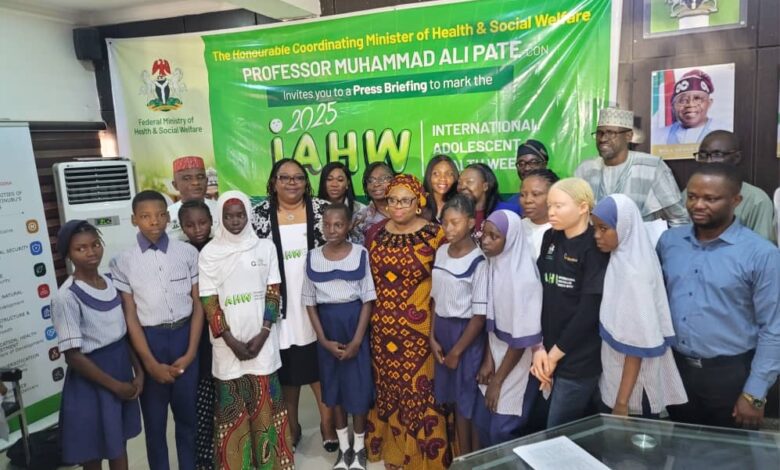

The Federal Government has called for increased investment and policy commitment toward improving adolescent health and well-being in Nigeria, stressing that the nation’s future progress depends on the physical and mental development of its young population.
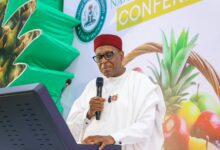
Spokesperson to the Federal Ministry of Health and Social Welfare, Alaba Balogun disclosed this in a statement on Tuesday.
Alaba informed that the Coordinating Minister of Health and Social Welfare, Professor Muhammad Pate, at a press briefing to commemorate the 2025 International Adolescent Health Week (IAHW), said that Nigeria must make a strong commitment to closing the gaps in adolescent health and development if it hopes to secure its economic, social, and political stability.
Pate noted that adolescents account for 23 percent of Nigeria’s population, describing them as a vital sub-population whose well-being must be prioritized in national development planning.
“To secure and sustain our future economic, social, and political progress, Nigeria needs to make a strong commitment to closing the gaps in the health and development of its adolescents,” he said.
Highlighting key milestones, the Coordinating Minister, represented by the Director Human Resource Department in the Ministry, Tetshoma Dafeta; disclosed that the Ministry had established an Adolescent and School Health Branch, a funded budget line for adolescent health, and several policy documents including the National Adolescent Health Policy, Clinical Protocol on Adolescent Health and Development, and Training Manuals to guide service delivery.
However, Prof. Pate admitted that despite these achievements, “a lot more needs to be done” to address the broad spectrum of adolescent needs, especially in integrating physical and mental health.
This year’s IAHW theme, “Thriving Inside-Out: Strengthening Physical and Mental Health of Adolescents,” he said, underscores the need for a holistic approach that nurtures both the physical and mental aspects of young people’s well-being.
“Thriving inside-out means recognizing that physical and mental well-being are deeply interconnected, one cannot flourish without the other,” the Minister emphasized.
He called for stronger collaboration among schools, families, and healthcare providers to create comprehensive programs that integrate nutrition, exercise, sleep hygiene, and mental health support. He also urged communities to create safe recreational spaces, youth centers, and peer support systems to enhance adolescent development.
In a special appeal to policymakers, the Coordinating Minister urged legislators at all levels to include specific budgetary allocations within key ministries, such as Education, Women Affairs, Youth Development, Sports, Transport, and Justice, to fund adolescent-focused initiatives.
“By investing in adolescent health today, we invest in a healthier, more resilient society tomorrow,” he said.
Earlier in her welcome address, the Permanent Secretary of the Ministry, Daju Kachallom mni, described adolescence as a “critical stage of growth” that demands targeted interventions. She reaffirmed the Ministry’s commitment to supporting programs that strengthen the physical and mental well-being of adolescents across Nigeria.
The Permanent Secretary, represented by the Director Family Health Department in the Ministry, Dr. Binyerem Ukaire; cited the establishment of the Reproductive, Maternal, Newborn, Child, Adolescent, and Elderly Health plus Nutrition (RMNCAEH+N) platform as a major government effort to coordinate multi-stakeholder partnerships involving civil society, the private sector, and development partners.
“By investing in adolescent health, we are investing in the very foundation of our nation’s future,” she said.
Several goodwill messages were delivered by the International Partners and NGOs; amongst which were Mrs. Mary Bantoruo, speaking on behalf of the World Health Organization (WHO) Representative to Nigeria, Dr. Pavel Ussu. It underscored the global and national significance of the week. Dr. Ussu congratulated the Federal Government, the Federal Ministry of Health, youth-led organizations, and partners for their collective effort in advancing adolescent health in Nigeria.
The WHO, he stated, remains steadfast in supporting Nigeria’s Health Sector Renewal Initiative and will continue working with the government to strengthen systems, build resilience, and ensure that physical and mental health services are within reach for every adolescent.
Representing the Society for Family Health (SFH), another goodwill message followed, emphasizing shared commitment to nurturing and empowering young Nigerians. The representative conveyed greetings from Dr. Omokhudu Idogho, the Group Managing Director of SFH, and the organization’s leadership team.
In his vote of thanks, Dr. John Ovouraye, Director Gender, Adolescent School Health, Elderly Division in Family Health Department of the Ministry outlined activities to commemorate the Adolescent Health Week, to include amongst others, sensitization visits to selected schools in Amac Kuje and Bwari area councils in Abuja.