
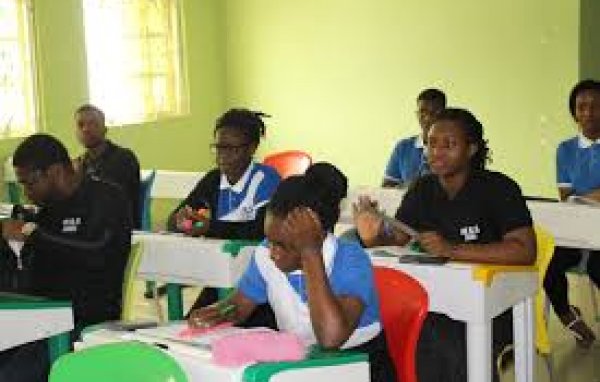

It is not uncommon to see sign boards advertising schools all around town but something else catches the eye. The claims of one school running on 2 or more curriculums.
Wikipedia defines curriculum as the totality of student experiences that occur in an educational process. The term often refers specifically to a planned sequence of instruction, or to a view of the student’s experiences in terms of the educator’s or school’s instructional goals.
The official curriculum used in Nigeria is the one issued by the Nigerian Educational Research and Development Council (NERDC), but these schools in their advertisement say they use British Curriculum and American Curriculum while operating on Nigerian soil.
On why this is so, and whether the current curriculum would help the Nigerian child be at par with his/her contemporaries from other climes after the period of study, Headteacher, Bristol Academy, Karu, Ms. Mercy Ochiba said, “for now, no. Now the content of our curriculum as it is, is lacking some essentials that I believe when it is added would meet up with global standards. But for now, with this new introduction, they are just trying to achieve the standard, but we are still not there”.
Loopholes Spotted In Nigeria’s Education Curriculum
Ms. Ochiba explained that borrowing from the curriculum of other nations was necessary after identifying loop holes in that of Nigeria.
“The school curriculum should include things like safety, it should include things like global citizenship, it should also include things like critical thinking for the children and all of that.
“Right now, the curriculum is too centered on the sciences and some details that are really not necessary because in the global space today, in the workplace, what you need is a skill that you can actually display, that you can offer to an organization, not just cramming or memorizing”, she said.
Speaking further, the Headteacher stated that more emphasis should be placed on Information Communication Technology (ICT) and Artificial Intelligence (AI) so the Nigerian child can compete favourably with others:
“We need to change the curriculum to content that can help our students to prepare for engagement in the workforce and the ICT cannot be ignored. We need to focus more on Information and Communication Technology and of course AI. AI is beginning to take over the world so we need to include more of that in our curriculum for schools”, she said.
On what Nigerian schools running British and American curriculum were doing differently from those using only Nigeria’s, Ms. Ochiba explained, “for some of them, it’s an advertisement but for some, it is not.
Like in our own case, we can actually claim that we are doing British and Nigerian curriculum because the early years, early childhood education, everything we are teaching there is based on the early years foundation stage curriculum, the British curriculum for early years foundation stage.
“We (Nigeria) don’t have a standardized curriculum for early childhood education. I don’t know for now but since I’ve been in this office, I’ve not seen. There was a new curriculum in 2014, another one in 2018. It’s all focused on primary school, not early years, early childhood education. So for early childhood education, our own curriculum is the early years foundation stage, British.
“In that curriculum, you are supposed to teach the child about themselves, about their surroundings and then about the world at large. So everything that is structured in that curriculum is structured based on that. And then we follow the Montessori method of education, not exclusively. We still have it at the back of our minds that our children are in Nigeria.
“They are not in the UK or in America. So we can’t do exclusive Montessori because at the end of the day, having a child in primary one who is unable to write, because the Montessori system of education is about practical life, they do practical life at their own pace.You don’t teach them to write. You just allow them to discover and explore the world on their own. But we don’t do it exclusively.
“We teach our children to write, to handle materials because we believe that handling materials is part of development. So we make them to handle materials from as early as age two. And we have seen that that has given us good results”.
Mistrust In Nigerian Government Push Schools To Adopt Their Preferred Curriculum
When asked why Nigerian Schools operate with multiple types of curriculum, the Educationist replied, “the truth is, an average Nigerian does not have confidence in the Nigerian system. So we are just looking at our educational system that the people at the forefront are just doing things for their own interest. Take for instance the recent introduction of basic digital technologies into school curriculum.

“If you check the rural areas, you will discover that most of the schools, most of the students don’t even have access to these things and you are introducing it as part of the curriculum. So most of the time, the decision taken by the people in government either feels fishy or it’s clouded.
“We don’t really understand what they are doing, so it’s hard, a bit hard to believe that what they are doing is for the best interest of the Nigerian child. So most people try to now introduce their own ideology into it to say, okay, if I do this, it might help the child better than what the body in charge of school systems in Nigeria is offering. So that’s how you see a whole lot of people trying to bring in different things.
“But if I have the opportunity to speak to one person who is in the position of making a change, I would say they should standardize the educational system across both public schools, primary schools, everybody should do the same thing.
“For instance, someone was telling me that in Equatorial Guinea, that all the private schools and all the public schools have the same content that is taught to everybody. Because they know that whether a child is in the private school or in the public school, it is for the good of the nation that the child is going to school to add to national development. So I think until we get to that point where everybody is thinking about national development, we are still a long way off”, she said.
Untrained Teachers, Weak Monitoring, Fuelling Nigeria’s Learning Crisis
The United Nations Children’s Fund (UNICEF) in a recent report said 2 out of 3 or 4 out of 10 children of school age cannot perform basic literacy skills for their age. Also, where children up to 10 years can neither read nor solve simple mathematical problems.
Responding, Ms. Ochiba blamed untrained teachers for fueling the crisis:
“Teacher’s training needs to be prioritized, we really need to invest in training the trainer. The teachers need to be trained to know what to do. Most teachers today don’t know the sequence of teaching children, you know, nurturing children from the age where they don’t know anything until they are able to achieve something. So teacher’s training needs to come in”, she said.
The Educationist further lamented that weak enforcement and unconducive learning environments were also culprits:
“The bodies that need to enforce the achievement of the curriculum, they don’t need to relax.
“A good number of times you see that they don’t even look at what schools are doing. They just get there, they give them some envelopes and then they forget and they go away. So enforcement is another one.
“And then the environment too. The learning environment too matters. Because if the learning environment is not conducive, the child will definitely not learn at the pace he or she is supposed to learn”, she said.
On her part, Proprietress of the King’s Orchard, Mrs Bukola Obute Warri explained that the use of different curriculum in Nigerian Schools stem from requests of expatriates working in the country.
“Some schools in Nigeria are American schools, some schools are British schools, So we have people in Nigeria who are British citizens, who are also American citizens who would like their children to go to schools that they are supposed to be in, especially expatriates.
“That’s the major reason why all of these multiple curriculums started in the first place. Most of these schools are owned by Nigerians but they adopt the British or American curriculum. That’s what they want, the kind of people they want to have in their schools are people who want the American curriculum or people who want the British curriculum”, she said.
Mrs Obute noted that, “the curriculum is different in structure and mode of delivery also, structure and mode of delivery, that’s exactly what makes it different. Let me give you an example, science in the American curriculum grade one, there’s a topic called Characteristics of living things. We learnt it as Mr. Niger D, that same topic is in year one of the British curriculum, which is called Animals including humans. That’s what they call it in the British curriculum, the Nigerian curriculum calls it Living things and non-living things”.
She continued: “If you check the Nigerian curriculum, they just write living things and non-living things and they leave it there. There are no methodologies, they do not break it down for teachers, so teachers just go and buy textbooks. Non-living things, living things, characteristics, and then they just go.
“The method of delivery for the Nigerian curriculum is very poor. This is 2025, nothing in the curriculum has changed since how many years but if you go to the British curriculum. For example, they call it Animals including humans, If you go to a site like Twinkle which has British Worksheets and lesson plans you will see PowerPoint lesson plans, you will see up-to-date worksheets that teach all of these things systematically, in stages. They even have science experiments, all of these are embedded in the curriculum, so it’s not like our curriculum. Ours is skeletal while theirs
is rich and very fleshy”.
According to the Educationist, schools patronise the British curriculum because it contains several resources that helps the learner understand the topic:
“So that’s why people prefer the British curriculum because if you have access to it, you see how all of these topics can be broken down and taught. You see worksheets on it, you see PowerPoint lesson plans on it. The idea is that they teach children in a way that they can stand globally”, she said.
Mrs Obute however noted that although some are more advantageous, no curriculum is superior to the other, “I wouldn’t say that they are superior curriculums, honestly we teach the same thing everywhere but it is the approach, it is the structure of the curriculum and the content of the curriculum. The way the curriculum is being administered, that’s what proves the effectiveness of every curriculum.
“The International curriculums have people who work on it year in, year out, I can assure you, they get reviewed about every two to three years. Our curriculum has remained the same for a long time”.
She also suggested that subjects with similar topics be merged to avoid repetition and make meaningful impact on the learners:
“We need people who will not just give teachers topics but give them systematic delivery of curriculum and we don’t need one million subjects for children in primary school. We teach the same thing in basic science, we teach it in basic tech, we teach it in social studies, we teach it in civic education, we teach it in security studies. Five subjects that have no business being five subjects.
“Basic science, basic tech can be one, because in my time, it was integrated science, I don’t know why they removed it. Social studies, Security studies and civic education can be one. So I’m saying that the way our curriculum is, it cannot stand on a global stage to compete because we do not have a systematic approach to our curriculum.
“We just do our curriculum because every year, they are supposed to change something. Let’s change textbooks, let’s approve Metropolitan, let’s do this, let’s do that, no. We have to sit down to say. ‘Okay this is 2025, what exactly is the education system globally saying?’ Then, we teach the same thing, we are not losing our culture, but we are also at par with the world. Our children are very intelligent, they pass WAEC and JAMB a lot but there’s a lot of abstract teaching that we do that does require reasoning.
“Let me give you an example, you want to give a child a question on Science, living things and non-living things, A typical Nigerian teacher is going to say list three living things and three non-living things.
“Let me tell you how the British will coin that, ‘Hadassah is in the room, she has a beautiful snake plant by her bed that she waters every morning. She has a pack of sweets on her shelf, they will now provide a picture, she has a cat, Alex that sleeps by her bedside. She has a wardrobe filled with her shoes, clothes and hair accessories.
“‘From Hadassah’s bedroom, can you help us identify the living things and the non-living things? Or can you pick out three living things and three non-living things’?
“One person has asked the question where you use an application, the other person, no reasoning, just abstract. Same thing, different delivery”, she explained.
She also noted that the major problem of Nigerian education was that teachers were not trained. “Year in and year out, all they do is change lesson notes and it’s not healthy”, she lamented.
The Federal Government on August 31, 2025 announced the completion of a comprehensive review of the national curriculum for basic, senior secondary, and technical education.
The new framework is designed to reduce content overload, improve learning outcomes, and ensure Nigerian students are equipped with skills relevant to today’s global demands. With this development it is expected that Nigerian children, after their studies would be able to compete favourably with their counterparts in other climes.
To achieve this, Nigeria should borrow from Equatorial Guinea Bissau and have a uniform curriculum across its schools so from foundation, children are not disadvantaged because of the education their parents can afford to give them. If it’s good for the elite schools, the government should incorporate them to be taught in public schools too.
Nigeria is governed by laws, schools should be put in check and not be allowed to adopt whatever they feel is best. If strict measures are not put in place, some schools would end up indoctrinating children or teaching them things not compatible with the nation’s constitution.