Nigeria To Produce “Made In Nigeria” Solar Panels, Battery Systems -Adelabu
By Sunday Etuka, Abuja


The Minister of Power, Chief Adebayo Adelabu has disclosed that the next generation of clean energy technologies, from solar panels to battery systems, will carry the label “Made in Nigeria.”
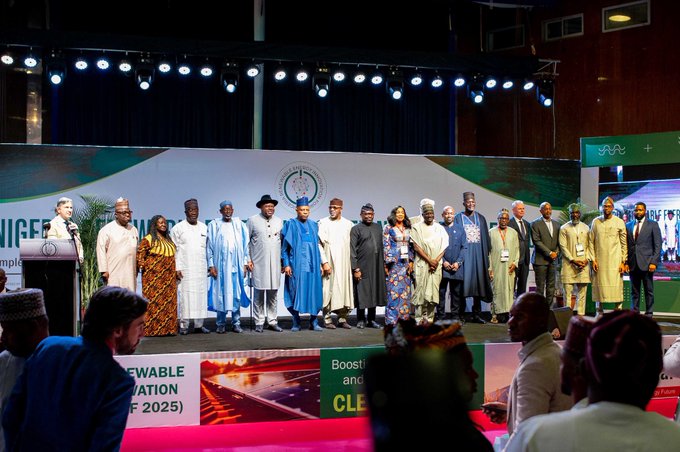
Chief Adelabu spoke on Tuesday at the inaugural Nigerian Renewable Energy Innovation Forum (NREIF) 2025, organised by the Rural Electrification Agency (REA) at the Transcorp Hilton, Abuja.
The Minister also disclosed that through the strategic partnerships and investment deals being signed at the Forum, the country is bringing on stream nearly 4 gigawatts per annum of solar manufacturing capacity — equivalent to almost 80 percent of the nation’s current national generation capacity.
“This milestone is a powerful testament to the confidence that the private sector has in Nigeria’s policy direction, market fundamentals, and long-term growth trajectory,” he noted.
Adelabu said the NREIF 2025 is not just another event, but a declaration that Nigeria is ready to lead Africa’s renewable energy transformation. Adding that under the leadership of President Bola Tinubu, the Ministry of Power has worked tirelessly to translate ambition into policy and policy into action.
He stated that the REA, Ministry’s implementing partner for the Forum, continues to play a pivotal role — extending electricity to unserved communities, scaling distributed renewable energy, and nurturing the ecosystem that gives confidence to investors and innovators alike.
Together, he said the Ministry and REA are shifting the narrative — from access to industrialization, and from deployment to domestic value creation.
The Minister informed that the Federal Government has approved a N4 trillion debt refinancing plan, to resolve legacy payments owed to generation companies and gas suppliers — a bold step to rebuild trust and unlock new private investment.
“We are deepening payment assurance frameworks, promoting cost-reflective tariffs, and encouraging local and international financiers to invest in our growing project pipeline — from on-grid expansion to distributed renewable solutions,” he said.
Adelabu who stated that the focus should be shifted from the immediate challenges to the monumental scale of opportunities that abound in the sector, noted that with a dynamic and overwhelmingly youthful population of nearly 238 million people, the energy required to fully bridge the nation’s infrastructure gap and unleash their productive potential is vast—far exceeding the 5 GW currently available on the national grid.
He noted that investing in clean energy access and industrial power solutions now is not merely about meeting demand; it is about igniting an exponential economic multiplier effect that will define Nigeria’s prosperity and secure its future.
Earlier in his welcome remarks, the Managing Director of REA, Engr. Abba Aliyu, said Africa holds nearly 60% of the world’s best solar resources, but attracts less than 3% of global renewable energy investment. Therefore, it must convert this immense comparative advantage into competitive strength — by building industries, nurturing innovation, and driving the kind of local value creation that secures its place in the clean energy economy.
As for Nigeria, he said the moment is urgent, noting that the population is projected to exceed 250 million by 2030, with rising urbanization, industrial demand, and digital infrastructure needs — from data centres to electric mobility — all requiring sustainable and reliable energy.
According to him, the nation’s ambitious targets of achieving net-zero by 2060, Delivering 30GW of electricity by 2030, with at least 30% from renewables, And through the Energy Transition Plan (ETP) and Energy Compact, committing to mobilize over $10 billion in clean energy investment this decade, have formed the backdrop against which the NREIF becomes not just timely — but essential, as platform to translate targets into investments, and investments into impact.
The theme for this year, “The Nigeria First Policy”, could not have come at a better time. Saying that “It captures our collective aspiration to domesticate the technologies, industries, and capabilities that will power our energy future.”
Engr. Aliyu said for years, Nigeria has deployed renewable energy systems in thousands of communities, institutions, and industrial clusters. But to secure long-term sustainability and economic competitiveness, it must now go further — to ensure that what it deploys is increasingly designed, assembled, and manufactured in Nigeria.
“At the Rural Electrification Agency, we see this shift as both a necessity and an opportunity. With an active project portfolio and pipeline exceeding $3 billion, spanning programs such as IMAS, REF, NEP, DARES, EEP, and the National Public Sector Solarisation Initiative (NPSSI), REA’s responsibility now extends beyond electrification.
“Our task is to ensure that this pipeline generates the highest possible domestic value — by catalyzing local industries, supporting innovators, and unlocking green jobs across the value chain.
“That is precisely why the NREIF was established — to bring together the entire renewable energy ecosystem: from innovators to financiers, from academia to regulators, from manufacturers to developers — all working together to ensure that Nigeria captures the full value of its energy transition,” he said.