Nigerian Children Advocate Tougher Sanctions To End Violence Against Children
By Alice Etuka, Abuja

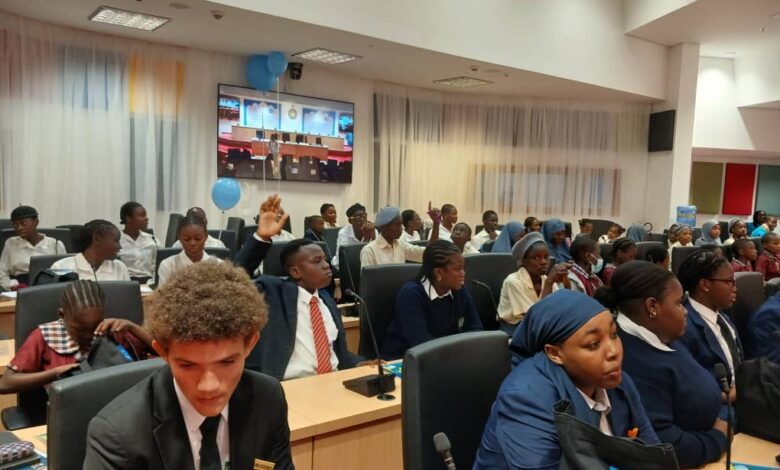

As the global community mark the 2025 World Children’s Day (WCD), children in Nigeria have called for stringent punishment for those who violate the Child Protection Law.

Speaking at the World Children’s Day celebration organised by the United Nations Children’s Fund (UNICEF) in Abuja on Thursday, a student from JSS Bwari, Precious Orasakwe noted that child protection in Nigeria was a complex but urgent challenge requiring coordinated interventions across social, legal, and economic sectors.
Orasakwe stated that, “violence against children is highly prevalent in Nigeria. UNICEF reports that six out of ten Nigerian children experience at least one form of emotional, physical, or sexual violence before turning 18.
“Sexual violence affects one in four girls and roughly 10% of boys, while emotional violence is also widespread. Despite the high incidence, fewer than five percent of affected children ever receive professional help or official support services”, she said.
According to her, “Nigeria’s insecurity significantly undermines child protection. More than 1,600 schoolchildren have been kidnapped by armed groups since 2014, with teachers and school infrastructure often attacked.
“These abductions disrupt schooling, expose children to trauma, and contribute to an atmosphere of fear that reduces school attendance. Economic costs associated with violence are equally alarming, estimated at between USD 6 billion and ₦1.42 trillion annually”.
She further informed that “Boko haram exploitation terror groups recruit children displaced by conflict (e.g chibok girls), over 1,000 schools destroyed in North-east Nigeria since 2014 and also on Monday 17th November, 2025 bandit harmed federal Government college Birni Yauri in Kebbi State abducted unspecified number of students along with five teacher and were a teacher was killed in the incident”.
Furthermore, she said a balanced approach was required to meaningfully address child protection gaps:
“Targeted global sanctions should be applied to perpetrators of trafficking and abductions, while avoiding broad sanctions that harm civilians. Increased international aid should support long-term child protection programs, and systemic reforms must strengthen laws, institutions, and community practices.
“Child protection in Nigeria is a complex but urgent challenge requiring coordinated interventions across social, legal, and economic sectors. Targeted sanctions, international support, and comprehensive reforms are essential to create a safer environment for Nigerian children”, She said.
On his part, the Minister of Budget and Economic Planning, Abubakar Bagudu while speaking about the abducted Kebbi children said the government needs support to protect children from violence:
“The world should be united with one voice to say that nobody can enter a school and take a child. Mr. President has shown that despite successes that we have achieved, we need support.
“Support is not a failure. I need to buy arms from somebody, I need to buy technology from somebody. As we speak, maybe somebody has a drone technology that can show us where those children are, even if it is not a military. So if somebody provides that support, it is not a shame”, he said.
Similarly, UNICEF Nigeria Representative, Ms. Wafaa Saeed, stressed that this moment demands unity of purpose.
“It is time for all of us, government, development partners, donors, the private sector, and communities, to come together and put the Nigerian child at the top of every agenda. They are not just our responsibility, they are our future.
“With nearly half of Nigeria’s population under 18, the choices we make today will define the nation’s future. Every investment in children is an investment in peace, productivity, and progress,” she said.