NiMet, AATF Collaborate To Drive Climate-Resilient Agriculture In Nigeria
By Stella Enenche, Abuja

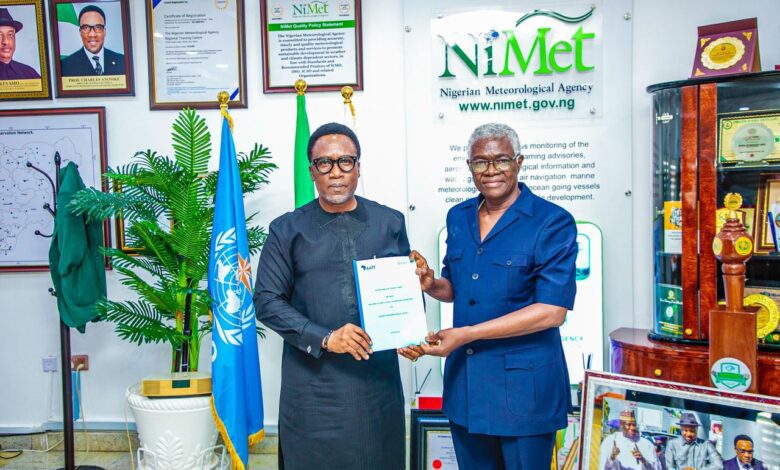

The Nigerian Meteorological Agency (NiMet) and the African Agricultural Technology Foundation (AATF) has disclosed their partnership to drive climate-resilient agriculture across the nation.
NiMet’s Director General, Prof. Charles Anosike disclosed this on Monday during the Memorandum of Understanding(MoU) signing in Abuja.
Specifically, both organizations would work together to develop climate-smart weather tools, build capacity for farmers, and promote technologies that strengthen agricultural value chains against the impacts of climate change.
Anosike, emphasized the importance of the collaboration in supporting farmers with timely and accurate climate information.
“For agriculture to be truly climate-resilient, access to reliable weather and climate information is essential. This MoU enables us to combine our expertise with AATF to deliver impactful solutions to farmers,” he said.
In his remarks, Regional Director of AATF, Dr. Jean Tignegre, highlighted the foundation’s mission to remove barriers that hinder smallholder farmers in sub-Saharan Africa from accessing transformative agricultural technologies.
He added that this partnership with NiMet is an important step in ensuring that farmers in Nigeria are better equipped to face climate challenges, noting that collaborations like this can scale innovations that will improve food security and livelihoods.
The MoU establishes both parties’ collaboration in key areas including the development of climate-smart weather support tools for women- and youth-led micro, small, and medium-sized enterprises (MSMEs) in agriculture, capacity building on climate-smart agricultural tools, provision of technical support in agreed project locations, and the joint development of funding proposals for climate-smart technologies in Nigeria.
The agreement, which runs until January 31, 2028, sets out frameworks for transparent project implementation and joint planning, while ensuring both organizations retain their mandates to enhance farmers’ resilience to climate change, strengthen Nigeria’s agricultural value chains, and contribute to sustainable food security nationwide.