

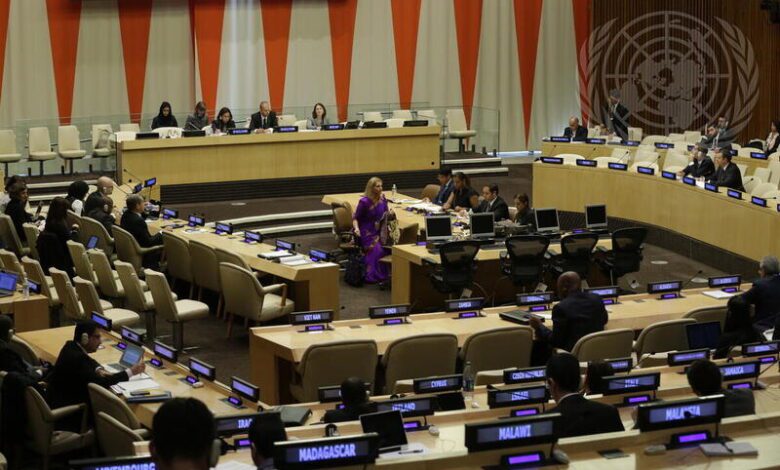

Twenty years after the establishment of the World Summit ofInformation Society (WSIS), nothing significant has changed.

“WSIS was born from a shared belief that digitalinnovation must reflect human needs, not just match the pace of technologicalchange,” according to International Telecommunications Union (ITU)Secretary-General Doreen Bogdan-Martin. “As artificial intelligence acceleratesour transition from an Information Society to an Intelligent Society, WSIShelps keep our focus where it should be – on people-centred, inclusive digitaldevelopment.
“On December 16 to 17,2025, WSIS held the DigitalConference in collaboration with the United Nations General Assembly (UNGA)specifically to review how far the society had fared in 20 years.
“Twenty years ago, leaders from all sectors came togetherand determined to chart a path where digital technologies could supportsustainable development and prosperity,”said Haoliang Xu, UNDP AssociateAdministrator.
“Today is about both celebrating progress and charting a pathforward. At UNDP, we are convinced of the power of technologies for accelerating development and serving people and the planet.
“But at the Digital UNGA, short of passing a vote of no confidence, participants kept mute on the realities on ground.
Although significant progress has been made, there are billions of unconnected persons across unserved and underserved communities.
The disparities have led to the establishment of the United Nations Sustainable Development Goals where it is envisaged that the 2.6billion unconnected population will be connected by 2030.
Formed from summits in 2003 in Geneva, Switzerland, and 2005 in Tunis, Tunisia, the WSIS process has focused the public and private sectors on people-centred and sustainable digital development aimed at ensuring that the benefits of technologies reach everyone.
To set the stage for the General Assembly review, the Digital@UNGA WSIS+20 Edition examined the impact of emerging technologies, governance and digital public infrastructure on building information and knowledge-based societies.
Laudable as the plans may have been, WSIS is Work inProgress.
The special Digital@UNGA event highlighted public-private cooperation to connect some of the world’s hardest-to-reach communities, withthe Partner2Connect (P2C) Digital Coalition’s yearly Meeting for 2025 that tookplace as part of the event.
During the event, new P2C commitments were announced thatreflect growing multistakeholder engagement to accelerate global progress onconnectivity.
Partner2Connect – the ITU-led pledging platform dedicated to mobilizing resources, partnerships, and commitments to achieve universal meaningful connectivity and sustainable digital transformation – is anaction-oriented mechanism that can connect communities and spur digital progress, following the original WSIS vision.
Partner2Connect pledges are categorized under WSIS ActionLines – a set of 11 priority areas for UN efforts to leverage fast-evolvingtechnologies for human development.
To date, over USD 80 billion has been mobilized as part ofthe goal to reach USD 100 billion in 2026.
Digital@UNGA was a joint initiative of ITU and UNDP to explore how digital technologies can drive progress for people and prosperity everywhere. The organizers are thankful to Digital@UNGA Lead Supporters and P2CChampions for supporting the Digital@UNGA: WSIS+20 Edition.
Apart from ITU and the UNDP,the event brought togetherrepresentatives of government, industry, civil society, academia, thetechnology community and the UN system, serving as a bridge to the WSIS+20review.
“WSIS was born from a shared belief that digitalinnovation must reflect human needs, not just match the pace of technological change,” said ITU Secretary-General, Doreen Bogdan-Martin. “As artificial intelligence accelerates our transition from an Information Society to anIntelligent Society, WSIS helps keep our focus where it should be – onpeople-centred, inclusive digital development.”
Two decades after the World Summit on the InformationSociety (WSIS) created an international dialogue for the digital age, theglobal digital community voiced support at a special event at UN headquarters for the WSIS process as the framework to guide digital cooperation.
Participants at the Digital@UNGA WSIS+20 Edition lookedback at 20 years of multi-stakeholder cooperation, welcomed new commitments, and discussed a common vision for the digital future in advance of the UNGeneral Assembly’s WSIS+20 Overall Review.
WSIS ‘major milestone was to review progress, reimagine the future information society, and align with new frameworks like the Global Digital Compact (GDC).
The Geneva Plan of Action and Tunis Agenda provide core principles for inclusive digital societies, forming the basis for global digital policy.
In terms of a multi stakeholders’ platform, the yearly WSISForum serves as a unique global platform for governments, civil society,private sector, and technical communities to collaborate and exchange ideas.
This dovetails into the WSIS Action Lines.
These 11 lines provide a roadmap for using ICTs fordevelopment, covering infrastructure, access, capacity building, security, and specific applications including e-gov, e-health, among others.
A database documents thousands of successful ICT projects,and the yearly WSIS Prizes recognize innovative solutions, promoting replicablebest practices.
A digital Cooperation is Fostered for the creation of the Internet Governance Forum (IGF) and strengthened UN agency collaboration (UNGIS) for coordinated digital development.
SDG Alignment.
WSIS efforts have successfully integrated with and accelerated the achievement of Sustainable Development Goals through digital transformation initiatives.
Despite the seemingly slow pace of the implementation ofWSIS, Smartphones account for about 87% of mobile phones in use, with around7.4 billion in circulation.
They account for ubiquitous ownership where mobile phones are widespread, with over three-quarters of people aged 10+ owning one according to ITU, 2023 reports.
Eighty four percent of adults in developing nations own amobile phone, but basic phones are more common in regions like Sub-Saharan Africa.
Women and low-income adults are less likely to own phones,with gaps more pronounced in smartphone ownership than basic devices.
Mobile data usage is immense, with video traffic alone requiring storage equivalent to billions of DVDs monthly.
Mobile technologies contribute significantly to the global economy, expected to add nearly $11 trillion by 2030.