

The National Pension Commission (PenCom) hasstrengthened collaboration with the Civil Society Organisations (CSOs) todeepen pension reforms in the country.

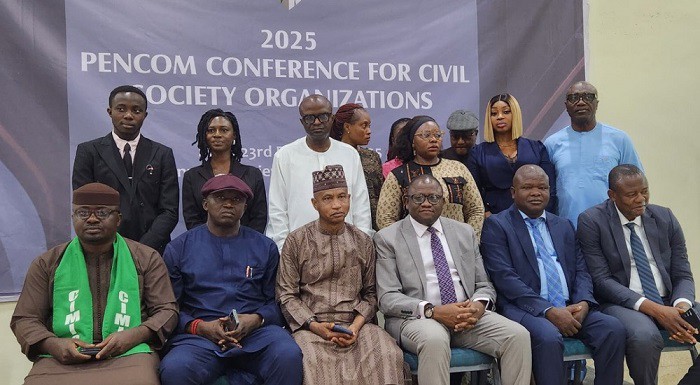
This strategic collaboration was reinforced atthe 2025 Conference for the Civil Society Groups on Tuesday in Abuja.
Speaking at the Conference, the PenCom DG, MsOmolala Oloworaran, underscored the need for partnership with the CSOs to builda pension system that is inclusive, resilient, transparent, and trusted byevery Nigerian.
“Distinguished members of Civil Society, yourrole in this journey is indispensable. You are trusted voices in communities.You understand informal work realities. You advocate for inclusion, fairness,and accountability. “We see Civil Society Organisations aspartners in awareness creation, advocates for pension inclusion amongvulnerable groups, and watchdogs that strengthen trust and transparency.
“Together, we must help Nigerians understandthat pension is not a tax, not a donation, and not a privilege—but a right anda tool for dignity in old age,” she noted.
The DG, who was represented by the Head of Corporate Communications, PenCom, Mr Ibrahim Buwai, explained the Commission formallylaunched Pension Revolution 2.0, the most comprehensive reform agenda in thepension industry since 2004. Noting that this was not cosmetic reform, butstructural—combining new regulations, stronger supervision, governance reforms,digital transformation, and industry realignment to future-proof the pensionsystem and position it as a pillar of national stability and long-termdevelopment.
Ms Oloworaran submitted that one of the mosthistoric milestones of the year was the Presidential approval and disbursementof ₦758 billion to settle outstanding pension liabilities. “This unprecedented intervention sent a clearand powerful message: Nigeria honours its promises to its workers and retirees.
“We also cleared long-standing pensionincrease backlogs for Federal Government treasury-funded retirees, some datingback to 2007. What many believed would never be paid has now been paid.“In addition, zero waiting time for thepayment of accrued pension rights was restored with effect from July 2025.Retirees now receive their benefits when due—not months or years later,” sheadded.
The DG mentioned that to further enhancebenefit adequacy, the Commission introduced Pension Boost 1.0, which hasalready added ₦2.68 billion to monthly pension payments for ContributaryPension Scheme (CPS) retirees.
“These are not just numbers. They representmeals on tables, medicines purchased, and dignity preserved,” she noted.
She said as the Commission moves into the nextphase of Pension Revolution 2.0, its focus remains clear: expand coverage,deepen trust, improve investment outcomes, strengthen supervision, and protectretirees.
On governance, she affirmed that the Commission raised capital requirements for pension operators, which was by nomeans a punitive measure, but a forward-thinking policy. Stating that a strongercapital means stronger institutions, better risk management, and higher professional standards.
“We equally strengthened governance rules toeliminate shadow directorships. Let me be clear: pensions cannot be managedfrom the shadows. Transparency, integrity, and fit-and-proper leadership arenon-negotiable in a system entrusted with Nigerians’ life savings,” she added.
Oloworaran reiterated that one of the mostdefining reforms of the past year was the restructuring and rebranding of the Micro Pension Plan into the Personal Pension Plan (PPP).
This reform, according to her, was aboutmeeting Nigerians where they are—artisans, traders, gig workers, creatives,farmers, transport workers, and millions in the informal economy who work hardbut face uncertainty in old age.
She explained that the Personal Pension Planprovides a simple, flexible, and inclusive framework for self-employed personsand professionals; informal sector workers, and formal sector employees whowish to make additional voluntary contributions.
She mentioned that one of the significantchanges under the PPP was the introduction of Accredited Pension Agents (APAs). Explaining that these agents are to market and onboard participants on behalfof PFAs that engage them.
“The APAs are not merely distributionchannels, they are also an employment strategy. It is expected that thousandsof young Nigerians will be trained, certified, and deployed as pensionprofessionals—earning livelihoods while expanding pension coverage, especiallyin rural and underserved communities. This is financial inclusion with impact.Inclusion that creates jobs.
“Participation in the PPP is deliberately madeeasy and accessible. Any Nigerian aged 18 years and above can participate usingmainly their National Identification Number (NIN), a valid phone number, and abank account,” she added.