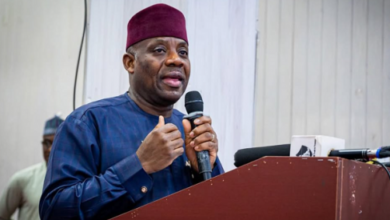
Proposed Armed Forces College Of Medicine To Bridge Manpower Deficit -Minister
By Alice Etuka, Abuja



The Minister of Education, Dr. Tunji Alausa said while the nation’s population exceeds 240 million, only 189 medical professionals currently serve within the Defence Forces.

Director Press and Public Relations, Federal Ministry of Education, Boriowo Folasade disclosed this in a statement on Friday.
Boriowo hinted that in view of this deficit, the Federal Government had advanced plans for the establishment of the Armed Forces College of Medicine & Health Sciences (AFCOM&HS).
She explained that the institution was a strategic national intervention to strengthen military healthcare services, address critical manpower shortages within the Armed Forces, and expand Nigeria’s overall medical training capacity.
The initiative was progressed at a high-level meeting convened by the Minister of Education, Dr. Tunji Alausa, and the Minister of State for Education, Prof. Suwaiba Ahmed, with the Minister of Defence, Christopher Musa, the Minister of State for Defence, Dr. Bello Matawalle, the Director-General of the Ministry of Defence Health Implementation Programme (MODHIP), the leadership of the Nigerian Defence Academy, and key stakeholders across the education, defence and health sectors.
In line with the NESRI 6-Point Agenda, particularly the focus on strengthening STEMM, the Minister emphasised that the proposed College represents a deliberate effort to build a structured and sustainable pipeline of combat casualty-trained doctors, surgeons, trauma specialists, emergency response medics, military public health professionals, disaster and humanitarian response professionals, and allied health professionals.
Dr. Alausa noted that while the nation’s population exceeds 240 million, only 189 medical professionals currently serve within the Defence Forces. He further highlighted Nigeria’s broader deficit of approximately 340,000 doctors, stressing the urgent need for scalable and innovative training models.
As part of ongoing reforms, the Federal Ministry of Education has doubled annual medical school admissions from about 5,000 to nearly 10,000, with projections to increase to approximately 19,000 annually in the coming years. AFCOM&HS forms a critical component of this expansion strategy.
In compliance with the Federal Government’s seven-year moratorium on new tertiary institutions and in line with the directive of President Bola Tinubu, the Nigerian Defence Academy will establish the College within its existing university framework. The institution will be linked to accredited federal and military hospitals to guarantee strong clinical training partnerships.
Clinical training will be anchored at designated military medical facilities, each structured to accommodate substantial student cohorts while maintaining quality and accreditation standards.
Medical Cadets will gain admission to the College through the Joint Admissions and Matriculation Board and, at the completion of the programme, will be commissioned as Captains, equipped with world-class medical expertise and the discipline, leadership and operational readiness required for military service.
The structure is designed to enhance retention, reduce attrition and ensure a steady pipeline of commissioned medical officers within the Armed Forces.
Representing the Minister of Defence, senior defence officials underscored the importance of institutional alignment, adherence to governance frameworks and the integration of global best practices to ensure long-term sustainability and uniform standards.
To guarantee full regulatory compliance and quality assurance, a Technical Working Group has been constituted comprising the
Federal Ministry of Education, Ministry of Defence, Nigerian Defence Academy, Director-General of MODHIP, the Medical and Dental Council of Nigeria, the Pharmacists Council of Nigeria, the Nursing and Midwifery Council of Nigeria, the National Universities Commission, the Joint Admissions and Matriculation Board, the Chairman of the Committee of Provosts of Medical Schools, and representatives of the Armed Forces. The objective is to ensure that all necessary processes are in place for admissions to commence by October/November 2026.
The establishment of the Armed Forces College of Medicine & Health Sciences represents a strategic investment in Nigeria’s health security, medical workforce development and the welfare of defence personnel. It will further position Nigeria as a regional hub for military medical training in West Africa.
The Federal Ministry of Education therefore, reaffirmed its commitment to working closely with defence and regulatory partners to deliver this critical initiative in strict compliance with national standards and global best practices.