
Even with the current 5,000 megawatts of power being supplied to Nigerians, the Minister of Power, Chief Adebayo Adelabu, has again assured of President Bola Tinubu’s determination to ensure that citizens enjoy full and uninterrupted electricity supply before he leaves office.

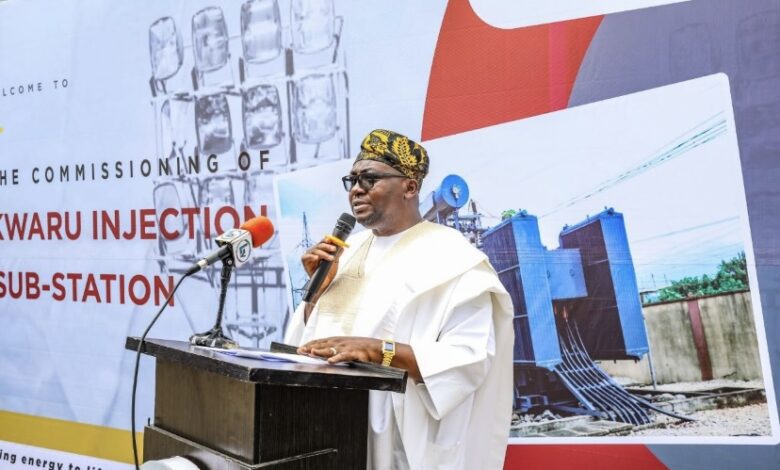
Chief Adelabu who gave the assurance at the weekend during the commissioning of the Kwaru 1X15 MVA 33/11KV Injection Substation in the Ikotun-Egbe, Lagos, said the President would continue to implement measures aimed at improving power generation, transmission, and distribution across the country.
The Minister, in a statement late on Sunday by his Special Adviser on Media and Strategic Communications, Tunji Bolaji, said “The present administration in Nigeria, led by His Excellency, Mr. Bola Ahmed Tinubu, with the Renewed Hope Agenda, recognizes that energy is not merely a commodity; it is the backbone of economic growth and job creation.”
He further explained that “to ensure the growth and sustainability of the sector, the Federal Government of Nigeria continues to implement a multi-pronged approach, which has yielded some remarkable achievements.”
Beyond improving electricity supply to communities such as Abaranje, Isijola, Igando Road, Omoboriowo, Okerube, and surrounding areas, Adelabu emphasized that the project would have far-reaching benefits for Lagos State’s economy.
“This initiative will reduce operational challenges caused by power shortages, provide direct support to small and medium-sized enterprises (SMEs), stimulate economic growth, and create new job opportunities,” he said.
The Minister highlighted key achievements under the Renewed Hope Agenda, including “the decentralization and liberalization of the power sector through the Electricity Act 2023, which has activated twelve state electricity markets and led to the development of a National Integrated Electricity Policy after 24 years.”
He also noted, “the attraction of over $2 billion in fresh investments to expand electricity access,” as well as “the transition towards full commercialization, which increased the sector’s revenue by 70 percent in 2024.”
Other milestones, according to Adelabu, include “an increase in Nigeria’s installed generation capacity from 13GW to 14GW, with an all-time peak of 5,801.44 MW and a maximum daily energy record of 128,370.75 MWh on March 4, 2025.”
He also mentioned, “the stabilization of the national grid through the Siemens Project, adding over 700 MW of transmission capacity,” and “the successful mobilization of ₦700 billion from FAAC for the Presidential Metering Initiative, alongside a $500 million World Bank DISREP fund, which will add 3.45 million meters to the sector.”
However, Adelabu acknowledged ongoing challenges, particularly in distribution, where “loss levels exceed regulatory limits, market remittances fall short, and customer complaints about service disruptions persist. Under my leadership, the Federal Ministry of Power remains fully committed to working with Distribution Companies (DisCos) to address these issues and ensure energy security nationwide,” he assured.
The Minister commendedIkeja Electric for completing the substation project within 12 months, praising their “diligence, proper planning, stakeholder engagement, and technical expertise. Ikeja Electric is one of the top-performing DisCosin Nigeria. We recognize their efforts and urge even greater strides in expanding access and improving service quality,” he said.
“The Federal Ministry of Power remains committed to supporting initiatives that enhance energy reliability and affordability for all customers”, he said.