UN Summit: Nigeria, Others Urge Collective Action To Tackle Food Insecurity
By Sunday Etuka, Abuja



Nigeria and other African nations, as well as the United Nations (UN), have underscored the need for collective action to address food insecurity both on the continent and globally.

They submitted that Africa needs predictable concession finance to invest in agriculture, rural transformation, infrastructure and literacy, while climate finance must be aligned with the food system.
Speaking alongside other African leaders on Monday at the opening session of the United Nations Food Systems Summit Stocktake (UNFSS+4) in Addis Ababa, the capital of Ethiopia, the Nigerian Vice President, Senator Kashim Shettima, said Nigeria is scaling its agricultural drive with modern technology such as Artificial Intelligence (AI), geospatial analytics and satellite-driven climate intelligence to end food insecurity in the country.
Senator Shettima, who stated that the target was to ensure a future that is anchored in abundance, equity, and human dignity, said that food insecurity has now become a shared affliction that is no longer taking cover in distant lands, therefore, African nations must learn to swim against the tide, amid climate change and other global challenges.
“The Fourth Industrial Revolution has not only disrupted the old order but gifted us instruments that were once confined to the imagination. Artificial intelligence, geospatial analytics, and satellite-driven climate intelligence are now part of our agricultural vocabulary.
“We are deploying these tools to monitor production, enhance transparency, connect producers to markets, and reduce waste across the value chain,” Shettima declared.
The VP, in a statement by the Senior Special Assistant to The President on Media & Communications, Office of The Vice President, Stanley Nkwocha, urged participants at the summit to leave the event with a conviction that Africa will succeed, even as he urged African nations to rise with a shared purpose and determination to make the continent food secure.
“A broken food system in any part of the world diminishes the dignity of humanity as a whole. Let us rise with a shared purpose. Let us build a world where no child sleeps on an empty stomach, where no farmer is forgotten, and where food is not a luxury but a human right,” he stated.
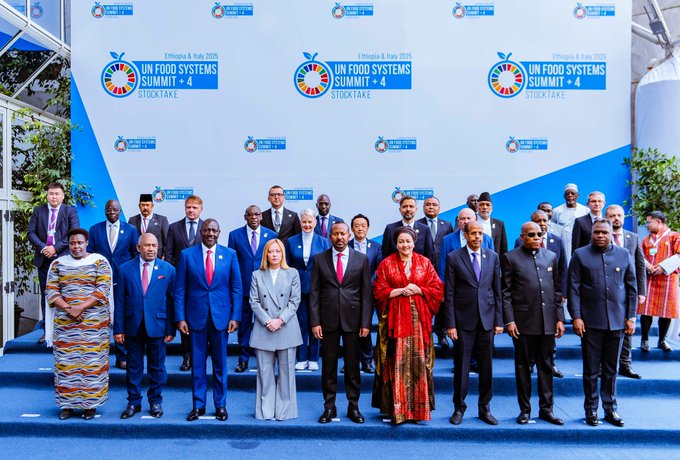
Senator Shettima noted that Nigeria has also pursued institutional reforms robustly, including deepening partnerships across sectors and prioritising agro-industrialisation as a key driver of inclusive growth.
This, he explained, followed the unveiling of the nation’s National Food Systems Transformation Pathway, leading to the rollout of targeted investments in infrastructure and human capacity.
Stating that the declaration of a national emergency on food security in Nigeria did not just amount to raising the alarm, the VP said, “It’s the reason we are advancing the Presidential Initiative on Food Security, a mission designed to upscale the cultivation of vital staples- maize, rice, cassava, and wheat.
“We are backing this with climate-smart innovations, financial inclusion for smallholder farmers, and an expansion of extension services, particularly for women and youth,” he maintained.
The Nigerian Vice President outlined other investments in agriculture to include the Special Agro-Industrial Processing Zones, just as he pointed out that the zones being developed in partnership with the African Development Bank and IFAD are not just places of production but also engines of transformation.
“They are creating jobs, attracting private capital, and linking rural producers to national and global markets. Our faith in the capacity of our people remains unshaken. But production is not enough. We believe that a sustainable food system must also be a healthy one,” he added.
Senator Shettima extended what he described as the warmest gratitude of President Bola Ahmed Tinubu and the people of Nigeria to the host countries, Ethiopia and Italy, assuring that, apart from just listening and learning, Nigeria is fully ready to lead in areas where leadership is
Also speaking, the Prime Minister of Ethiopia, Dr Abiy Ahmed, described the summit as a moment to take stock and to renew a shared commitment to building food systems that are resilient and inclusive.
On his part, the Secretary-General of the United Nations, António Guterres, who spoke through a recorded videocast, noted that food systems are about more than food, saying they include climate, justice and the right to a better future.
Others who spoke are the Prime Minister of Italy, Giorgia Meloni, and the Kenyan President, William Ruto, among other heads of state and representatives from multilateral organisations.