

In line with efforts to improve Nigeria’s healthcare system, making it less dependent on donor funding, the World Health Organization (WHO) has urged the country to pay attention to social accountability.
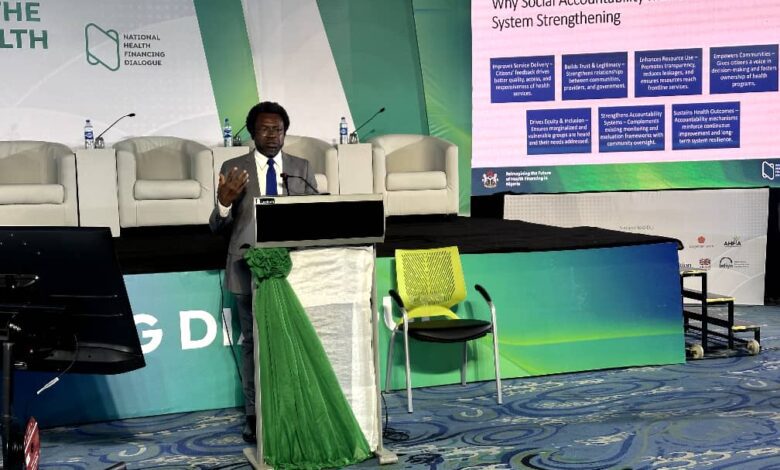
The Technical Officer on Health Financing at the World Health Organization (WHO) Nigeria, Dr. Francis Ukwuije who gave the nudge at the National Dialogue on Health Financing held in Abuja on Monday noted that social accountability improves service delivery through citizens’ feedback.
In his presentation titled, Strengthening Community Accountability: Linking CSOs, Communities and Local Governments, Dr. Ukwuije highlighted countries like Rwanda, Ethiopia, India and others who used social accountability tools to drive the desired change in their healthcare system.
According to him, “social accountability builds trust and legitimacy between the various institutions that are in health, especially linking government to communities. It enhances resource mobilization and its use, which is actually the fulcrum of the conversation we are having this week.
“It empowers communities to take decisions, but not just to take decisions about uptake of healthcare, but to be able to provide appropriate feedback in terms of what can be done differently. It drives equity and inclusion, especially among marginalized communities and strengthens accountability systems and finally sustains outcomes”.
He informed that the scorecard, one of the social accountability tools was used to strengthen the relationship between service providers like schools, health facilities, local governments, and others with the communities that they serve.
“So, we would like to ensure that we take into cognizance the context where these will be deployed and ensure that when we are designing, adapting, adopting them, and utilizing them, we take into consideration capacities and the funding that will be needed to implement them in the various communities or the context where we want to use them.
“There are some good reasons we would like to implement communities in Scorecards, and indeed, these are being done. Number one, Nigeria needs to accelerate Universal Health Coverage.
“We need to amplify the voices of communities and ensure that they are empowered enough to realize and recognize that their participation matters”, he said.
Earlier, the Minister of Health and Social Welfare, Prof. Muhammad Pate lamented that the country’s health sector had been underfunded and donor dependent for too long:
“For decades, our health sector has been underfunded. Families bear nearly 70% of healthcare costs out-of-pocket. We cannot continue to build a healthcare system on someone else’s taxpayer resources. We must mobilize our own funds, invest more, and make every naira count. Good healthcare anywhere in the world is not cheap, it must be paid for”, he said.
The four-day dialogue, he said, would feature diverse voices, civil society, policymakers, development partners, and media, and culminate in a Call to Action with clear financing commitments.
According to the Minister, “our goal is simple, we want a health system that works for all, protects the poorest, and positions Nigeria for sustainable prosperity.”
He therefore called for shared responsibility and challenged states to match federal investments. He also encouraged private innovation, and tasked civil society on advocacy and accountability.
On his part, the Director General, National Health Insurance Authority (NHIA) and Chair of the Health Financing Technical Working Group, Dr. Kelechi Ohiri said the theme, “Reimagining the Future of Health Financing in Nigeria,” was a declaration of a bold and necessary call to action at a time that many countries have become vulnerable to the impact of global funding upheavals.
He continued, “it is an acknowledgment that the traditional models of financing our health system are no longer sufficient to meet the challenges and opportunities of the 21st century.
“It is my hope that this policy dialogue will leapfrog a nationally supported reform agenda, focusing on increased domestic health financing, exploring innovative mechanisms, and optimizing resources and ensuring transparency”.