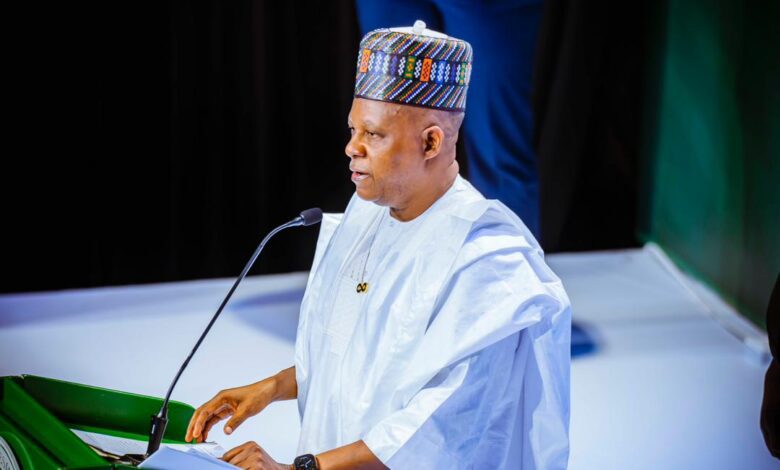


President Bola Tinubu has disclode that the ₦200 billion intervention fund to support Micro, Small, and Medium Enterprises (MSMEs) and manufacturers, was set aside to address structural challenges, and boost competitiveness.
The President made this known on Monday while declaring open the 31st Nigerian Economic Summit in Abuja.
He said; “As a people-oriented government, our priority remains restoring hope to the unemployed, the poor, the excluded, and the vulnerable. We have created pathways for young Nigerians to access grants, loans, and equity investments of up to 100,000 dollars to scale their enterprises, innovate, and build sustainable livelihoods.
“We established a ₦200 billion intervention fund to support micro, small, and medium enterprises and manufacturers, helping them overcome structural challenges and enhance competitiveness.
“Our expansion of digital micro-loan access has improved financial inclusion, empowering small businesses and stimulating community-level productivity. These efforts underline our commitment to an economy that works for all Nigerians.”
He stated that beyond the Gross Domestic Product (GDP) growth of 4.23 per cent recorded in September 2025, the economic reforms spearheaded by his administration have started yielding tangible results across sectors, surpassing projections from multilateral agencies and indigenous economic experts.
President Tinubu, who was represented at the summit by the
Vice President, Senator Kashim Shettima noted that all decisions taken by his administration had been “guided by the pursuit of balance between economic logic and public expectation.”
The President, in a statement by the Senior Special Assistant to The President on Media & Communications, Office of The Vice President, Stanley Nkwocha, attributed the significant progress his administration has made so far in stabilising Nigeria’s economy and rescuing public finance to the patience and sacrifices made by Nigerians.
“As experts in the economy, you know more than the average citizen that the stability in our foreign exchange market is not accidental. It reflects deliberate choices guided by the same economic wisdom that gatherings such as this embody.
“Along with subsidy removal, these decisions have rescued our public finances, stabilised the economy, and reassured investors at home and abroad. We owe this progress to the sacrifices of Nigerians, whose patience and understanding have been the bedrock of our endurance. To them, I say: the better days we promised are already within sight,” he stated.
The President acknowledged what he described as a “resounding consensus” that ongoing reforms by his administration have stabilised the nation’s macroeconomic environment, with the economy “expanding to ₦372.8 trillion in 2024, up from ₦309.5 trillion in 2023.”
On why his administration increased monthly federal allocations to states, enabling them to fund critical projects and social interventions, President Tinubu said he came to office “fully aware that the secret to a successful federation lies in empowering each federating unit with the resources and autonomy to pursue development peculiar to its needs.”
Every reform introduced by his administration, the President noted, had been inspired by a “deep reflection and the courage to act in the interest of the nation.”
He thanked the nation’s economic experts and stakeholders in public policy for staying with his administration through turbulent tides, providing insights, offering criticism, and reminding the government that “our collective goal is not comfort in divergence, but progress in convergence.”
The President further assured that the four Tax Reform Acts he recently signed into law “will boost domestic revenue mobilisation, reduce dependence on oil, and simplify compliance.
“These reforms protect low-income earners, ensure fairness in corporate taxation, and strengthen digital innovation in tax administration. By promoting transparency and coordination among all tiers of government, we are laying the foundation for a fairer and more prosperous Nigeria,” the President added.
Declaring the 31st Nigerian Economic Summit open, President Tinubu told participants that he was looking forward to their fruitful deliberations.
Earlier, the Minister of Budget and Economic Planning, Senator Atiku Bagudu, lauded the partnership between his ministry and the NESG, saying it had blossomed for over 30 years, ensuring public and private cooperation for the development of the Nigerian economy.
On his part, Chairman of the NESG, Mr Olaniyi Yusuf, advised relevant stakeholders and authorities to address security as an enabler of reforms, noting that without peace, reforms cannot take root, investors cannot take risks, and Nigerian youths cannot find opportunities for prosperity.