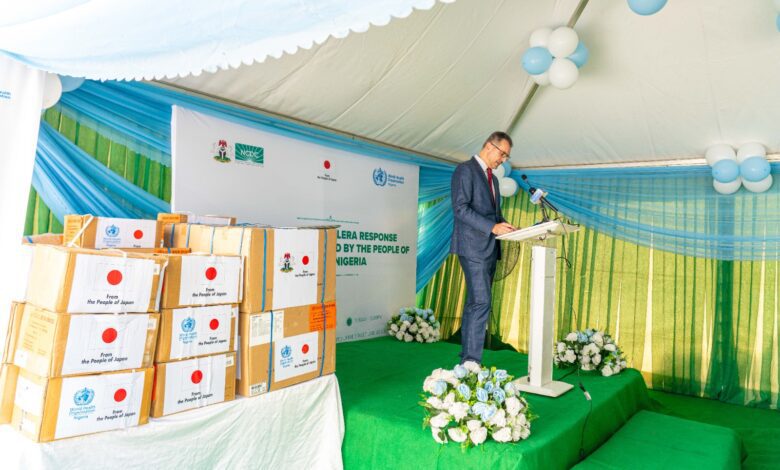


The Federal Government of Nigeria, through the Nigeria Centre for Disease Control and Prevention (NCDC), has received cholera kits delivered by the World Health Organisation (WHO) with funding from a US$500,000 grant from the people of Japan.

WHO announced the development in a statement on Monday.
Nigeria expressed deep gratitude to the people of Japan for their ongoing partnership with the donation of cholera kits, aimed at enhancing cholera preparedness and response efforts nationwide.
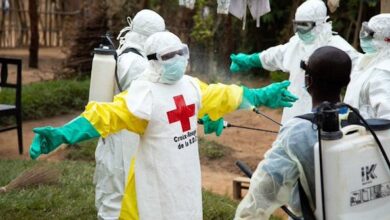
The cholera kits officially handed over to the Government were procured and delivered by the World Health Organisation (WHO) with funding from a US$500,000 grant from the people of Japan. The supplies are now being deployed to high-risk areas and states with ongoing outbreaks to support the timely detection and effective management of cholera cases.
Since the grant was received on 1 March 2025, the support has contributed to significant improvements in Nigeria’s ability to prevent, detect, and respond to cholera outbreaks.
WHO explained that the intervention focuses on three main areas: “Provision of Cholera Kits
To reduce morbidity and mortality due to Cholera: US$104,951 worth of critical cholera response supplies procured, reinforcing case management capacity in anticipation of transmission peaks. Continuity of clinical services ensured through strategic prepositioning of contingency stocks, preventing treatment interruption and saving lives. The final batch has now been officially handed over to the Federal Government.
“Training for Frontline Responders
Delivery of a National Training of Trainers (ToT) on cholera preparedness and response, equipping 176 trainers across all six geopolitical zones to enhance national expertise in key response pillars, namely, coordination, surveillance, laboratory diagnostics, infection prevention and control (IPC), case management, and risk communication.
This knowledge is being cascaded to frontline responders. targeting the 134 Priority Areas for Multisectoral Interventions (PAMIs) Local Government Areas. Across the country.
The TOT was cascaded down in partnership with state ministries of health and NGOs to health workers.
“Enhanced Surveillance and Coordination
The support has strengthened surveillance systems and improved coordination between national and sub-national health authorities, enabling faster outbreak detection and more efficient response actions. Based on the Integrated Disease Surveillance and Response Framework, delivery of community-based surveillance training was conducted in LGAs in 7 high risk cholera states for early case detection and reporting to enable rapid response”.
As of 2 November 2025, Nigeria has recorded over 22,196 suspected cholera cases and 505 associated deaths, a significant number of cases reported year-on-year, keeping the country away from the global objective of eliminating cholera by 2030.
The North-West and North-East regions remain the most affected, highlighting the need for sustained vigilance and preparedness.
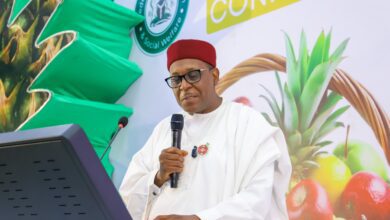
Director General NCDC, Dr Olajide Idris stated: “this support from the Government of Japan through WHO came at a critical time. It has enabled us to strengthen surveillance, improve laboratory diagnosis, and support states in responding more effectively to outbreaks.”
On his part, Ambassador of Japan to Nigeria, Mr Suzuki Hideo said, “Japan is proud to support Nigeria’s efforts to combat cholera and other infectious diseases. Through our partnership with WHO, we are contributing to stronger health systems and progress toward Universal Health Coverage.”
WHO Representative in Nigeria Dr. Pavel Ursu noted, “This partnership is saving lives. The cholera kits and training have enhanced Nigeria’s readiness to respond to outbreaks. WHO remains committed to supporting the country in reducing cholera-related deaths to below one per cent.”