

The Federal Government has said it is ramping up efforts to attract climate-focused investments into Nigeria’s marine and blue economy, as part of a broader strategy to drive sustainable growth and infrastructure development.
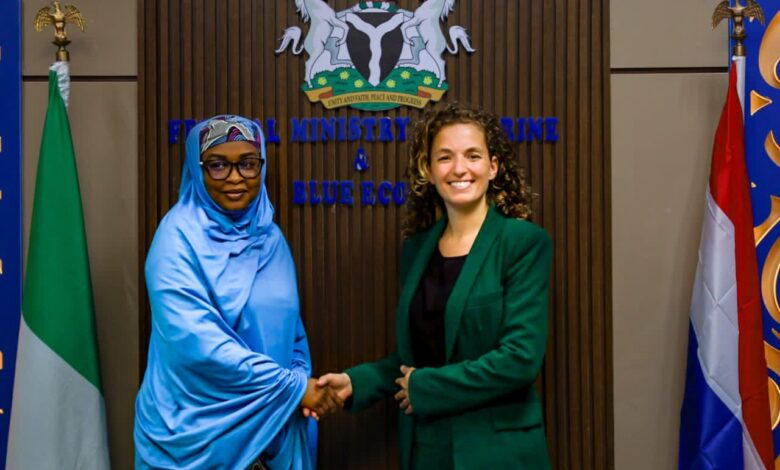
Permanent Secretary, Federal Ministry of Marine and Blue Economy, Mrs. Fatima Mahmood, disclosed this on Tuesday during a meeting with a delegation from Invest International, a development finance institution under the Dutch Ministry of Finance, led by Ms. Fenna Zoe Howkamp.
Mahmood said the government is prioritising environmentally sustainable policies to position Nigeria as a competitive destination for responsible investment in marine resources.
She stressed that integrating climate considerations into sectoral planning is key to reducing environmental risks while unlocking economic opportunities.
Mahmood in a statement by the Director Information and Public Relations, Anastasia Ogbonna , noted that areas such as fisheries, marine infrastructure, and emerging segments like marine mining present strong prospects for growth, provided they are developed in line with global environmental standards.
Highlighting fisheries as a critical component of the blue economy, Mahmood said the subsector holds significant potential for job creation and improved food security, adding that government is focused on scaling investments across the value chain.
She further underscored the need for strategic partnerships to modernise port services and strengthen marine infrastructure, describing collaboration with international financiers as vital to bridging funding gaps.
In her remarks, Howkamp said Invest International is exploring opportunities to support Nigeria’s blue economy through targeted financing and technical expertise.
She outlined proposals covering coastal protection, as well as nature-based solutions for water management and drainage systems.
According to her, the institution offers financing support of up to 35 per cent for large-scale public infrastructure projects valued between €100 million and €150 million, with options for co-financing alongside global institutions or direct funding arrangements.
She emphasised the importance of sustained collaboration to move proposed projects from feasibility stages to implementation, particularly those aimed at protecting coastal communities and strengthening climate resilience.
The engagement signals growing international interest in Nigeria’s blue economy, as the government intensifies efforts to align economic development with environmental sustainability.