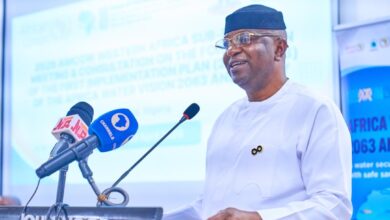
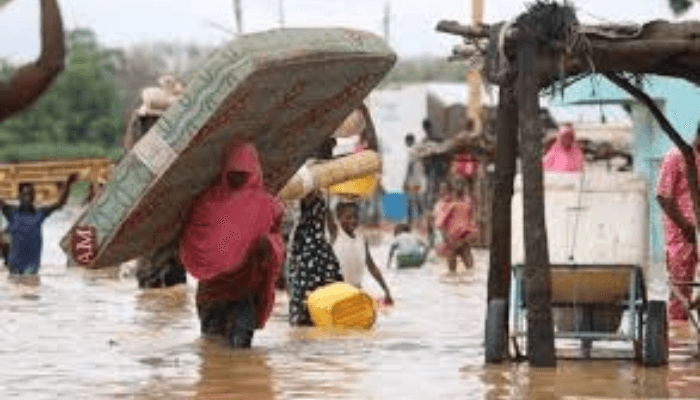


On Wednesday, April 15, 2026, the Federal Government through the Nigeria Hydrological Services Agency (NiHSA), under the Ministry of Water Resources and Sanitation, placed some Communities, Local Government Areas and States on flood Alert.
The flood alert, according to the Federal Government, was necessary to awaken the consciousness of the subnational governments of the need to put in place preventive measures early enough, as the nation begins to experience torrential rains.
Globally, floods are one of the most dangerous natural disasters, causing great destruction, damage, and even deaths. It is a sudden increase or even slow increase in the volume of water in a river or stream bed as the result of heavy rainfall, winds over the water, failure of dams, gages, detention basins, or other structures built to hold back water.
In Nigeria, flooding remains one of the most devastating natural disasters, with climate change, unregulated construction, and poor drainage infrastructure accelerating its frequency and severity.
Data by the National Emergency Management Agency (NEMA) shows that in 2024, over 320 people were killed, 1.3 million affected by floods in 34 states across Nigeria. It also revealed that in 2025, about 459,995 persons were affected in 27 States across 128 Local Government Areas (LGAs) of the country.
To avert the mistakes of the past, the Federal Government through NiHSA presented the 2026 Annual Flood Outlook (AFO) on time to allow for early preparations by subnational governments, who are always worst hit by the devastating floods.
While presenting the Outlook at the State House, Abuja, the Minister of Water Resources and sanitation, Prof. Joseph Utsev, said at least 14,118 communities, 266 Local Government Areas, 33 States and the Federal Capital Territory (FCT) are at high risk of flooding in 2026.
Specifically, he announced that the states with high flood risk include Abia, Adamawa, Anambra, Bauchi, Bayelsa, Benue, Borno, Cross River, Delta, Ebonyi, Edo, Enugu, Gombe, Imo, Jigawa, Kaduna, Kano, Kebbi, Kogi, Kwara, Lagos, Nasarawa, Niger, Ogun, Ondo, Osun, Oyo, Plateau, Rivers, Sokoto, Taraba, Yobe, Zamfara and the FCT.
The outlook also projected a moderate flood risk in 15,597 Communities, 405 LGAs, and 35 States except Ekiti State, while incidences of minimal flood is expected in 923 communities, 77 LGAs and 24 States.
The States are Adamawa, Anambra, Bauchi, Bayelsa, Benue, Borno, Cross River, Delta, Ebonyi, Edo, Jigawa, Kaduna, Kano, Kebbi, Kogi, Nasarawa, Niger, Ogun, Ondo, Osun, Oyo, Sokoto, Taraba and Zamfara.
The Minister explained that flash and urban flooding are projected in major cities in the country due to high rainfall intensities, low attention to management of water facilities including drainage systems, waterways and lack of flood resilience structures.
He said cities such as Abakaliki, Abeokuta, Abuja, Asaba, Benin City, Birnin–Kebbi, Calabar, Ibadan, Kaduna, Kano, Lagos, Makurdi, Nguru, Onitsha, Oshogbo, Port Harcourt, Sokoto, Warri and Yola, among others are to experience these categories of flood incidence.
Prof. Utsev said Bayelsa, Cross River, Delta, Lagos, Ogun, Rivers and Ondo are to experience coastal flooding due to rise in sea level and tidal surge and this, according to him, would impact on fishing, wildlife habitation and river navigation.
He underscored the need for collaboration, by working closely with development partners, research institutions, civil society organizations and the private sector to strengthen innovation, expand investments and build flood resilient Nigeria.
EARLY PREPARATION IS KEY
While the call for collaboration is necessary, strategic planning and implementation of preventive measures are potent to mitigate the impact of flooding in the country. And the time to act is now. The subnational governments must be intentional and work towards effective implementation of the preventive measures.
They must be willing to educate citizens to imbibe attitudinal change towards warnings for flood prevention by Government Agencies and desist from unethical traditional culture and beliefs of predicting rainfalls.
They must be proactive enough to clear blocked drainage systems and canals and relocate people living along the waterways and those that are having socio-economic activities on the flood plains.
States and local governments must desilt river channels and canals and to construct/create buffers or detention basins in their respective constituencies to collect runoff waters.
The Federal Government must encourage the modification of settlements to withstand floods by putting up flood barriers, and construction of dykes, floodwalls, buffer dams, detention basins and water retaining structures.
It must ensure the effective and efficient operational procedure for dams and reservoirs and maintenance of other hydraulic and water infrastructure across the country.
WHAT THE FEDERAL GOVERNMENT IS DOING
In February this year, the Federal Government through the Federal Ministry of Water Resources and Sanitation flagged off a Drainage and Erosion Control Project in Jahun Local Government Area of Jigawa State.
The intervention marks a decisive response to decades of erosion and flooding that have disrupted livelihoods, destroyed farmlands, and threatened lives and property in the community.
The Ministry has also completed Kashimbilla Multipurpose Dam—one of the nation’s flagship projects, together with the Gurara and Dadin Kowa Dams.
Beyond these, several other projects are advancing strongly. For instance, the Mangu Dam in Plateau State has reached 90 per cent completion; Adada Dam in Enugu State stands at 78 per cent; Ogbesse Multipurpose Dam in Ekiti State has achieved 65 per cent; and the Farin Ruwa Dam in Nasarawa State continues to record steady progress.
The Ministry is working on Alau Dam in Borno State, which is enhancing flood control and securing potable water for the people of Maiduguri.
It has also completed or advanced several smaller dams including Irawo Earth Dam in Oyo, Otukpo Multipurpose Dam in Benue, Amla Otukpo Dam, Alajue Dam, and rehabilitation works on Tiga, Challawa Gorge, and Ruwan Kanya Reservoirs.
Apart from the ongoing construction of dams and dykes across the country, the Federal Government is championing Anticipatory Action for flood and other related disaster management with relevant stakeholders in the disaster risk sector in the country.
Experts said flood management must be approached with all the seriousness it deserves, beginning with adequate preparations. And the time to do that is now.