
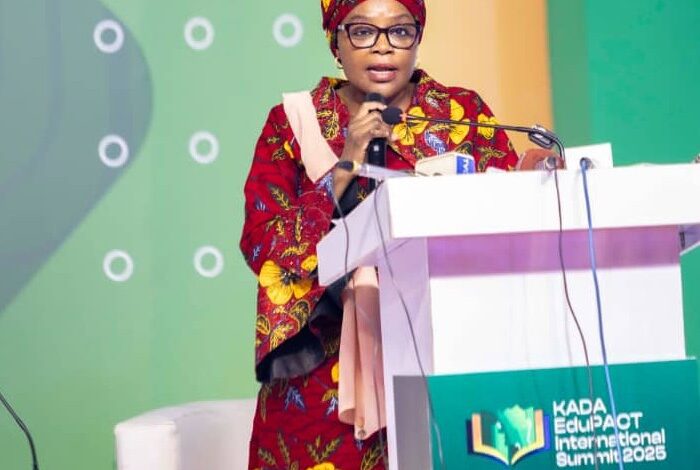


New reforms in the Universal Basic Education Commission (UBEC) has benefited over 8.7 million learners and more than 244,000 teachers.

Executive Secretary of UBEC, Dr. Aisha Garba announced this at the 29th Quarterly Meeting of UBEC Management with the Executive Chairmen of State Universal Basic Education Boards (SUBEBs) held in Abuja on Tuesday.
Garba stated that the Commission entered a decisive phase in the evolution of the Universal Basic Education programme over the past year.
“Throughout 2025. our focus shifted from diagnosing systemic challenges to implementing coordinated, large-scale reforms under the 2025-2031 Strategic Blueprint”, she said.
The UBEC Boss explained that this transition reflected their renewed role, not only as a funding institution but also as a systems enabler, driving alignment, strengthening delivery, and ensuring that impact was felt across all states.
“The results of this collective effort are already evident. Over 8.7 million learners have benefited from improved learning conditions and instructional materials. while more than 244,000 teachers have been equipped with skills in inclusive pedagogy and digital literacy.
“These gains represent meaningful progress towards improving learning outcomes across the basic education system”, she said.
According to Garba, “our efforts have also been reinforced by stronger coordination and more strategic use of data. Through sustained, data-driven advocacy, we unlocked over 100 billion in previously unaccessed matching grants, with 30 states and the FCT now actively drawing down on basic education funds.
“We have adapted to the evolving needs of States’ basic education. I’m pleased to announce that the revised Matching Grants Guidelines are now finalised, streamlined, transparent, and fit for purpose, strengthening our commitment to ensure every Nigerian child reaches their full academic potential.
“In parallel, procurement performance improved significantly, with a 95% completion rate for 2024 projects, enabling more timely and efficient delivery of interventions at scale”.
She added that digitisation had remained central to their reform agenda. “Through the Digitalisation of Public Schools Initiative, in collaboration with the Federal Ministry of Education and the Leadership of The Honorable Minister, we have expanded access to digital learning platforms, strengthened teacher capacity in digital pedagogy, and enhanced classroom delivery through interactive content.
“At the systems level, UBEC has continued to strengthen its role as a sector data hub through improvements to the NEDI platform and the development of the Basic Education Management Information System (BEMIS), supporting planning, monitoring, and performance tracking across states”, she said.
Furthermore, the Commission also leveraged the Matching Grant as a funding mechanism for this ambition, through the revision of the utilisation formula. While infrastructure accounts for 75 percent of the funds, we expanded the remaining 25 percent to include dedicated provisions for ICT and teacher training, as well as planning and Education Management Information Systems (EMIS).
“The theme of this meeting. ‘Accelerating Basic Education Performance Through Digitally Enabled Coordination’, speaks directly to this next phase of our refarm journey. Digitisation is not only transforming classroom delivery, it is a critical enabler for strengthening coordination, improving efficiency, and ensuring that decisions are guided by timely and reliable data.
“This meeting therefore provides an opportunity to examine how digital systems can be more effectively embedded across our planning, monitoring, and implementation processes By doing so we can strengthen collaboration between UBEC and SUBEBS, improve accountability. and ultimately drive better outcomes at the school level”, she said.
The Executive Secretary therefore, urged the participants to approach deliberations with openness, practicality, and a shared commitment to results. “We must move beyond recognising the importance of digital transformation to actively institutionalising it within our day-to-day operations. The effectiveness of our systems and the learning outcomes of our children will depend on the actions we take here”, she concluded.