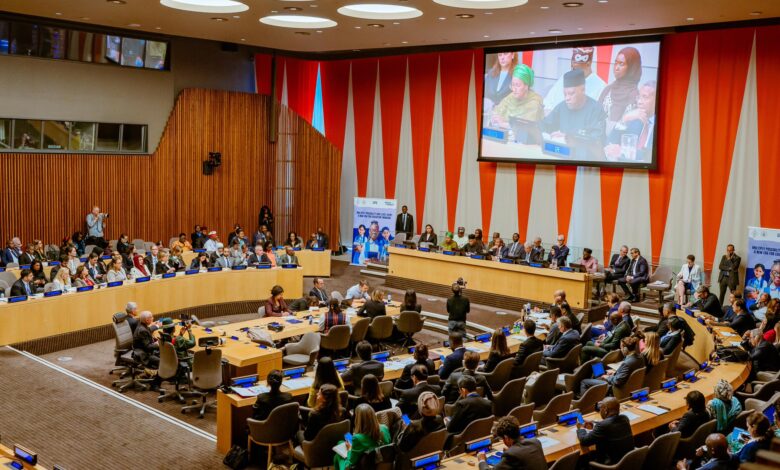
UNGA 81: Nigeria, Italy Deepen Partnership To Raise $5Bn For Global Education Financing
By Sunday Etuka


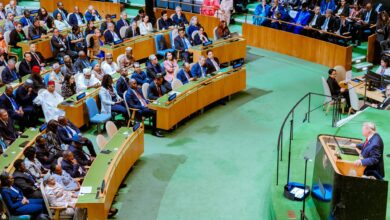
President Bola Tinubu says the vision behind a proposed $5 billion Global Partnership for Education (GPE) financing drive aligns closely with Nigeria’s own push to widen access to schooling and build teacher capacity, as Abuja and Rome deepened cooperation on the campaign at the United Nations General Assembly (UNGA) in New York.

The Nigerian leader made the remarks in a video message on Wednesday during the Multiply Possibility high-level event, “A New Era for Education Financing,” held on the sidelines of the 81st UNGA session. He also commended GPE stakeholders for their work accelerating education financing worldwide.
Vice President Kashim Shettima, representing President Tinubu at the gathering, told delegates that education sits at the center of Nigeria’s economic future rather than at the margins of its development agenda. He said it underpins national productivity as well as the prosperity and stability of citizens.
“For Nigeria, education is not an expenditure at the margins of our development agenda. It is an investment in our economic future, national productivity, and the prosperity and stability of our people,” Shettima said, adding that the administration has raised education spending since 2023 while pursuing reforms to strengthen basic education financing, expand foundational learning, and improve access to tertiary and technical education.
The VP, in a statement by his Senior Special Assistant on Media & Communications, Stanley Nkwocha, pointed to the Nigerian Education Loan Fund as a tool widening access to higher education while tying education more closely to skills, employment, and enterprise.
Beyond traditional budget allocations, Shettima said President Tinubu has directed that liquid funds recovered by the Economic and Financial Crimes Commission, once legally cleared and free of litigation, be channeled into the Loan Fund.
The Federal Executive Council has also approved consideration of unclaimed dividends and dormant funds for the same purpose, subject to legal requirements, he said, describing the moves as proof that financing education requires mobilizing every lawful domestic resource available.
Citing Nigeria’s partnerships with the World Bank and GPE through the HOPE-EDU program, Shettima said the initiative is expected to reach roughly 29 million children and 500,000 teachers nationwide.
He said GPE does not replace national investment but multiplies it, with the campaign aiming to mobilize $5 billion globally and unlock further financing for partner countries, while domestic resources remain the anchor.
Nigeria’s growing youth population could become one of its greatest economic assets, Shettima said, but only if young people gain access to quality education, relevant skills, and real opportunities.
He called for smarter multilateralism that leverages scarce international resources into much larger investments, and urged participants to treat the event as more than a fundraiser, framing it instead as a renewed compact for human capital involving national leadership, international partnership, and responsible financing.
Thanking Italy and GPE for joining the conversation, Shettima said Nigeria, as a campaign co-host, is not simply asking the world to invest more in education but demonstrating that it is investing in education itself.
Italian Prime Minister Giorgia Meloni praised President Tinubu’s leadership and Nigeria’s commitment to improving education outcomes in a video presentation, and urged global partners to show stronger commitment to reversing setbacks in developing countries.
UN Deputy Secretary-General Amina Mohammed thanked partners for their interest in improving education financing in developing nations and said the needed change starts with the choices governments make.
She called on international finance institutions to help committed countries find the fiscal space to improve outcomes, including teacher training and motivation.
GPE Board Chair Jakaya Kikwete said accelerating education financing remains urgent given education’s role in advancing human rights, security, and peace, noting that the effort responds to falling development assistance and a widening financing gap.
Girls’ education activist Malala Yousafzai called for greater collaboration on ideas and resources, arguing that global partnerships deliver stronger results than isolated national efforts, and urged multilateral organizations and governments to commit more toward gender equality in education, particularly for girls in developing countries.
Governments and donors at the event pledged support toward the education of at least 370 million children worldwide, with Italy committing 50 million Euros to GPE programs and interventions.