Moghalu Urges USIU-Africa Graduates To Embrace Lifelong Learning Over “Finished” Mindset
By Sunday Etuka


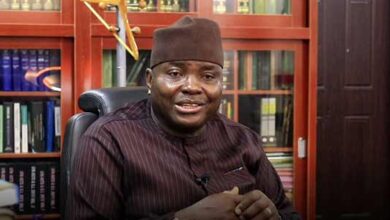
Former Deputy Governor of the Central Bank of Nigeria (CBN), Dr. Kingsley Moghalu, has charged graduating students of the United States International University-Africa (USIU-Africa) to view education as a continuous process rather than a final destination, urging them to see themselves as “perpetual students” rather than finished graduates.

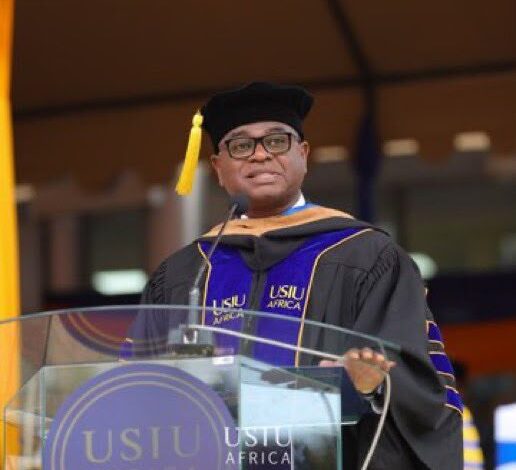
Moghalu, who served as Chief Guest and Commencement Speaker at the university’s 48th Commencement Ceremony held in Nairobi, Kenya, on 26th September 2026, addressed about 1,600 graduating students, challenging the traditional notion of higher education as a “gatekeeper” system where learning ends once a degree is obtained.
In his address, he explained that the world was shifting away from what he described as the “checkpoint” model of education toward a lifelong cycle of curiosity, stressing that the university’s role was never to produce a finished product but to serve as a greenhouse that nurtures growth.
He told the graduates that even as they moved into the world, their development must continue, noting that the most successful people of their generation would not necessarily be those with the highest grades, but those with the highest “learning quotient”—the capacity to unlearn outdated skills and acquire new ones without losing momentum.
Turning to the subject of technology, Moghalu acknowledged widespread anxiety among young people about whether artificial intelligence, automation and algorithms could render their expertise obsolete.
He described this fear as valid but rooted in a misunderstanding of what such tools truly represent, explaining that unlike an oracle that merely provides answers, a tool exists to help people build.
He noted that when used properly, AI enhances rather than replaces student learning.
While acknowledging that AI can optimise supply chains, write functional code and summarise legal documents within seconds, Moghalu maintained that it cannot feel the weight of a moral dilemma, imagine possibilities beyond its training data, or empathise with a grieving patient or a discouraged colleague.
He described technology as “an exoskeleton for the mind,” capable of making people faster and more efficient, but incapable of providing direction or purpose, insisting that individuals remain the architects of their own paths.
The former CBN deputy governor further revealed that his personal commitment to continuous learning had led him back to executive education on several occasions, most recently in the study of AI governance and ethics, noting that while tools continue to evolve, the obligation to keep pace with them remains constant.