
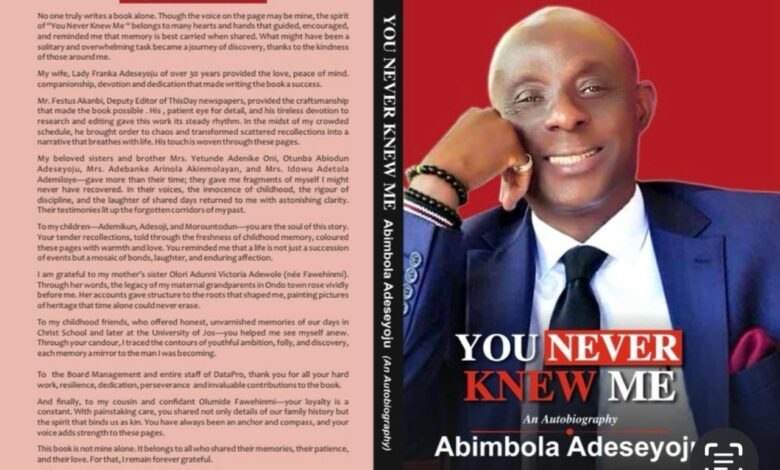


‘You Never Knew Me’, a 215-page Autobiography of Mr. Abimbola Adeseyoju, Managing Director, DataPro, is not only an addition to the existing literature on credit rating, but a recommended companion for those who want to succeed in Life, from bottom to the top.
The writer presented a mental picture of how his destiny was shaped and reshaped through parental guidance and divine intervention, using a blend of scholarly and journalistic skills to codify a thorn-filled journey in a very lucid language and approachable diction.
The ten-chapter autobiography delves deeper into dynamics of life, and how a strong foundation backed by divine providence could redirect a straying man to his destination. It gives a chronological narration of how the vision and idea of DataPro, one of the top data rating agencies in Nigeria was birthed, and the milestones so far achieved.
The First Chapter of the autobiography, with the title, “With My Mother, Parenting is Forever”, shows how the writer enjoyed not only the warmth of his mother, father and his uncle, but quality parenting which shaped his destiny. He said in the book that when the weight of youthful indiscretion and misdirection threatened to overwhelm him in his teens, his uncle stepped in, offering support and a lifeline.
In Chapter Two of the autobiography (The Growing Up Years), the writer thought he could only achieve his destiny with adequate preparation, but that was met with failure. He was enrolled in school with enthusiasm, but that happiness was later cut short. His five-year journey at Christ’s School ended on a disastrous note in 1977. This was despite exhibiting his six Ps mantra, which he so much believed in. It is called “Proper Prior Preparation Prevents Poor Performance.” Unfortunately, despite the six Ps, everything went wrong, his results were withheld by the West African School Examinations Council (WASEC), now West African Examination Council (WAEC) and later released with F9s in 1977.
The writer went into deeper crises in Chapter Three of the autobiography (The Gap Years), after abysmal performance in the WASEC in 1977. However, with the encouragement from his parents, he was able to find his feet. When he thought he had lost everything, his uncle stepped in to better his life. Although that intervention was brief, as he went back to his old ways of life. He later rediscovered himself, changed his name from Taiye to Abimbola and put in for Unified Tertiary Matriculation Examination (UTME) and got 315 or 325 marks, which was the second highest in the country in 1982. His gap years, according to how he puts it, taught him the virtues of perseverance, patience, consistency, discipline, resilience, hard work, proactiveness, faithfulness, humility, and infinite trust in the powers of the Almighty God, the author and finisher of all things.
“More importantly, it demonstrated the crucial role of family support. With the unconditional love I got from my mother, I realised that it is important for parents to, firstly, recognise that each child is unique and, secondly, mould each child according to his or her God-given talent, never minding how difficult it is to nurture a ‘special’ or those that people generally prefer to call a ‘difficult’ child,” he said.
The Chapter Four and Five of the autobiography (The Family Man and Parenting: Building the Present on the Legacies of the Past) captured his marital journey, his transformation from a young man into adulthood, a family man. He confessed that marriage cured him of some of the wild ways of his younger years. As the training he received from his parents was passed down differently to his children.
“Despite all the home training that I got from my mother and father, I preferred to use a different approach when it was time to raise my children. We now live in a different era! Our generation is different, and most importantly, I had already become addicted to the teachings and practices of Compliance. As one of the earliest coverts and experts on Anti-Money Laundering Compliance in Africa, I wanted to practice what I preached. Not only within my organisation but also to my immediate family. One principle that is fundamental and central to identifying weaknesses and vulnerabilities in any real-life situation is what we call the Risk-Based Approach. What the principle says is quite simple. To mitigate any risk, you first have to identify and assess the vulnerabilities, threats, and weaknesses of the entity. So, while raising my children, I began to study their innate characteristics to decide on how best to handle them depending on their risk profile,” he said.
In Chapter six of the autobiography title, ‘DataPro: A Vision Foretold’, the writer narrated how a God-given vision between 1981 and 1982, took more than a decade to unravel, after going through a journey of self-discovery, and isolation. Noting that his working experience with Daily Times and Prime People helped sharpen his writing skills, and some of the contacts he has today. According to him, his work with Research and Data Services Limited (REDASEL), owned by one Mr. Lai Alabi, in 1992 shaped his destiny. He said REDASEL was into Financial Analysis & Publication, from where he was exposed into financial analysis and reporting, which was handy when he started DataPro.
In Chapter Seven, titled ‘Shaping the Credit Rating Industry in Nigeria’, the writer narrated how DataPro became Nigeria’s third rating agency, after an encounter with representatives of Dun & Bradstreet (D&B), the legendary name in global business intelligence. Founded as far back as 1841 by Lewis Tappan, he said D&B had pioneered the concept of a centralised source of credit information, long before the world began speaking the language of “big data” and “analytics.” He said over the decades, they had built a reputation for delivering sharp, reliable insights that guided businesses away from risky ventures and toward profitable partnerships. He said at a time the company wanted to gather information from Nigeria, about some companies here. They wanted to know who they were dealing with, because, by the mid-1990s, Nigeria had earned an unfortunate global reputation as the epicentre of Advance Fee Fraud (419), after the section of our criminal code outlawed it. Foreigners were being targeted with elaborate scams, complete with forged documents, fake company names, bogus websites, and fantastical business proposals. He said with the naira devalued, the fraudsters saw foreign victims as a goldmine, and they pursued them with relentless creativity. For any serious international business player, dealing with Nigerian counterparts without a trusted verification system was a dangerous gamble. That reality created a business opportunity hiding in plain sight. D&B needed credible, on-ground partners in markets like Nigeria to dig up authentic information and verify business claims. The model was simple: instead of running a full-blown office, they would work with Correspondent Offices, local companies with the capacity to gather reliable intelligence and deliver it to D&B’s global clients. That’s where DataPro came in.” DataPro later became a rating agency after fighting so many battles.
In Chapter Eight, ‘Becoming a Data Protection Compliance Organisation (DPCO)’, the writer narrated that for DataPro, stepping into the role of a licensed Data Protection Compliance Organization (DPCO) felt like a natural next chapter in the company’s story. Saying that long before the Nigeria Data Protection Regulation (NDPR) came along in 2019, the company had already helped some clients understand data protection, running GDPR workshops, offering training, and setting up compliance frameworks. It had been in the business of regulatory compliance for decades, so when the regulation came, DataPro did not hesitate.
On how the company built the largest Country Politically Exposed Persons (PEP) List in the World, as contained in Chapter Nine of the autobiography, the writer said it was a result of patience, persistence, as the journey lasted over ten years and is still counting. He said for years, the teams crisscrossed Nigeria. “We traveled from bustling cities like Lagos and Kano to remote villages tucked deep in the countryside. In each of the 774 LGAs, we collected data, verified records, and built the foundation of what would later become NiPEL. But the journey was not smooth. At the outset, we faced skepticism and even resistance. Some government agencies were reluctant to cooperate or provide access to information. In a country where data is often treated as power, convincing gatekeepers to share was no small task. There were instances where our teams returned empty handed from local offices, having been told, “We do not have such records,” even when we knew the documents may exist. When NiPEL finally launched, it was a quiet revolution. For the first time, financial institutions in Nigeria had a trusted, indigenous database that could serve as the first line of screening at the point of customer onboarding. Compliance officers could instantly determine if a prospective client was politically exposed, ensuring adherence to AML/CFT laws and protecting their institutions from risk. Within a short time, about 80% of financial institutions in Nigeria adopted NiPEL, integrating it into their compliance systems. Banks, insurance firms, capital market operators, and designated non-financial businesses saw NiPEL as a reliable partner in their battle against financial crime.”
In Chapter Ten, “DataPro: A Future Assured”, the author took stock of the milestones achieved after building for thirty years. He said he has been steering the company for three decades, through storms, calm seas, and the occasional pirate attack (corporate pirates). And now, he can see the harbour where he would hand over the wheel, not because he is worn out, but because he has spent years training a crew that can sail without him barking orders from the captain’s deck.