

The Catholic Bishops’ Conference of Nigeria (CBCN) has called on the National Assembly to urgently strengthen the nation’s electoral framework, warning that dwindling voter turnout and widespread distrust in the system threaten the legitimacy of elected leaders.

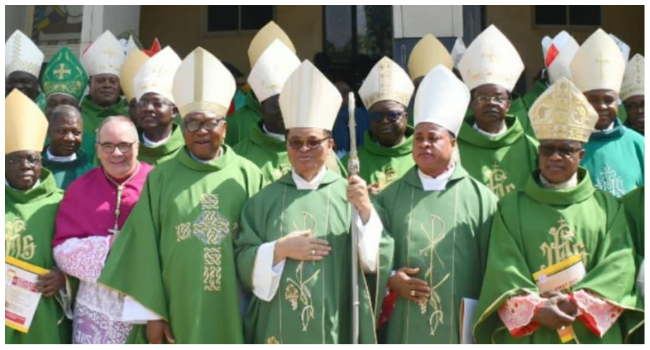
This was contained in a communiqué issued on Wednesday at the end of its First Plenary Meeting in Abuja.
The bishops in the communiqué signed by CBCN President, Archbishop Lucius Ugorji of Owerri, and Secretary, Bishop Donatus Ogun of Uromi, said democracy can only survive if the will of the people is transparently respected.
Citing data from the Independent National Electoral Commission (INEC), the Conference noted that only about 23 per cent of registered voters participated in the 2023 general elections, with turnout in recent FCT polls reportedly dropping to seven per cent.
The bishops described the trend as alarming and indicative of deepening voter apathy.
They called on lawmakers to revisit their position on electoral reform and make the electronic transmission of results from the Bimodal Voter Accreditation System (BVAS) to the INEC Result Viewing (IReV) portal mandatory to curb manipulation and human interference.
“Failure to restore credibility to the electoral process will further erode public confidence and weaken our democracy,” the bishops warned.
On insecurity, the Conference expressed support for President Bola Tinubu’s declaration of a national security emergency and the recruitment of more security personnel.
However, it lamented that killings, kidnappings and mass displacements persist in parts of the North and Middle Belt.
The bishops urged governments at all levels to invest in modern surveillance technology, enhance intelligence gathering and ensure the speedy prosecution of terrorists and their sponsors.
They cautioned that delays in prosecution or reintegration of repentant insurgents without transparency risk creating the impression of official complicity.
The CBCN also raised concerns over illegal mining and oil bunkering, describing them as economic sabotage depriving the nation of critical revenue.
It said criminal networks exploiting gold and lithium deposits often channel proceeds into violent activities.
To address the problem, the bishops recommended the deployment of drones and artificial intelligence to monitor remote mining sites and complement the work of existing security operatives.
On food security, they criticised reliance on importation to stabilise prices, arguing that greater security for farmers and targeted subsidies would better serve national interests.
With Lent coinciding with Ramadan, the bishops described the overlap as a providential moment for Christians and Muslims to deepen prayer, fasting and acts of charity while promoting peaceful coexistence.
They reaffirmed that leadership is a moral responsibility rooted in service to the common good and urged citizens to remain engaged in nation building rather than yield to despair.