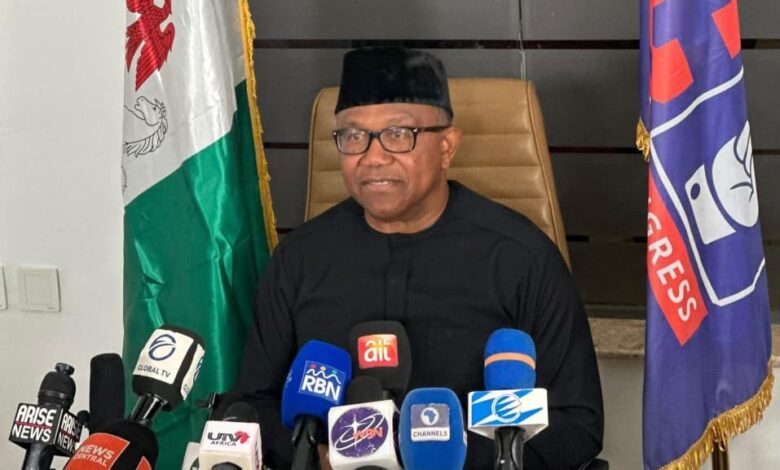


Former Anambra State Governor, Peter Obi, says Nigeria at 66 should be a moment of sober reflection rather than mere celebration.
Obi stated this in his Independence Day message titled “Nigeria at 66 Looking Back, Looking Forward,” where he noted that the anniversary should be a day of thanksgiving for abundant human and natural resources and appreciation for founding fathers and past leaders who laboured to build the nation.
He however said independence anniversaries must not be reduced to celebration but should be used to examine where the country stands and whether it is moving in the direction envisioned by founding fathers.
According to him, every serious nation must ask three questions of where it is today, where it wants to be and how to get there, adding that the questions are urgent given deepening challenges despite promises made by the APC led government in 2023.
Obi said Nigeria today is confronted with over 140 million people living in poverty and severe hardship, over 18 million out of school children, persistent insecurity, terrorism, banditry and kidnapping, noting that 37 young Nigerians in their productive age recently lost their lives.
He added that over 40 million Nigerians will face extreme hunger by end of 2026, infant and maternal mortality remain high, youth unemployment and underemployment affect over 35 million, drug abuse stands at 14 percent against global average of 6 percent and life expectancy is 54 years against global average of 74 years.
He quoted Socrates that unexamined life is not worth living, saying an unexamined nation cannot chart its future, and asked whether Nigeria is cursed or has become the curse through its choices.
Obi said Nigeria is not cursed but immensely endowed, stressing that the problem is failure to convert resources into human development, productivity, security and shared prosperity.
He recounted a two-day visit to Sokoto State with Senator Rabiu Kwankwaso where they consulted on insecurity, out of school children, poverty, youth unemployment and drug abuse, and visited the Internally Displaced Persons camp at Ramin Kura within Sokoto metropolis.
“What we saw was deeply troubling. Thousands of women and children live in deplorable conditions, displaced from their homes and deprived of the basic necessities of life,” Obi said, noting that many children have no education and limited access to healthcare.
He said the situation at Ramin Kura reflects suffering in many parts of the country while government acts as though the problems belong to another country.
Obi said his message is not of despair but of hope and responsibility, insisting that a new Nigeria is possible.
He promised that as President, he will make governance measurable, accountable and centred on welfare and productivity, with tangible impact within the first year.
“We will confront insecurity decisively so that our farmers can return to their farms, our children can return to school, businesses can operate freely, and families can live without fear,” he said.
He said his administration would work to ensure displaced Nigerians return safely and with dignity to their communities and move the economy from consumption to production that creates jobs and supports agriculture and manufacturing.
Obi said his government will prioritise education, healthcare, security and productive enterprise, adding that he will lead by example.
“In four years as President of this great nation, I will not spend my holidays outside Nigeria. My holidays will be spent in Zamfara State, Borno State, Kwara State, Ebonyi State, Edo State, Ekiti State and other Nigerian States,” he said.
He said he wants to continue to see Nigeria, know Nigeria and spend time with Nigerians to listen and understand their challenges.
Obi said the goal is to build a Nigeria that is secure, united and productive, governed with competence, accountability and justice, where no child is denied education due to poverty or insecurity, no mother dies for lack of basic healthcare and public resources are deployed for public good.
He said the Nigeria desired will not be built by prayers or promises alone but by leadership that sees public office as sacred trust and citizens who demand accountability.