Nigeria has called for sustained European Union (EU) support to preserve recent gains in maritime security across the Gulf of Guinea, warning that emerging threats could erode progress if collaboration weakens.
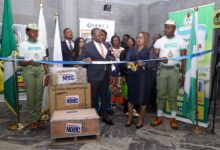
Minister of Marine and Blue Economy, Adegboyega Oyetola, made the appeal on Thursday in Abuja during a meeting with the EU Evaluation Mission on the Gulf of Guinea Inter-regional Network (GoGIN II) Project.
He noted that while piracy and sea robbery incidents have declined in recent years, challenges such as illegal fishing, trafficking, and environmental crimes continue to evolve, requiring stronger international coordination.
Oyetola emphasised that the Yaoundé Architecture for Maritime Security remains central to regional stability, providing a framework for joint operations, intelligence sharing, and collective response among Gulf of Guinea countries.
He credited EU-backed initiatives, particularly GoGIN II, with enhancing maritime domain awareness and improving cooperation among regional institutions, but stressed that more needs to be done to sustain these improvements.
Oyetola in a statement by his Special Adviser,Dr. Bolaji Akinola underscored the importance of strengthening interoperability between national agencies and regional centres, alongside continued investment in technology and human capacity.
Highlighting Nigeria’s contribution, he said the Deep Blue Project has played a key role in reducing piracy incidents, demonstrating the impact of coordinated national and international efforts.
With the GoGIN II programme nearing completion, Oyetola urged stakeholders to prioritise sustainability by deepening regional ownership and ensuring that existing systems, including the YARIS information sharing platform, remain fully operational.
In her remarks, leader of the EU delegation, Stéphanie Vergniault, said the evaluation mission is focused on reviewing the programme’s effectiveness and drawing lessons to guide future maritime security interventions.
She added that consultations with Nigerian stakeholders are aimed at assessing operational realities, identifying gaps, and shaping the next phase of EU engagement in the region.