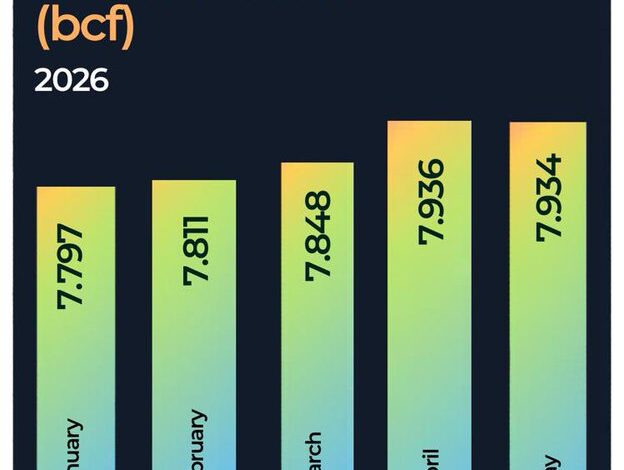


Nigeria’s daily gas production climbed to 7.93 billion cubic feet per day (bcf/d) in May 2026, a 0.63% increase from the 7.88bcf/d recorded in the same period of 2025, a new data by the Nigerian Upstream Petroleum Regulatory Commission (NUPRC) has shown.

The figures point to a sustained upward trend in the nation’s gas output, with year-to-date production averaging 7.87bcf/d , up from the 7.82bcf/d recorded in the first quarter of 2026, and rising further to 7.94bcf/d across April and May 2026.
A breakdown of May’s production data shows that Associated Gas (AG) accounted for 3.96bcf/d, while Non-Associated Gas (NAG) contributed 3.98bcf/d.
This shows that non-associated gas is increasingly carrying its own weight in the production mix and reflects the maturation of dedicated gas development initiatives.
On a month-on-month basis, gas production declined marginally by 0.12% from 7.94bcf/d recorded in April.
Over the past five months, gas production has maintained a positive trajectory, rising from 7.80bcf/d in January to 7.81bcf/d in February, 7.85bcf/d in March, and 7.94bcf/d in April.
In terms of gas utilisation during the period, export sales declined from 4.13bcf/d to 3.07bcf/d, accounting for 40% of total production. Meanwhile, sales to the domestic market increased from 2.03bcf/d to 2.18bcf/d, representing 26.6% of total gas utilisation.
The increase in domestic sales reflects ongoing efforts to meet local supply obligations.
As the power, industrial, and gas-based manufacturing sectors continue to expand under the national gas agenda, the potential for further growth remains significant.
Further analysis shows that 2.11bcf/d, representing 26.5% of total production, was allocated to own-use, while 0.57bcf/d, or 6.9%, was flared, underscoring the country’s commitment to ending routine gas flaring by 2030.