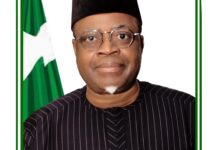

The Minister of Water Resources and Sanitation, Prof. Joseph Utsev, on Monday declared that the country’s response to climate change cannot succeed without placing water, sanitation, and hygiene services at the centre of adaptation planning.
Declaring the Annual National Climate Change and WASH Conference open in Abuja, Prof. Utsev, told the delegates that climate change was already reshaping how millions of Nigerians access water and sanitation, through foods, prolonged droughts, shifting rainfall patterns, and worsening water quality, and that the consequences would deepen unless the sector received urgent policy attention.
“The climate crisis is fundamentally a water crisis,” the minister said. “Without water security, there can be no climate resilience. Without sanitation, there can be no public health resilience. Without resilient WASH systems, adaptation efforts remain incomplete.”
The one-day conference, themed, “Water, Sanitation and Hygiene (WASH) Systems at the Frontline of Climate Change: Aligning NDC 3.0 with National Adaptation Priorities,” was organised by the Ministry of Water Resources and Sanitation, in collaboration with UNICEF, WaterAid Nigeria, and the SURWASH programme.
The conference brought together government institutions, river basin development authorities, state governments, academia and civil society to align the water and sanitation sector with Nigeria’s updated Nationally Determined Contributions under the Paris Agreement.
Utsev used the occasion to outline six priority actions for the sector, including strengthening climate-resilient water infrastructure, expanding integrated water resources management, deploying climate-smart sanitation solutions, building out early warning and hydrological monitoring systems, mobilising climate finance, and deepening community participation, and gender inclusion, in adaptation planning.
He described resilient WASH systems not only as a public health necessity but as a prerequisite for food security, environmental protection, and economic growth, arguing that the sector’s importance extended beyond its traditional framing.
The Minister applauded the contributions of development partners, including WaterAid, UNICEF, the SURWASH Programme, and the National Technical Working Group on Climate Resilient WASH, crediting their technical and financial support for progress recorded in the past year.
Also speaking, the Minister of Environment, Balarabe Lawal, represented by the Ministry’s Chief Environmental Officer, Mrs. Chika Okpala stressed the need for integrated action across environmental governance and WASH delivery.
The Ministry of Environment listed commitments including coordinating NDC 3.0 implementation, promoting circular economy waste management, supporting antimicrobial resistance surveillance through improved wastewater management, and advancing a One Health approach that connects human, animal, and environmental health.
Earlier, in his welcome address, the Acting Permanent Secretary of the Ministry of Water Resources and Sanitation, Engr. Ali Ibrahim, said the conference would review progress on last year’s communique and develop a new actionable roadmap.
He noted that the 2025 conference had generated recommendations around resilient infrastructure design, climate finance, and cross-sectoral coordination, but that urgency had grown in the intervening year.
“Climate impacts continue to test the resilience of our WASH system, from flooding and erosion to drought and water scarcity,” Ibrahim said. “These realities require us to rethink planning, strengthen infrastructure, improve financing, and adopt innovative approaches that are locally grounded and sustainable.”
Representing UNICEF Nigeria, Obinna Uche highlighted the agency’s recent National Youth Summit, held approximately three weeks ago, where young people from across the country reviewed NDC 3.0 and developed action recommendations.
He acknowledged the role of Young Climate Councils in Abuja and other states in building climate-smart communities.
“By integrating WASH into NDCs, we are not just ticking the policy box,” Uche said. “We are directly protecting public health, safeguarding the livelihoods of our most vulnerable populations, and empowering women and girls who bear the heaviest burden of water scarcity and unsafe sanitation.”
The conference, which follows the one held in 2025, is expected to produce a communique with recommendations feeding into Nigeria’s NDC 3.0 adaptation planning process.