FG Targets Bakassi, Coastal Hotspots In New Maritime Security Expansion
By Stella Enenche, Abuja


The Federal Government has unveiled plans to extend the Deep Blue Project to Nigeria’s most vulnerable coastal corridors, including the Bakassi Peninsula, in a renewed push to sustain gains against piracy and maritime crime.

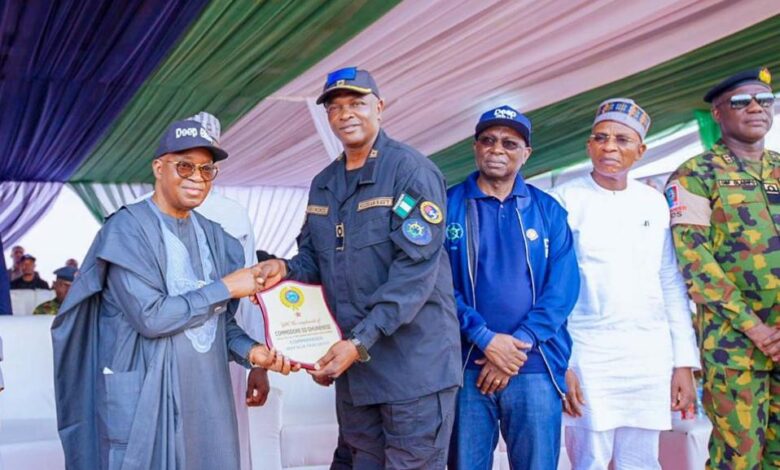
Minister of Marine and Blue Economy, Adegboyega Oyetola, disclosed the expansion plan on Thursday during the graduation of 492 advanced combat personnel under the Deep Blue Project in Rivers State.
The minister said the next phase of the maritime security initiative would focus on high-risk coastal locations such as Bakassi and Igbokoda, alongside other vulnerable waterways identified as strategic to Nigeria’s maritime trade and national security.
According to him, the expansion is intended to reinforce the country’s maritime security architecture, improve operational response capabilities and ensure the sustainability of assets deployed under the Integrated National Security and Waterways Protection Infrastructure, otherwise known as the Deep Blue Project.
Oyetola said the Federal Government was consolidating on achievements already recorded since the project became operational in 2021, noting that Nigeria had not recorded any piracy incident within its territorial waters in the last four years.
He added that piracy incidents across the Gulf of Guinea had dropped by more than 70 per cent within the same period due to improved inter-agency collaboration and sustained maritime surveillance operations.
The minister recalled that before the introduction of the project, the Gulf of Guinea accounted for nearly 45 per cent of global piracy incidents and more than 90 per cent of crew kidnappings at sea at the peak of maritime insecurity in the region.
He said the deployment of integrated air, land and sea assets, backed by advanced surveillance systems and rapid-response platforms, had transformed Nigeria’s maritime security landscape and boosted investor confidence in the blue economy sector.
Oyetola linked maritime security to the broader economic agenda of President Bola Ahmed Tinubu’s administration, stressing that safer waterways were critical to trade facilitation, economic growth and regional competitiveness.
He charged the graduating personnel to demonstrate professionalism, patriotism and discipline while carrying out their responsibilities.
Earlier, Director-General of the Nigerian Maritime Administration and Safety Agency, Dayo Mobereola, described the graduation as evidence of Nigeria’s growing operational readiness to secure its maritime domain.
Mobereola said the 492 operatives completed 33 specialised courses covering different operational units within the Deep Blue architecture.
The graduating personnel include maritime security operatives, helicopter pilots and technicians, special mission vessel crew members, interceptor boat drivers and mechanics, intelligence operators and unmanned aerial systems specialists.
He disclosed that the officers received advanced training in countries including Italy, Australia, Syria and Swaziland, in addition to local training programmes in Nigeria.
Mobereola also outlined key operational assets under the project, including special mission aircraft, surveillance helicopters, deep-sea vessels, unmanned aerial vehicles, interceptor boats and armoured coastal patrol vehicles.
Highlights of the ceremony included the commissioning of a UAV Workshop and Training Centre, tactical demonstrations by operatives and inspection of maritime security assets.