
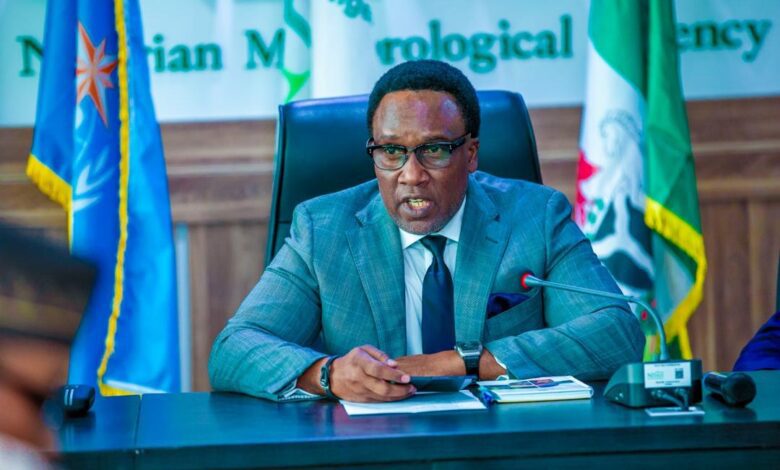


The Nigerian Meteorological Agency (NiMet) has reaffirmed its commitment to providing weather and climate information to farmers to strengthen food security and build resilience in Nigeria’s agricultural sector.
The Director-General of NiMet, Prof. Charles Anosike, gave the assurance on Tuesday at the National Strategic Dialogue on the Preparation of the AGROW Component 2.2 National Implementation Strategy and Digital Agriculture Architecture, organised by the Federal Ministry of Agriculture and Food Security under the World Bank-supported Nigeria Sustainable Agricultural Value Chain (AGROW) Project.
Anosike at the dialogue, themed “Building a Unified, Inclusive and Future-Ready Digital Agriculture Ecosystem for a More Productive, Resilient and Food-Secure Nigeria,” said integrating reliable weather and climate information into digital agriculture systems would enable farmers to make informed decisions, minimise losses and improve productivity amid changing climate conditions.
He noted that climate variability, unpredictable rainfall patterns and extreme weather events were increasingly affecting agricultural activities, making timely and accurate climate information essential for planning across the agricultural value chain.
According to him, NiMet provides Seasonal Climate Predictions, regular weather updates, agrometeorological services and impact-based advisories to support farmers in making informed decisions on planting, water management and the application of agricultural inputs.
He said, “Climate variability, changing rainfall patterns and extreme weather events are increasingly affecting agriculture, making timely and reliable climate information critical to agricultural planning and decision-making.”
The NiMet chief described digital agriculture as a critical pathway for translating weather and climate information into practical solutions at the farm level, highlighting the agency’s partnerships with Tomorrow.io and MTN on the Digital Climate Advisory Services (DCAS) System.
He explained that the initiative was designed to deliver location-specific weather advisories to farmers through mobile short message services (SMS), while its partnership with the Agricultural Innovation Mechanism for Scale (AIM for Scale) was aimed at strengthening the integration of artificial intelligence-based weather forecasting into digital advisory systems.
Anosike stressed the need to ensure that digital agricultural services were accessible to farmers, regardless of their location, literacy level or access to technology.
He said collaboration with agricultural extension services, technology providers, telecommunications companies, community radio stations and farmer organisations would be crucial to delivering climate information to farmers at the grassroots.
The NiMet director-general also emphasised the importance of developing farmer-centred digital services that address local languages, literacy levels, internet connectivity, affordability and gender inclusion.
He called for farmers to be actively involved in the development of climate services to ensure that the solutions provided were relevant to their needs and agricultural realities.
Anosike commended the Minister of Agriculture and Food Security, Senator Abubakar Kyari, for his efforts to promote climate-smart agriculture, urging stakeholders at the dialogue to develop a practical, inclusive and measurable roadmap for integrating weather and climate services into agricultural decision-making.
Anosike expressed optimism that the engagement would advance climate-smart, digitally enabled and farmer-centred agriculture, reaffirming NiMet’s readiness to provide the technical expertise required to strengthen climate services, improve agricultural productivity and support resilient livelihoods across the country.