FG Empowers 87,701 TVET Graduates With Starter Kits, Targets Job Creation
By Alice Etuka, Abuja


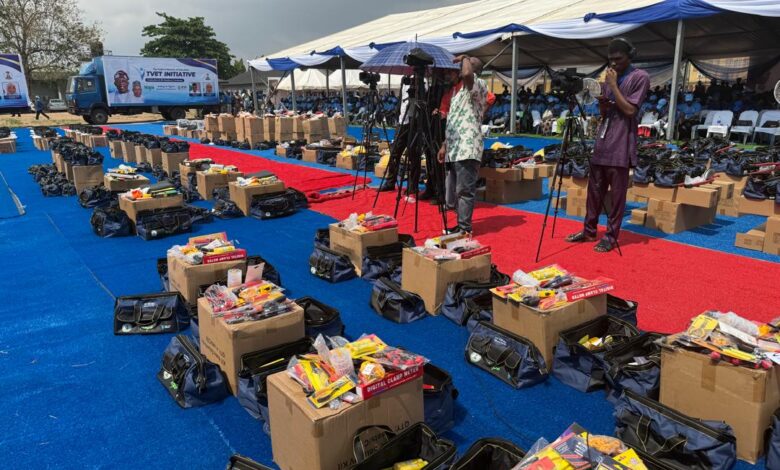
The Federal Government has empowered graduates of its Technical and Vocational Education and Training (TVET) programme with starter kits to enable them establish businesses, become self-employed and create jobs, as 87,701 trainees complete the first cohort of the initiative nationwide.

The Minister of Education, Dr. Maruf Tunji Alausa, disclosed this on Friday during the graduation and starter kit handover ceremony for beneficiaries at the Federal Technical College, Yaba, Lagos State.
Alausa said 7,000 beneficiaries in Lagos State were expected to receive starter kits under the phased nationwide distribution, aimed at bridging the gap between skills acquisition and economic opportunities.
He explained that the provision of equipment was critical to ensuring that graduates translated the skills acquired during training into productive ventures capable of generating income and providing employment for others.
According to him, the first cohort recorded 87,701 successful graduates nationwide across various trades, including welding and fabrication, electrical installation, automobile mechanics, solar photovoltaic installation, fashion design, hospitality, information and communication technology, agriculture, leatherwork and beauty therapy.
The minister also revealed that the second cohort had attracted 1.49 million applications, out of which 150,000 learners had been admitted into accredited training centres across the country.
He said the growing interest in the programme demonstrated increasing recognition of vocational education as a viable pathway to employment, entrepreneurship and economic independence.
Alausa, however, clarified that the distribution of starter kits would be conducted in phases following assessment, verification and documentation to ensure transparency and accountability.
He explained that completion of training, certification and eligibility for starter kit support were separate stages of the programme’s implementation.
The minister added that beneficiaries in some agricultural and livestock-related trades, where conventional starter kits might not be readily available, would receive financial support to establish their businesses.
He urged the graduates to deploy the equipment responsibly, maintain professional standards, observe safety regulations and continually improve their skills, stressing that they should aim to build sustainable businesses capable of employing other Nigerians.
Earlier, the Director overseeing the Office of the Permanent Secretary, Dr. Folake Olatunji-David, represented by the Director of Technology and Science Education, Mrs. P.O. Ogungbemi, described the ceremony as a major milestone in repositioning technical and vocational education as a driver of economic growth.
She commended Alausa and the Minister of State for Education, Prof. Suwaiba Said Ahmad, for prioritising TVET under the Nigeria Education Sector Renewal Initiative and President Bola Tinubu’s Renewed Hope Agenda.
Olatunji-David said the initiative was designed to bridge the gap between academic qualifications and labour market demands by equipping young Nigerians with certified competencies to become skilled professionals and job creators.
Speaking on behalf of the beneficiaries, Feyisayo Onafowokan, a leatherwork and shoemaking trainee, described the programme as life-changing, saying it had provided her with an opportunity to overcome unemployment and achieve self-reliance.
Onafowokan, a single mother, said the training had opened a new pathway to economic independence, expressing gratitude to the Federal Government, the Ministry of Education and her instructors for the opportunity.
Similarly, a welding and fabrication trainee, Mr. Femi White, commended the government for the initiative, describing vocational skills as essential to building sustainable livelihoods and contributing to national development.
Alausa also acknowledged the contributions of the National Board for Technical Education, the National Business and Technical Examinations Board, the Nigerian Education Loan Fund, training institutions and development partners, including GIZ and UNESCO.
He called on state governments, community leaders and private-sector organisations to support the graduates through mentorship, employment opportunities and enterprise development.
The minister reaffirmed the Federal Government’s commitment to strengthening technical education through quality training, competency-based assessment, recognised certification and stronger industry partnerships.
He said the success of the initiative would ultimately be measured by the number of graduates who secure employment, establish sustainable businesses, improve their earnings and create jobs for others.