


The Nigerian Communications Commission (NCC) has warned that artificial intelligence (AI) is accelerating cyberattacks, exposing individuals, businesses and critical national infrastructure to increasingly sophisticated threats.

The Executive Vice Chairman of the NCC, Dr Aminu Maida, gave the warning at the second International Cyber Security Conference (ICSC-2026) in Abuja on Tuesday.
Maida, represented by the commission’s Executive Commissioner, Technical Services, Abraham Oshadami, described telecommunications as the backbone of Nigeria’s digital economy.
“Every transaction, every conversation, every critical public service, and every enterprise operation runs across our networks,” he said.
He warned that cybercriminals were deploying AI-driven phishing, automated credential theft, deepfakes and self-modifying malware to evade security systems.
“We are no longer defending against human hackers operating at human speed; we are confronting machine learning systems operating at microsecond computational speed,” he said.
Maida said the NCC was strengthening security standards among licensed operators and collaboration with the NCC Computer Security Incident Response Team and the Nigeria Computer Emergency Response Team.
He said cybersecurity must go beyond keeping attackers out to ensuring networks remain reliable even when breaches occur.
Also speaking, the Director-General of the National Information Technology Development Agency (NITDA), Kashifu Inuwa urged Nigerians to remain vigilant, warning that hackers increasingly exploited human weaknesses to obtain sensitive information.
“We are the first line of defence when it comes to cybersecurity,” he said.
Abdullahi said AI-powered social-engineering tools made it easier for criminals to manipulate people, while warning that control of information security could influence public opinion.
“Whoever controls security can control and shape public opinion,” he said.
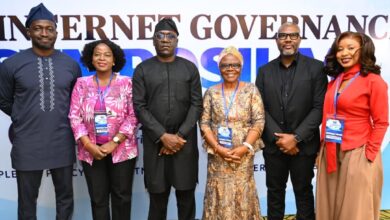
The conference, hosted by NITDA and the NCC, was themed “Cyber Resilience in the Age of AI: Defending Minds, Networks, and Nations.”