Alausa Eyes Transnational Education Partnerships In Robotics, Others
By Alice Etuka, Abuja


The Minister of Education, Dr. Tunji Alausa, has led discussions with the leadership of Harrisburg University of Science and Technology (HU), Pennsylvania, United States, on opportunities to develop Transnational Education partnerships that can strengthen practical Science, Technology, Engineering and Mathematics (STEM) education in Nigerian universities.

Special Adviser to the Minister on Media and Communications, Ikharo Attah disclosed this in a statement on Sunday.
The visit, which comes ahead of 81st session of UN General Assembly (UNGA 81), formed part of the minister’s efforts to connect Nigeria’s higher education system with international expertise and innovative approaches that can equip students with the technical and practical skills required for a rapidly changing global economy.
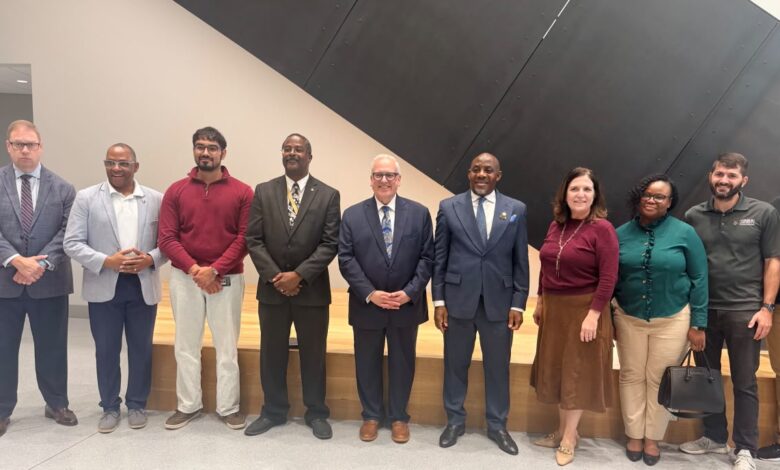
Dr. Alausa, who led a delegation to the university in the US, toured the institution’s hands-on STEM laboratories and applied learning facilities and met with the President of Harrisburg University, Dr. Christopher Reber, and senior officials.
During the tour, students demonstrated practical applications of their training in advanced manufacturing and robotics, cybersecurity, data analytics, biotechnology, health sciences, and interactive media
The demonstrations provided the delegation with a practical view of an education model that integrates classroom instruction with experimentation, research, technology and problem-solving, enabling students to apply theoretical knowledge to real-world challenges.
Against this backdrop, Dr. Alausa highlighted the Federal Ministry of Education’s focus on Transnational Education (TNE) as a means of establishing structured academic and institutional linkages between Nigerian universities and reputable international institutions.
Nigeria, through the National Universities Commission (NUC), has established a TNE framework providing for joint, twinning and articulation programmes, branch campuses, online and blended learning, franchised programmes, joint academic and research programmes, as well as faculty and student exchange and mobility.
The Minister stressed that TNE should extend beyond access to foreign qualifications, noting that well-structured cross-border education can support knowledge exchange, research and innovation, faculty development, technology transfer and stronger links between universities and industry.
For Nigeria, the value of such arrangements lies in their potential to translate international expertise into stronger teaching, research and practical training at home. Areas examined included artificial intelligence, data science, cybersecurity, robotics, advanced manufacturing, biotechnology, health sciences and other emerging fields.
These areas could help Nigerian universities improve laboratory-based learning, enhance faculty expertise, expand research programmes and develop graduates with skills aligned with industry needs and the demands of the digital economy.
Dr. Alausa also interacted with Nigerian and other African students at Harrisburg University, underscoring the importance of maintaining strong academic and cultural links between African students and institutions on the continent. The interaction also resonated with the theme of the African Cultural Festival (ACF) 2026, “The Great Reunion: Culture, Education, and Collaboration,” which highlights the role of education, cultural exchange and shared learning in strengthening connections among Africans and advancing common development goals.
Among those present were Mr. David Clickner, Chief Strategy Officer, Harrisburg University; Richard Pitts Jr., Ph.D., Department Chair, Department of Manufacturing Systems; Dr. Luanne Reese Hutchinson, Executive Director, Strategic Healthcare Initiative; Mr. Wole Adeniyi of the African Cultural Festival; and Nigerian and other African students of the university.
The visit reinforces the Ministry’s commitment to ensuring that international academic relationships translate into tangible outcomes for Nigerian students, universities and the wider economy, particularly in practical skills, research, innovation and technology.
Dr. Alausa assured that, under President Bola Ahmed Tinubu’s Renewed Hope Agenda, the Federal Ministry of Education would continue to pursue reforms and strategic international initiatives that place education, skills development and innovation at the centre of national development.
He reaffirmed the Ministry’s commitment to equipping Nigerian students with the knowledge, practical competencies and technological skills required to drive innovation, contribute to economic growth and compete effectively in the global knowledge economy.