Economic Reforms Are Restoring Investor Confidence As Capital Inflows Surge 84% -Tinubu
By Sunday Etuka


Foreign capital importation into Nigeria climbed to $10.37 billion in the first quarter of 2026, an increase of 83.83% over the same period in 2025, President Bola Tinubu said on Monday as he argued that his administration’s reforms are lifting the economy out of years of underperformance.

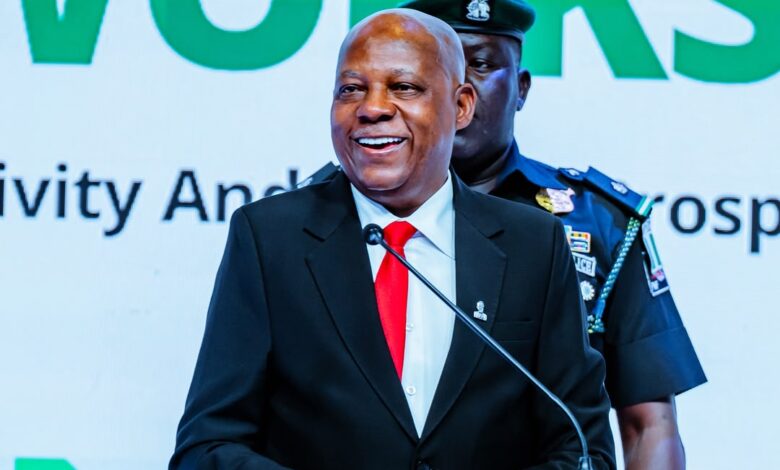
Represented by Vice President Kashim Shettima, the President spoke at the formal opening of the 32nd Nigerian Economic Summit (NESG) in Abuja.
He said the figure, which covers both portfolio and foreign direct investment, shows that confidence is returning.
According to a statement by Stanley Nkwocha, Senior Special Assistant to the Vice President on Media and Communications, the President said the government set out to rewrite the story of a country that has long performed below its potential.
He noted that the process began with a difficult reset because no shortcut to growth exists.
“We cannot harness the immense opportunities offered by our growing population without first stabilising the economy,” he said, adding that the public and private sectors must be given the conditions to invest, expand and create productive jobs.
Citing National Bureau of Statistics data, Tinubu said real GDP grew by 3.89% in the first quarter of 2026, up from 3.13% a year earlier. Non-oil activities made up 96.08% of GDP, while manufacturing expanded by 3.29% and the oil sector by 2.57%.
The President said the government’s ambitions go beyond favourable statistics. He stressed that job creation is only half the task and that the quality of work must improve and underemployment fall.
Infrastructure, education, industrial policy and investment incentives, he added, should be judged by the activity, skills, competitiveness, exports and jobs they produce.
He promised continued easing of regulatory burdens, greater transparency and policy predictability, and wider access to finance. He also pointed to tax reforms meant to build a modern, equitable system, as well as changes to the electricity market to improve supply and draw investment in generation, transmission, distribution and alternative energy.
In agriculture, the government is linking farms to storage, processing centres and markets while expanding irrigation, mechanisation, finance and rural infrastructure. In solid minerals, it wants to shift from extraction to domestic processing, industrial production and exports. The President acknowledged that much work remains.
The summit’s theme is “Growth That Works: Delivering Jobs, Productivity and Shared Prosperity.”
United Nations Deputy Secretary-General Dr. Amina Mohammed acknowledged the gains from the reforms but urged that they be consolidated and stabilised urgently, and that citizens’ expectations be managed carefully.
She also praised the African Development Bank for its new financial architecture for development in Africa.
Finance Minister and Coordinating Minister of the Economy, Dr. Taiwo Oyedele, presented the Nigerian Economic Policy Framework, which he described as a national economic doctrine setting out how the country makes decisions and measures progress.
He invited members of the Nigerian Economic Summit Group (NESG) and private sector experts to critique the draft rigorously with facts and figures. Its principles include enterprise, open but fair markets and whole-of-government coherence, with focus areas such as economic stability, human capital development and productivity.
NESG Chairman Olaniyi Yusuf said the task before experts is to ensure the reforms are stabilised rather than reversed, and that the summit must move Nigeria from policy consensus to a framework that solves practical problems.
BUA Group Chairman Abdul Samad Rabiu praised the reforms, saying improved access to foreign exchange has made the business environment more predictable.
He recalled that businesses once held plenty of naira but could not obtain the foreign currency needed for raw materials and machinery, while acknowledging the hardship ordinary Nigerians have faced.
Also at the opening session were Anambra State Governor Prof. Chukwuma Soludo, Lagos State Governor Babajide Sanwo-Olu, Budget and Economic Planning Minister Senator Abubakar Bagudu, Industry, Trade and Investment Minister Dr. Jumoke Oduwole, Livestock Development Minister Idi Mukhtar Maiha, Minister of State for Budget and Economic Planning Dr. Doris Uzoka-Anite, and business leaders from Nigeria and abroad.