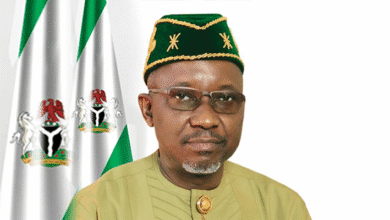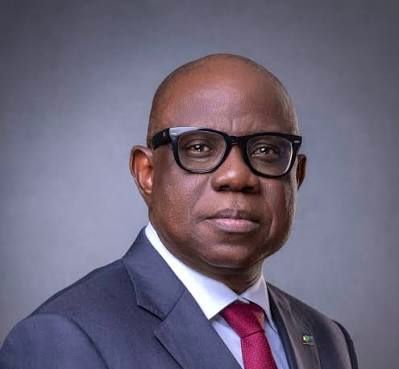


On April 2, 2025, President Bola Tinubu, appointed Engr. Bayo Ojulari, as the Group Chief Executive Officer of the Nigerian National Petroleum Company Limited (NNPC Ltd).

Engr. Ojulari replaced Mallam Mele Kyari, who held the position for six years, between 2019 and 2025, focusing on transparency and improved profitability.
Ojulari was mandated by the President to enhance the operational efficiency, restore investor confidence, and push for a more commercially viable NNPC Limited.
On April 4, 2025, Engr. Ojulari officially took over the leadership of the national oil company, with the pledge to consolidate on the successes of his predecessor and reposition the company for maximum profitability.
President Tinubu had set an ambitious target for Ojulari, including $60 billion in total sectoral investments by 2030, a three million barrels per day (bpd) oil production goal, and a 10billion standard cubic feet (bscf) per day gas production by 2030, to drive economic growth and energy security.
Ojulari said though the targets set for his management were quite enormous, he would be relying on the co-operation of the Management and staff of the company, as well as the counsel of his predecessor to achieve set targets.
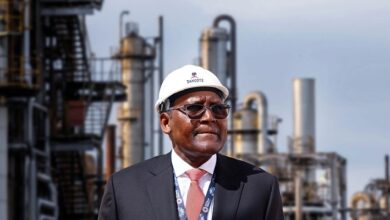
Just a year after taking over the mantle of leadership at the company, Engr. Ojulari has performed exceptionally, and this could be seen from the exponential increase in crude oil production, which has buoyed the federal government’s revenue generation.
CRUDE OIL PRODUCTION RISE
For instance, crude oil production grew from a historic low of 960,000 barrels per day in 2022 to an average of 1.71 million barrels per day, and a peak production of 1.84 million barrels per day in 2025.
This growth, according to Ojulari, was not accidental. “It was as a result of an integrated energy security model that combines legislative and executive policy alignment, actionable intelligence, kinetic deployment capabilities, regulatory oversight, industry cooperation, community‑embedded surveillance mechanisms,” he added.
Obviously, the commendable rise in the national crude oil production in the country was a direct result of the establishment of the integrated energy security for pipelines in the Niger Delta.
The resurgence of crude oil production is attributable to the effective tackling of the twin menace of oil theft and pervasive pipeline sabotage, which has restored investors’ confidence in the nation’s oil and gas sector.
According to the data by the Nigerian Upstream Petroleum Regulatory Commission (NUPRC) and the Central Bank of Nigeria (CBN), Nigeria earned an average of N55.5 trillion from crude oil sales in 2025, which was higher when compared to the N50.88 trillion in 2024.
In January 2026, in line with its ambitious gas target, the company officially unveiled its Gas Master Plan (GMP) 2026, to revolutionise the nation’s gas sector, guarantee energy security and sustainable economic growth.
Ojulari, described the NNPC Gas Master Plan 2026 as a bold, effective execution-anchored roadmap designed to unlock Nigeria’s immense gas potential and elevate the country into a globally competitive gas hub.
Ojulari noted that with about 210 trillion cubic feet (Tcf) of proven gas reserves and an upside potential of up to 600 Tcf, Nigeria possesses one of the most consequential hydrocarbon basins in the world.
According to him, the Plan was structured not just to deliver – but to exceed- the Presidential mandate of increasing national gas production to 10 billion cubic feet per day by 2027 and 12 billion cubic feet per day by 2030, while catalysing over 60 billion dollars in new investments across the oil and gas value chain by 2030.
NNPC LTD REPOSITIONED FOR PROFITABILITY
In keeping with the target of the company as contained in the Petroleum Industry Act (PIA) 2021, the NNPC Limited has transitioned into a commercially focused and profit-driven entity. This important shift has enabled the company to operate effectively in line with global best practices without government funding.
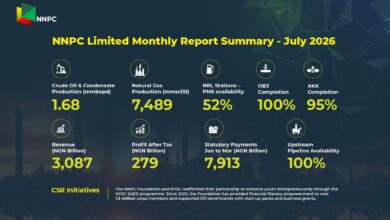
In December 2025, NNPC Limited reported a Profit After Tax (PAT) of N5.76 trillion for the 2025 fiscal year. The company also posted a total revenue generation of N60.51 trillion in the year under review. In addition, it paid the sum of N14.7 trillion as statutory payments to the government agencies for the year.
In January 2026, NNPC Limited reported a Profit After Tax (PAT) of N385 billion, and generated a total revenue of N2,571 trillion within the same period reported. The company also made statutory payments of N726 billion to the government.
Through the recent reforms in the nation’s oil and gas sector, the country has unlocked over $24billion in fresh investments, with an additional $10billion currently in the pipeline.
Ojulari announced recently that “Shortening the project cycle is very important. The resolution of long-standing issues, including legacy asset disputes and previously stalled FIDs, has unlocked significant investor confidence. These interventions have contributed over $24bn in capital investment from just two projects.”
FUTURE PLANS
Looking ahead, NNPC said it would focus on increasing crude oil and gas production. The company said it would also focus on the successful completion of the Ajaokuta-Kaduna-Kano (AKK) pipeline project valued at approximately $2.8 billion, which would transport gas in its full form into the northern part of Nigeria for industrialisation.
NNPC also expects to rationalise its portfolio to attract significant investment for incremental production, as well as more investment to develop all the fields that have been left fallow for a very long time.
Ojulari is poised to drive these performance aspirations set for the company by President Bola Tinubu.