


Nigerians should expect cheaper rides if a new directive from the National Economic Council (NEC) works as intended.
Council has resolved that the Federal and State Governments will set up a joint financing framework to speed up the rollout of Compressed Natural Gas (CNG) and electric vehicles, with the savings to be passed on to commuters.
The resolution was reached at the 161st meeting of NEC, held virtually on Thursday and chaired by Vice President Kashim Shettima.
It followed a presentation on the National Affordable CNG Transit Programme by the Chairman of the Presidential Initiative on CNG and Electric Vehicles, Barrister Ismaeel Ahmed.
Council directed that the programme must do more than put alternative energy vehicles on the road. It must deliver real benefits to citizens through lower transportation costs.
Relevant authorities were also told to engage transport unions and operators so that savings from using CNG and electric vehicles reach commuters in the form of reduced fares.
To give effect to the decision, Council agreed to form a committee to coordinate the financing arrangement, engage stakeholders and develop practical measures.
The aim is for the economic gains of the programme to translate into affordable, accessible and sustainable transport for Nigerians.
The decision came a day after transport unions, petroleum marketers and other industry players told the Federal Government that thin refuelling infrastructure, weak financing and a supply shortfall are the biggest obstacles to wider CNG adoption.
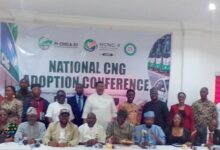
They spoke on Wednesday in Abuja at the National CNG Adoption Conference, held at the Roses Regency Hotel, Wuye, Abuja.
The conference was organised by the Presidential Initiative on CNG, the National Compressed Natural Gas Forum and the Petroleum Products Retail Outlets Owners Association of Nigeria (PETROAN).
It was themed “Strengthening the National CNG Adoption and Mobilization Agenda” and drew government agencies, organised labour, transport unions, energy associations, financiers and private operators.
It was meant to examine investment opportunities, infrastructure, safety, regulatory challenges and ways to speed up adoption.
The National Chairman of the National Compressed Natural Gas Forum, Faruk Abdullahi, said the programme’s success could not rest on the government alone.
He said conversion centres, gas suppliers and infrastructure providers also could not deliver on their own, and called for joint effort from labour, unions, professional bodies, investors and ordinary Nigerians who rely on affordable energy.
Abdullahi said the country must move from awareness to real uptake and from policy statements to implementation.
He added that having gas reserves does not guarantee adoption, because motorists will convert only when the fuel is accessible, affordable, safe and reliable.
He urged transport unions to educate members, identify vehicles fit for conversion, arrange group conversions and press financial institutions for affordable loans.
He also asked every participating organisation to name a focal person on CNG, run internal awareness programmes and set pilot targets, with progress tracked through a common coordination mechanism.
According to him, the true measure of the initiative will be the number of vehicles safely converted, the operators who gain real savings, the infrastructure built and the investments attracted, not the number of meetings held.
He announced plans for a National CNG Road Show and a Maiden National CNG Summit to deepen talks on investment, infrastructure and policy coordination.
Giving an update, the Conversion Manager of the Presidential Initiative on CNG and Electric Vehicles, Adaugo Uzogara, said that since May 2023 the initiative has established over 500 conversion centres and more than 90 refuelling stations across 25 states.
She said many direct and indirect jobs had been created and expressed hope that continued collaboration would carry CNG to all 36 states, offering cleaner, cheaper and safer energy.
The President of PETROAN, Dr. Billy Gillis-Harry, also contributed to discussions on the future of CNG in Nigeria’s evolving energy market.
His participation underlined the importance of involving existing petroleum retail operators in expanding alternative fuel infrastructure and ensuring the transition creates viable opportunities across the downstream sector.
During the open session, however, participants described serious gaps on the ground.
They said the biggest challenge is a supply gap, citing figures from the Nigerian Upstream Petroleum Regulatory Commission (NUPRC) and noting that CNG stations are often crowded with vehicles.
They added that building a single CNG station could cost over N3 billion and urged the government to provide incentives so that Nigerian investors do not take their capital to neighbouring countries.
The Petroleum Tanker Drivers said fuelling points are too few, with only a handful operating around Lagos and queues sometimes reaching 50 vehicles.
They said the diesel engines in tanker trucks generally cannot be converted, and that buying a CNG truck or engine could cost about N100 million, which most members cannot afford.
The transport body said the 90 refuelling stations and 500 conversion centres were far too few for the number of trucks on the road and called for new stations along coastal routes.
It also raised the need for technology transfer and local capacity to maintain converted vehicles, and asked what financing had been mobilised and at what interest rate.
It noted that many trucks imported with conversion kits have since gone out of service because of poor maintenance.
Describing the reality for long distance operators, the group said a trip from Lagos to Abuja offers only a few refuelling points, that drivers in Abuja can wait among 250 or more vehicles in a queue, and that some stations stand idle.
They also asked why transporters have no dedicated bank, unlike agriculture and industry, noting that they are forced to borrow from commercial lenders at high cost.
The stakeholders praised the removal of the fuel subsidy as a bold step that opened the door to alternatives such as CNG, solar and electric power.
They noted, however, that infrastructure, financing and capacity building remain weak, and called on the conference to issue a strong statement on how to overcome these challenges.
They also said the sector must plan around guaranteed buyers for gas, since suppliers who sign agreements must be ready to take delivery or face heavy penalties.
Storage facilities for gas are capital intensive, they said, and the Presidential Initiative had done well to start by building demand through conversion centres.
The stakeholders agreed that safety, infrastructure, financing, local capacity and reliable supply must be tackled together if CNG is to become a practical option for millions of Nigerian motorists and businesses.