
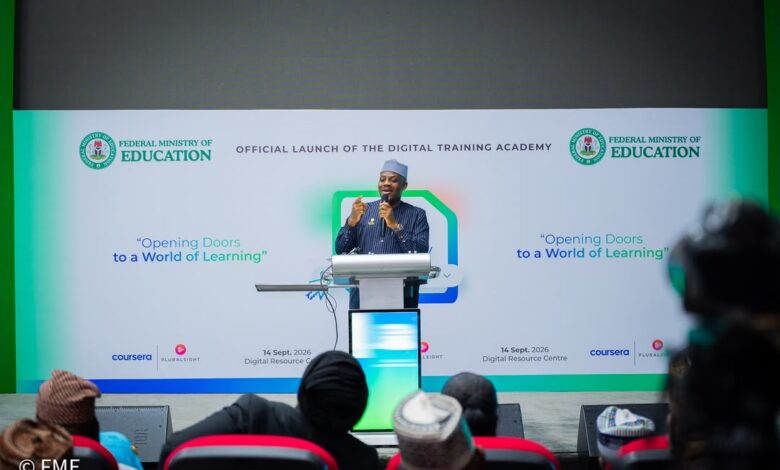


In line with its effort to tackle the high unemployment rate in the nation, the Federal Government has launched a 6- months Digital Training Course for 32,000 students to the tune of N10.5 billion.

Minister of Education, Dr. Tunji Alausa announced the development during the launch of the Digital Training Academy in Abuja on Monday.
He explained that, “this Digital Training Academy reflects the Nigeria we are working to build. A nation in which geography does not limit ambition, financial circumstances do not close the door to learning, and every citizen has a fair chance to acquire relevant skills and contribute productively to society”.
According to him, the training was opening a new pathway to opportunity for thousands of Nigerians, connecting talent to world-class learning, learning to certification, and certification to productive work, enterprise and national development.
“This initiative is an integral part of the Renewed Hope Agenda of the Administration of His Excellency, President Bola Ahmed Tinubu, GCFR, powered by the Nigeria Education Sector Renewal Initiative (NESRI).
“At its heart is Mr. President’s firm conviction that every Nigerian, irrespective of location, background or economic circumstance, deserves access to quality education and the skills needed to participate meaningfully in the modern economy.
“Through the Academy, the Federal Government of Nigeria, in partnership with leading global learning providers including Coursera and Pluralsight, will provide 32,000 Nigerians with free access to high-quality digital and professional training”, he said.
Alausa further stated that participants would be able to develop skills in several high-demand areas such as Software development methodologies, AI/Machine learning, IT Automation, Cyber Security, Cloud Computing, National Language processing and Quantum Computing.
“These are not abstract subjects. They are fields shaping contemporary workplaces, transforming industries and creating new opportunities for employment and enterprise across the world.
“Successful learners will earn recognised certificates that demonstrate the knowledge and competencies they have acquired”, he said.
Addressing the participants, the Minister stated: “the next training for six months will give you a license for Coursera, Pluralsight, and other licenses; IBM, Huawei, Google. Government will pay for it. These licenses are expensive. It’s available for 10.5 billion for this digital training that we’re having. That’s 32,000 licenses.
Our objective here is very clear: To bridge Nigeria’s skills gap, Improve employability and enable more of our citizens to take part in the digital economy”.
In her welcome address, Minister of State for Education, Prof. Suwaiba Ahmad, said the world was changing rapidly and employers now value graduates who possess practical, industry-relevant digital skills alongside degrees and diplomas.
She encouraged students to cease the opportunity the government was offering them while adding that the aspiration was for Nigerian graduates to leave institutions with a degree in one hand, practical skills in the other, and the confidence to compete anywhere in the world.
National Coordinator of the Special Programs Operations and Implementation Unit of the Federal Ministry of Education, Bayo Onigbanjo, in his presentation stated that selection process for the program was based on merit.
Onigbanjo informed that 72,850 students registered and took the pre-assessment, with 19,719 scoring above 65 percent and being moved into the pipeline.
He added that 20,000 licences were secured with Coursera and 12,000 with Pluralsight, and that 6,388 students had already signed up and started classes.
He further disclosed that cybersecurity was the most in-demand track with 9,525 students, representing 48 percent of sign-ups, followed by AI and machine learning at 30 percent.
He said the academy would track completion, certification and job placement as key performance indicators, stressing that the aim was not just to issue certificates but to ensure students were placed in jobs.